
A wire ferrule is a small metal sleeve crimped over stripped stranded wire before it enters a screw terminal. Without one, strands spread under clamping force, contact resistance rises, and connections work loose. EN 60204-1 clause 13.1.1 requires a means of retaining strands on screwed connections; a correctly crimped ferrule is the standard compliance method.
If you searched for a bootlace ferrule, a cable ferrule, or a cord end terminal, you are in the right place; all three are the same component. Bootlace ferrule is the usual term in the UK and Ireland, wire ferrule dominates in North America, cable ferrule turns up in both, and cord end terminal is what most manufacturers print on their own catalogues and packaging. European datasheets may also use the German Aderendhülse. In UK trade conversation the word is often shortened further, to just ferrule or ferrules, with “wire” or “bootlace” dropped once the context is clear. The article uses wire ferrule throughout.
What is a wire ferrule?
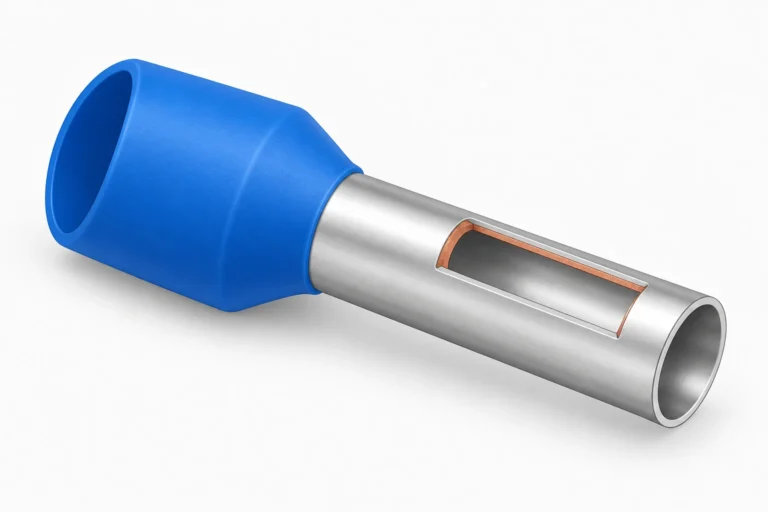
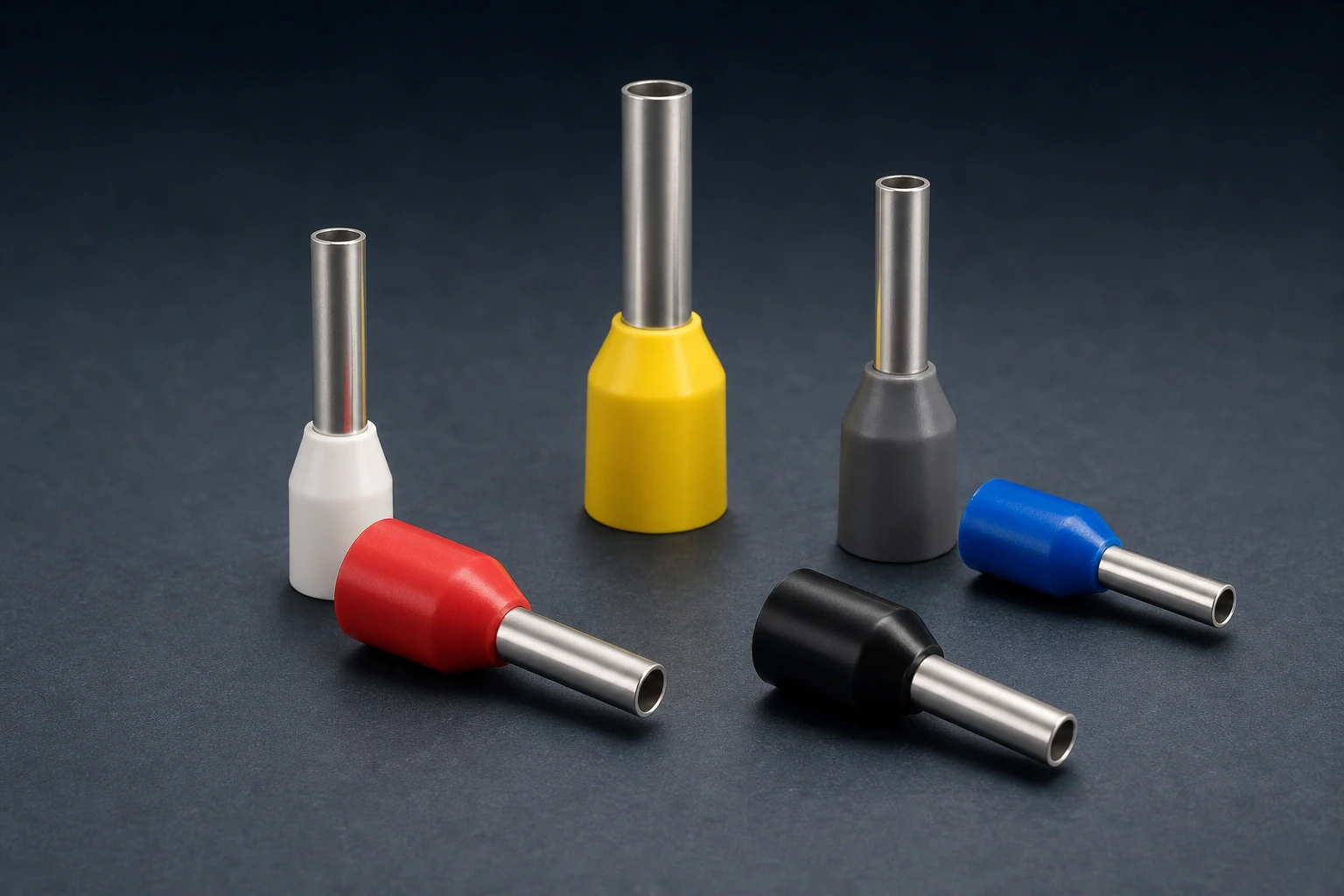
A wire ferrule, also called a bootlace ferrule, is a short tin-plated copper sleeve crimped over stripped stranded wire before insertion into a screw or spring-clamp terminal. It consolidates loose strands into a stable cylindrical contact, prevents strand splaying under clamping force, and keeps the connection torqued over years of vibration and thermal cycling. Ferrule dimensions and materials are defined under DIN 46228, Part 1 for uninsulated, Part 4 for insulated, covering 0.5mm² to 16mm² and above.
What does a wire ferrule do?
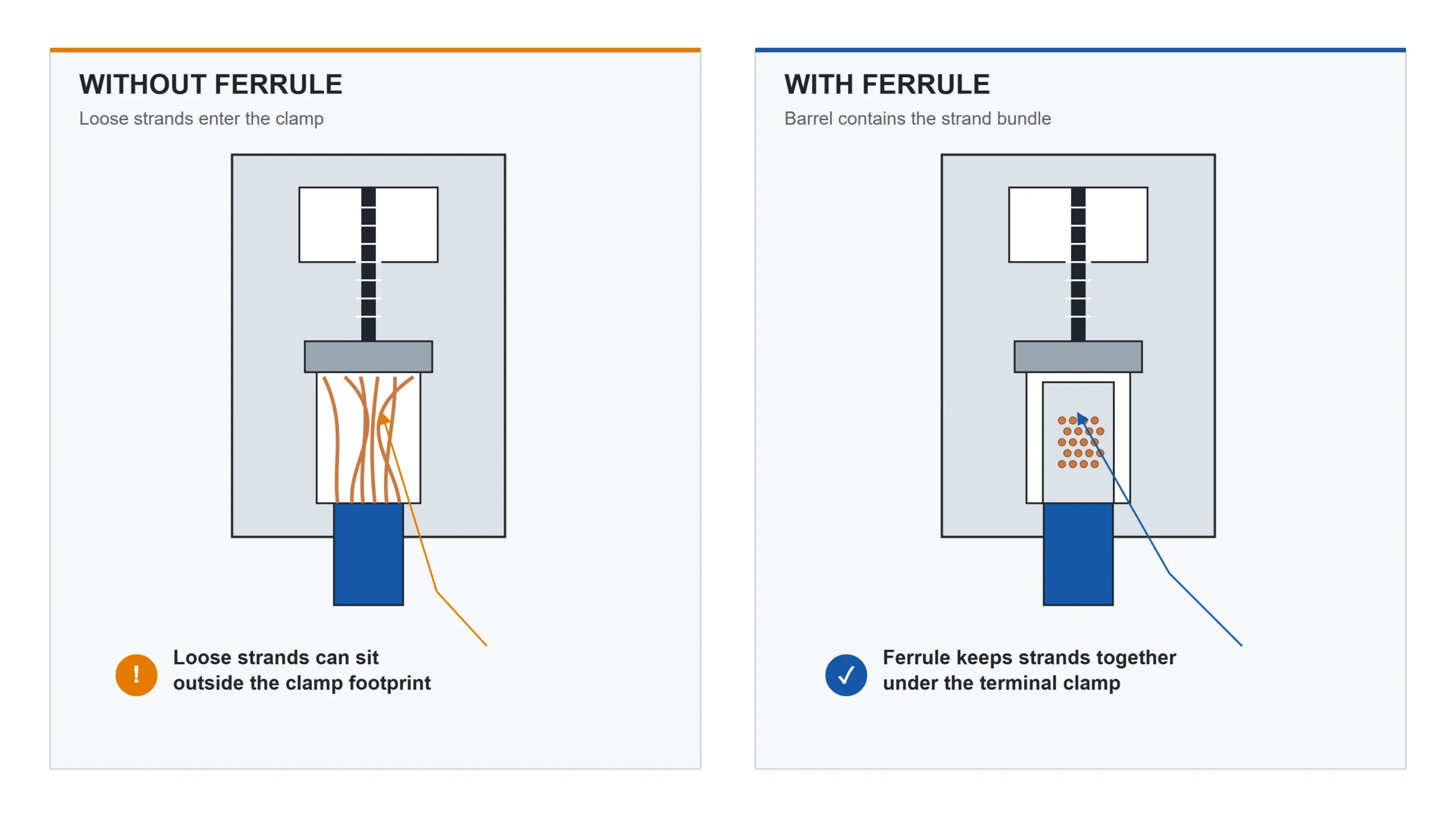
The problem with stranded wire in a screw terminal is mechanical, not electrical. When the clamping screw tightens directly against loose strands, a few strands carry most of the load while others deflect sideways. Contact resistance rises. Under vibration or thermal cycling, the strands compact further, the screw loses torque, and the connection loosens. In the worst case, individual strands escape the terminal entirely and create a short circuit risk on high-density terminal strips where slot spacing runs 5mm or less.
A ferrule fixes this at the source. The crimp consolidates all strands into a single copper body that the terminal clamps uniformly across its full face. Contact resistance drops. The connection stays torqued. And the ferrule’s closed end stops strands from migrating into adjacent terminal slots.
There is a secondary benefit: oxidation resistance. Tin plating on the ferrule barrel slows oxidation at the conductor surface, and the compressed crimp leaves no air gaps between strands for moisture ingress. Over a ten-year panel service life, the difference between a ferrule-terminated and a bare-wire terminated connection is measurable in contact resistance drift.
Types of wire ferrules
Not all ferrules are interchangeable. Four types cover the majority of industrial panel wiring applications, each suited to a different installation requirement. The Termnex wire ferrule and bootlace ferrule range brings the main configurations together for comparison, with the full dimension table for each type one click further in.
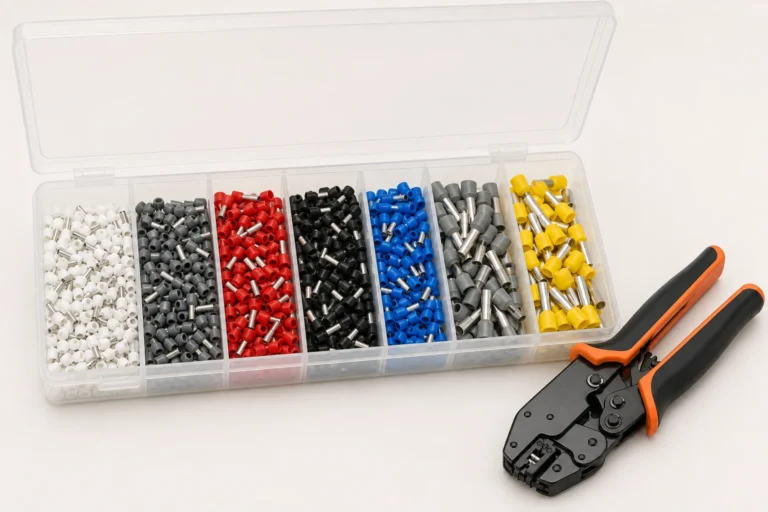
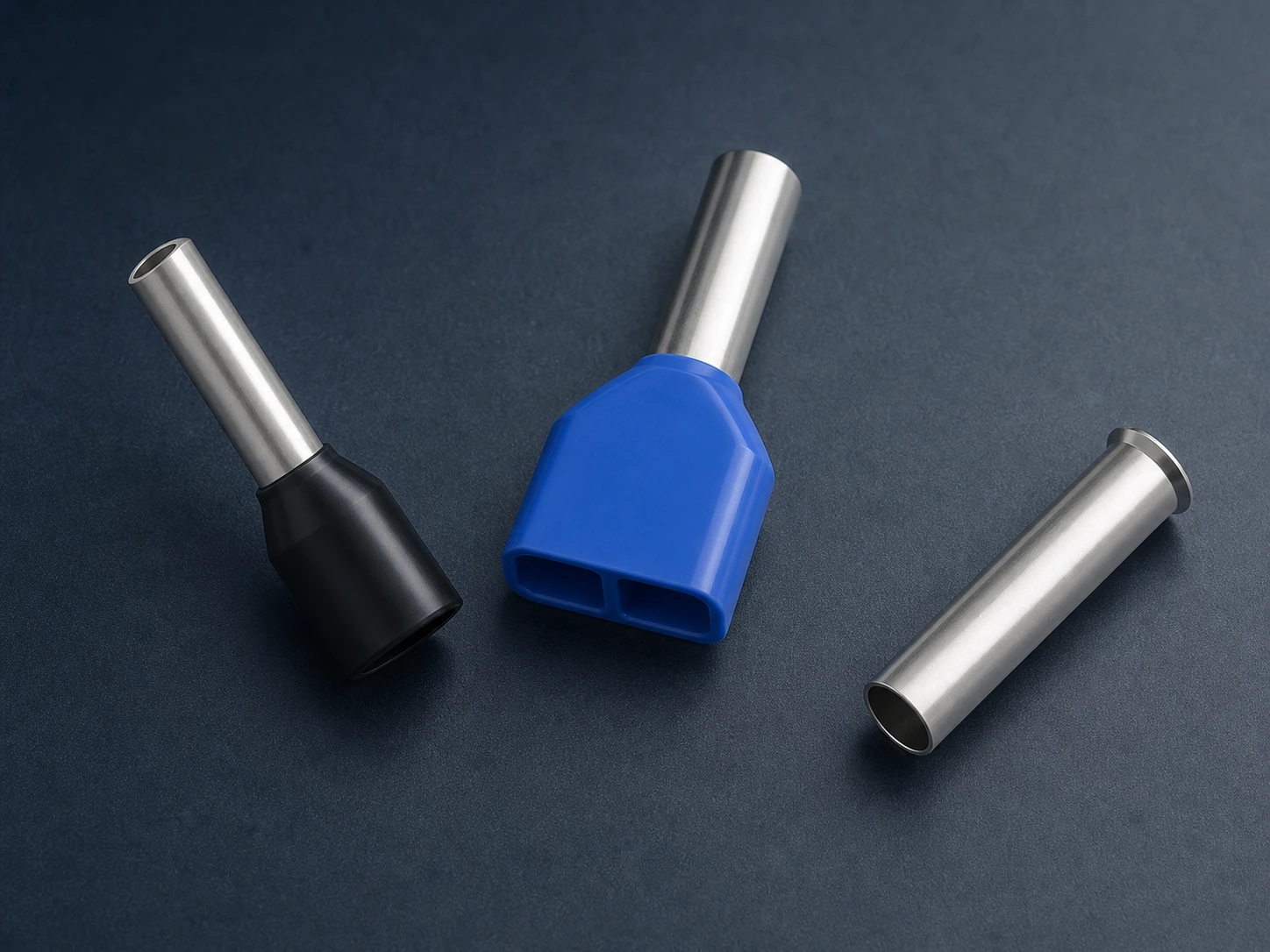
Insulated bootlace ferrules (DIN 46228 Part 4) The standard choice for most panel wiring. A plastic collar, typically polypropylene or polyamide, rated to 105–110°C, extends over the stripped wire entry point, providing insulation at the termination and a grip surface for insertion. The collar is color-coded by cross-section under DIN 46228 Part 4: white for 0.5mm², grey for 0.75mm², red for 1.0mm², black for 1.5mm², blue for 2.5mm², grey for 4mm², yellow for 6mm². The color coding is the fastest quality check in a dense terminal strip; a mismatched color means a wrong size ferrule, visible at a glance without a multimeter.
Non-insulated ferrules (DIN 46228 Part 1) The same copper barrel without the plastic collar. Used where space at the terminal entry is tight, where the terminal design already provides insulation, or where the installation specifies bare terminations for inspection purposes. Non-insulated ferrules require more care during installation; the unprotected barrel makes inadvertent contact with adjacent terminals more likely in confined spaces.
Twin wire ferrules A single ferrule body with a divided barrel that accepts two conductors simultaneously. Used where two wires must share a single terminal position, common in control circuits where a signal loops from one device to the next through the same terminal point. Twin ferrules eliminate the stacked-ferrule workaround (two ferrules side by side in one terminal), which is unreliable and non-compliant with most terminal manufacturers’ installation requirements.
High-temperature ferrules Standard polypropylene collars are rated to around 105°C. Applications near motor drives, transformers, or in enclosures with poor ventilation may exceed this. High-temperature variants use polyamide collars rated to 180°C or above, with the same DIN 46228 Part 4 dimensional compliance.
Wire ferrule sizes: how to read the DIN 46228 specification
Ferrule sizing follows conductor cross-section in mm², not wire gauge. The ferrule must match the conductor exactly: one size up and the crimp is loose, one size down and the conductor won’t fit or the strands bunch unevenly inside the barrel.
DIN 46228 Part 4 defines the standard insulated ferrule range:
| Cross-Section | Collar Color |
|---|---|
| 0.5mm² | White |
| 0.75mm² | Grey |
| 1.0mm² | Red |
| 1.5mm² | Black |
| 2.5mm² | Blue |
| 4.0mm² | Grey |
| 6.0mm² | Yellow |
| 10.0mm² | Red |
| 16.0mm² | Blue |
Cross-section does not decide pin length. The same conductor size is manufactured with several pin lengths, and the terminal manufacturer’s ferrule or strip-length requirements are the starting point for selection. If the terminal publishes only a strip length, use it as a compatibility input and confirm the pin length rather than assuming the two numbers are equal. The ferrule pin length guide explains the decision.
When should you use wire ferrules?
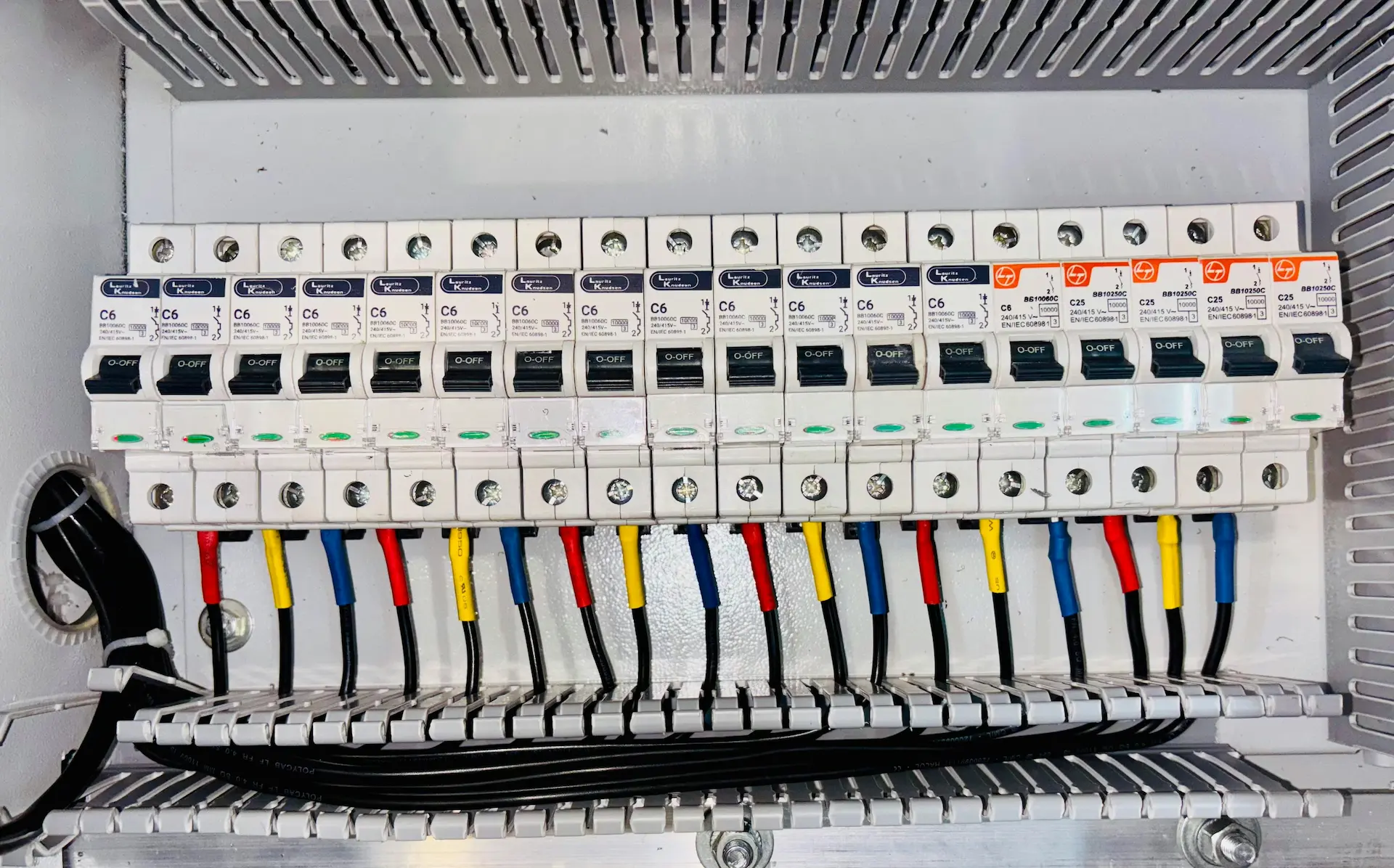
In a control panel, the rule is simple: whenever stranded wire terminates in a screw or spring-clamp terminal, use a ferrule.
EN 60204-1 clause 13.1.1 is the regulatory basis: finely stranded Class 5 or Class 6 conductors used with screwed connections require a means of retaining the strands. A correctly crimped ferrule is the standard compliance method. The requirement covers the vast majority of industrial control panel wiring, where flexible stranded cable is the norm for routing through cable ducts and around components.
Three situations where ferrules are non-negotiable:
High-density terminal strips, where strand migration into an adjacent slot creates a short circuit. Ferrules are the only reliable prevention method at 5mm or narrower terminal pitch.
Vibrating environments, machine panels, motor control centres, transport equipment. Bare stranded wire compacts and loosens under vibration. A ferrule-terminated connection holds torque over the equipment service life.
Maintenance-heavy installations: terminals are opened and re-terminated repeatedly. Bare wire frays with each re-termination cycle. A ferrule produces a clean, consistent contact every time.
Solid wire does not need ferrules; the conductor itself provides the rigid contact surface. Ferrules are a stranded-wire solution.
How to select the right wire ferrule
Three parameters, in order:
1. Cross-section, match exactly Select the ferrule cross-section to match the conductor’s nominal mm² rating. Do not round up. A 1.5mm² conductor takes a 1.5mm² ferrule; the barrel inner diameter is sized to compress the strands to the correct contact density at that cross-section. A larger ferrule leaves the crimp loose; a smaller one won’t accept the conductor cleanly.
- Insulated or non-insulated
Default to insulated (DIN 46228 Part 4) for standard panel wiring. Use non-insulated (DIN 46228 Part 1) only where the terminal entry is too narrow for the collar, or where the installation specification requires bare terminations.
- Pin length, check the terminal requirement
Use the terminal manufacturer’s stated ferrule requirement where one is provided. If it publishes a strip length only, treat that number as the compatibility basis and confirm the appropriate pin length. Do not choose a default from conductor size alone.
Twin ferrule selection For twin ferrule applications, both conductors must be the same cross-section; a twin ferrule is sized for two identical conductors, not a mixed pair. Check the terminal manufacturer’s approval for twin ferrule use; not all terminals are rated for it.
All Termnex wire ferrules meet DIN 46228 Part 1 and Part 4 requirements, available in insulated and non-insulated versions across the full 0.5–16mm² range.
FAQ
What is a wire ferrule?
A wire ferrule is a short tin-plated copper sleeve crimped over the stripped end of a stranded wire before insertion into a screw or spring-clamp terminal. It consolidates the wire strands into a stable cylindrical contact, preventing splaying, loosening, and strand migration. Ferrule dimensions and materials are standardised under DIN 46228.
What is the difference between insulated and non-insulated ferrules?
Insulated ferrules (DIN 46228 Part 4) have a plastic collar that provides insulation at the wire entry point and color-codes the ferrule by cross-section for quick visual verification. Non-insulated ferrules (DIN 46228 Part 1) have no collar, used where terminal entry space is limited or where the installation specifies bare terminations. For standard panel wiring, insulated is the default choice. The insulated versus non-insulated comparison works through the cases where it is not.
Do I need ferrules on stranded wire?
In industrial control panels, yes. EN 60204-1 clause 13.1.1 requires that finely stranded conductors used with screwed connections have a means of retaining their strands. A correctly crimped ferrule is the standard compliance method. Solid wire does not require ferrules. Which terminal types actually need one sets it out row by row, including where spring-cage practice is divided.
What size ferrule do I need?
Match the ferrule cross-section exactly to the conductor’s nominal mm² rating. Then select pin length from the terminal manufacturer’s ferrule or strip-length requirements rather than from conductor size. The wire ferrule sizes guide lists the available cross-sections.
What is DIN 46228?
DIN 46228 is the German standard that defines dimensions, materials, tolerances, and test requirements for wire end ferrules. Part 1 covers non-insulated ferrules, Part 4 covers insulated ferrules with plastic collars. Most industrial ferrule products reference DIN 46228 compliance as the baseline quality standard.
Can I use one ferrule for two wires?
Only with a twin wire ferrule specifically designed for that purpose. Standard single ferrules must not be used with two conductors; the barrel is sized for one conductor cross-section and the crimp will be unreliable. Twin ferrules require both conductors to be the same cross-section, and the terminal block must be rated for twin ferrule use. When to use twin wire ferrules covers where they help and where a distribution block is the better answer.
Picking a ferrule once you know what it is
Knowing what the part does still leaves three choices: cross-section, pin length, and whether the collar is insulated. The Termnex range covers DIN 46228 sizes in insulated, twin and non-insulated series. Send the conductor sizes you are terminating, the terminal type they go into, and the market the panel ships to. The quotation names the part numbers and the certificates that go with them. Contact us.