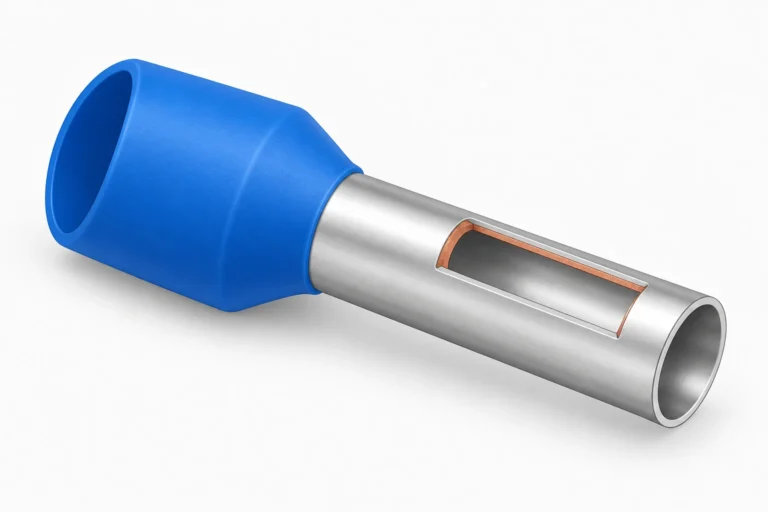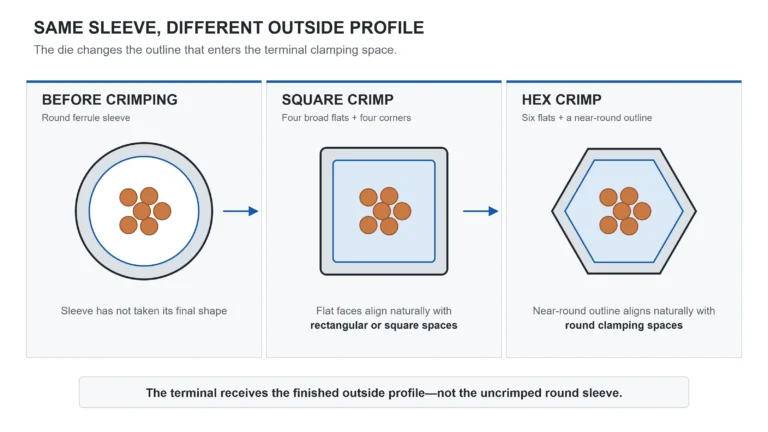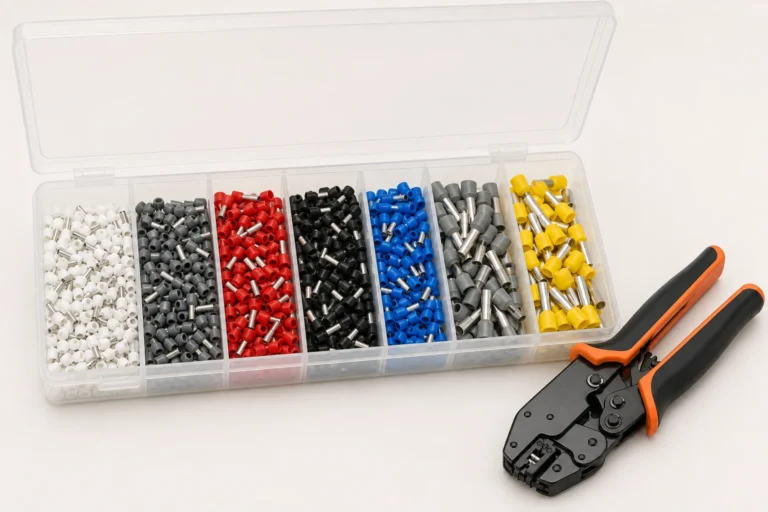

Wire ferrule sizes run from 0.14 mm² to 150 mm², covering signal wiring up to heavy power terminations. Match the ferrule to your conductor’s cross-section first. Color is a confirmation, not a starting point. Within the standardized range, the same gray collar appears on 0.75 mm² and 4.00 mm² ferrules under DIN 46228-4.
The same part is sold under four names. Wire ferrule is standard North American usage, bootlace ferrule is the common UK term, cable ferrule appears in both markets, and cord end terminal is how most manufacturers label them in their own catalogues. All four describe the same component: a metal sleeve crimped onto a stranded conductor. For consistency, wire ferrule is the term used throughout.
Wire ferrule sizes at a glance
Wire ferrules are sized by conductor cross-section: mm² in metric systems, AWG in North American practice. For control panel work, the practical range is 0.5 mm² (20 AWG) to 6 mm² (10 AWG). Select by cross-section first, then confirm pin length against the terminal manufacturer’s ferrule or strip-length requirements. A strip-length value is a compatibility input, not an automatic one-to-one pin-length answer. Color coding under DIN 46228-4 is a visual aid only. Gray alone covers three different sizes.
Which unit you start from depends on where you work. North American panel shops look up ferrules by AWG; UK and European shops look up bootlace ferrule sizes by mm². Both routes land on the same part, so this guide gives you a table for each:
- Wire Ferrule Sizes by AWG: start from American wire gauge
- Complete Wire Ferrule Sizes Chart in mm²: start from metric cross-section, with the full DIN 46228-4 colour table
Need the chart at the bench? Download the printable wire ferrule size and colour chart (PDF). It is generated from the same DIN 46228-4 data as the tables below and prints on two pages.
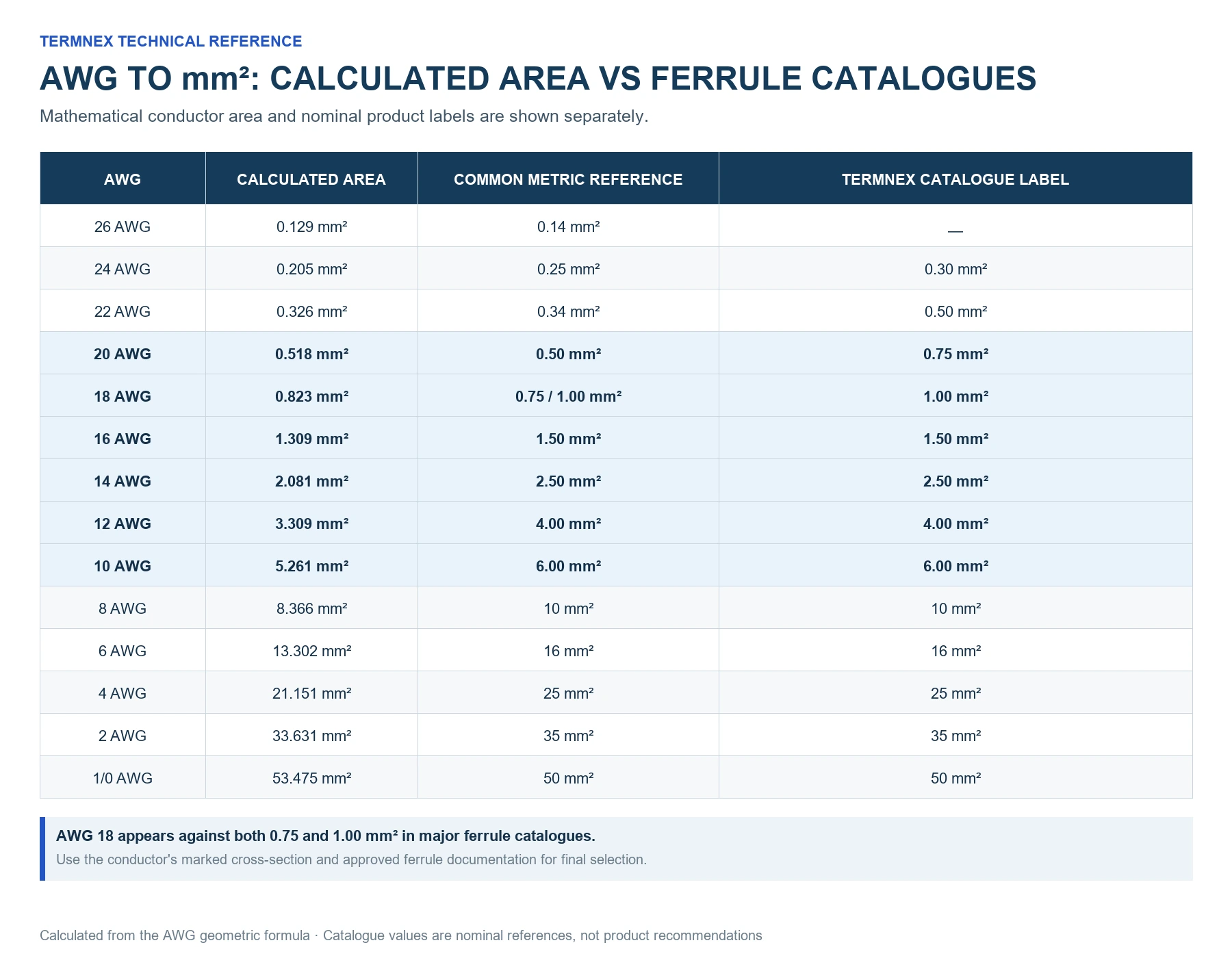
For a quick one-size lookup without scanning the full tables, use the AWG to mm² converter. It keeps calculated conductor area, common metric references and Termnex catalogue labels separate.
If your conductor is already marked in mm² and you just need the verified colour and dimensions, use the Wire Ferrule Size & Colour Code Chart.
If you’re new to wire ferrules and want a grounding in how they work and where they’re used, start with What Are Wire Ferrules? A Panel Builder’s Guide to Types, Sizes and Selection.
Wire ferrule sizes by AWG
If you specify wire in AWG, work from this table. One thing to know before you order: the ferrule itself is normally marked in mm², not AWG, because the part is manufactured to a metric standard. A bin labelled 2.5 is the ferrule you want for 14 AWG wire. There is no separate “14 AWG ferrule” part number in most catalogues.
The table separates mathematical conductor area from nominal ferrule catalogue references. Those values are not interchangeable. A catalogue may group the same AWG under more than one metric ferrule size, and a supplier’s packaging may use a different AWG label again. Select by the conductor’s marked cross-section whenever it is available.
| AWG | Calculated Area | Common Metric Ferrule Reference | Catalogue Note |
|---|---|---|---|
| 26 AWG | 0.129 mm² | 0.14 mm² | Nominal catalogue reference; confirm the conductor and ferrule documentation. |
| 24 AWG | 0.205 mm² | 0.25 mm² | Termnex product catalogue and packaging use AWG 24 for 0.30 mm². |
| 22 AWG | 0.326 mm² | 0.34 mm² | Termnex product catalogue and packaging use AWG 22 for 0.50 mm². |
| 20 AWG | 0.518 mm² | 0.50 mm² | Termnex product catalogue and packaging use AWG 20 for 0.75 mm². |
| 18 AWG | 0.823 mm² | 0.75 mm²; 1.00 mm² | 0.75 and 1.00 mm² both appear under AWG 18 in major ferrule catalogues; the Termnex product catalogue labels 1.00 mm² as AWG 18. |
| 16 AWG | 1.309 mm² | 1.50 mm² | The Termnex product catalogue uses the same label. |
| 14 AWG | 2.081 mm² | 2.50 mm² | The Termnex product catalogue uses the same label. |
| 12 AWG | 3.309 mm² | 4.00 mm² | The Termnex product catalogue uses the same label. |
| 10 AWG | 5.261 mm² | 6.00 mm² | The Termnex product catalogue uses the same label. |
| 8 AWG | 8.366 mm² | 10 mm² | The Termnex product catalogue uses the same label. |
| 6 AWG | 13.302 mm² | 16 mm² | The Termnex product catalogue uses the same label. |
| 4 AWG | 21.151 mm² | 25 mm² | The Termnex product catalogue uses the same label. |
| 2 AWG | 33.631 mm² | 35 mm² | The Termnex product catalogue uses the same label. |
| 1/0 AWG | 53.475 mm² | 50 mm² | The Termnex product catalogue uses the same label. |
Bold rows are the 20 AWG to 10 AWG band that covers most control panel wiring. Above 1/0 AWG there is no standardized collar colour at all. See Sizes Above 50 mm².
For UL 508A panel shops, note that this table tells you which ferrule fits the conductor. It does not tell you whether that ferrule is compliant in your panel. That depends on the ferrule-and-tool pairing, covered in DIN 46228 vs UL 486F.
At the top of this table, AWG is not always the label you will hear. Battery, welding and car-audio cable is usually described by gauge instead of AWG: a 4 gauge conductor and a 4 AWG conductor are the same wire, and the ferrule is the same 25 mm² / 4 AWG bootlace ferrule. At the very top of the standardized range, 0 gauge is the common name for 1/0 AWG, matching the 50 mm² / 1/0 AWG bootlace ferrule. Smaller AWG sizes are rarely called out by gauge in the same way.
Complete wire ferrule sizes chart in mm²
Use this table if you specify conductors in mm², standard practice in the UK and Europe, where the part is usually called a bootlace ferrule. Bootlace ferrule sizes follow the same DIN 46228-4 table, so this is the chart for both names. It is the master reference and covers the full DIN 46228-4 range. The calculated AWG column is geometric; the catalogue column shows how named ferrule ranges label the same metric size. For quick reference during panel assembly, the common control-panel sizes are 0.5 mm² to 6 mm², highlighted in the table. Larger sizes from 10 mm² upward are used in power distribution and heavy industrial panels.
The colors below are taken directly from the DIN colour table (Kennfarbe der Kunststoffhülse nach DIN 47002), cross-checked against a manufacturer catalogue. The standardized colour range runs 0.5 mm² to 50 mm² and stops there. See Sizes Above 50 mm² below.
| Cross-Section | Calculated AWG | Catalogue Reference | Collar Colour (DIN 47002) | Typical Application |
|---|---|---|---|---|
| 0.14 mm² | 25.64 AWG | Common: AWG 26 | Not standardised | Low-current signal wiring |
| 0.25 mm² | 23.14 AWG | Common: AWG 24 | Not standardised | Sensor and instrumentation circuits |
| 0.34 mm² | 21.81 AWG | Common: AWG 22 | Not standardised | Low-current control circuits |
| 0.50 mm² | 20.15 AWG | Common: AWG 20; Termnex product label: AWG 22 | White | Sensors and PLC I/O wiring |
| 0.75 mm² | 18.40 AWG | Common: AWG 18; Termnex product label: AWG 20 | Grey | Control and auxiliary circuits |
| 1.00 mm² | 17.16 AWG | AWG 18 | Red | Control panels and general wiring |
| 1.50 mm² | 15.41 AWG | AWG 16 | Black | Internal panel power wiring |
| 2.50 mm² | 13.21 AWG | AWG 14 | Blue | Power circuits and feeders |
| 4.00 mm² | 11.18 AWG | AWG 12 | Grey | Larger power conductors |
| 6.00 mm² | 9.43 AWG | AWG 10 | Yellow | Higher-load panel wiring |
| 10 mm² | 7.23 AWG | AWG 8 | Red | Heavy-duty terminations |
| 16 mm² | 5.20 AWG | AWG 6 | Blue | High-current distribution |
| 25 mm² | 3.28 AWG | AWG 4 | Yellow | Power distribution panels |
| 35 mm² | 1.83 AWG | AWG 2 | Red | Heavy industrial terminations |
| 50 mm² | 0.29 AWG | AWG 1/0 | Blue | Main feeders and switchgear terminations |
| 70 mm² | ≈ 2/0 AWG | AWG 2/0 | No standard colour | Heavy power distribution |
| 95 mm² | ≈ 3/0 AWG | AWG 3/0 | No standard colour | Heavy power distribution |
| 120 mm² | ≈ 4/0 AWG | AWG 4/0 | No standard colour | Heavy power distribution |
| 150 mm² | Beyond 4/0 AWG | 250/300 MCM | No standard colour | Heavy power distribution |
A note on repeating colors: Within the standardized 0.5–50 mm² range, gray appears at 0.75 mm² and 4.00 mm². Red appears at 1.00 mm², 10.00 mm², and 35.00 mm². Blue covers 2.50 mm², 16.00 mm², and 50.00 mm². DIN 46228-4 assigns each size a collar colour identified per DIN 47002; colour remains a visual aid, not a unique identifier across the full range. Colours below 0.5 mm² are manufacturer-specific. In a panel shop handling multiple wire gauges, color alone will mislead you. Read the size marking on the collar.
Shop by cross-section. Each page below lists every pin length, collar colour and UL 486F status Termnex carries at that size, across the insulated, twin and non-insulated series:
0.5 mm² · 0.75 mm² · 1 mm² · 1.5 mm² · 2.5 mm² · 4 mm² · 6 mm² · 10 mm² · 16 mm² · 25 mm² (4 AWG / 4 gauge) · 35 mm² · 50 mm² (1/0 AWG / 0 gauge)
Wire ferrule sizes for insulated, uninsulated, and twin types
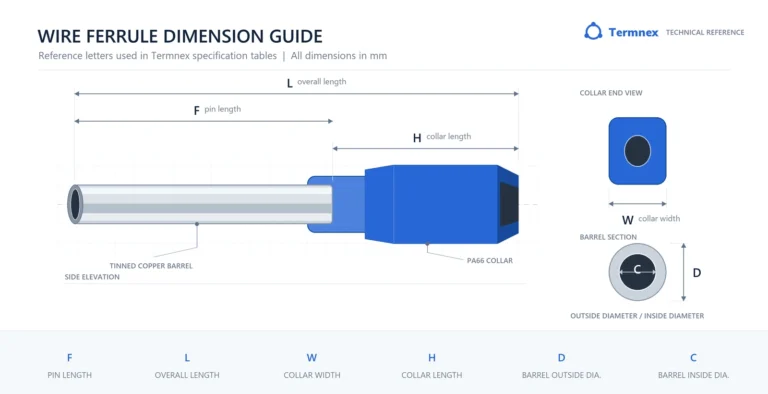
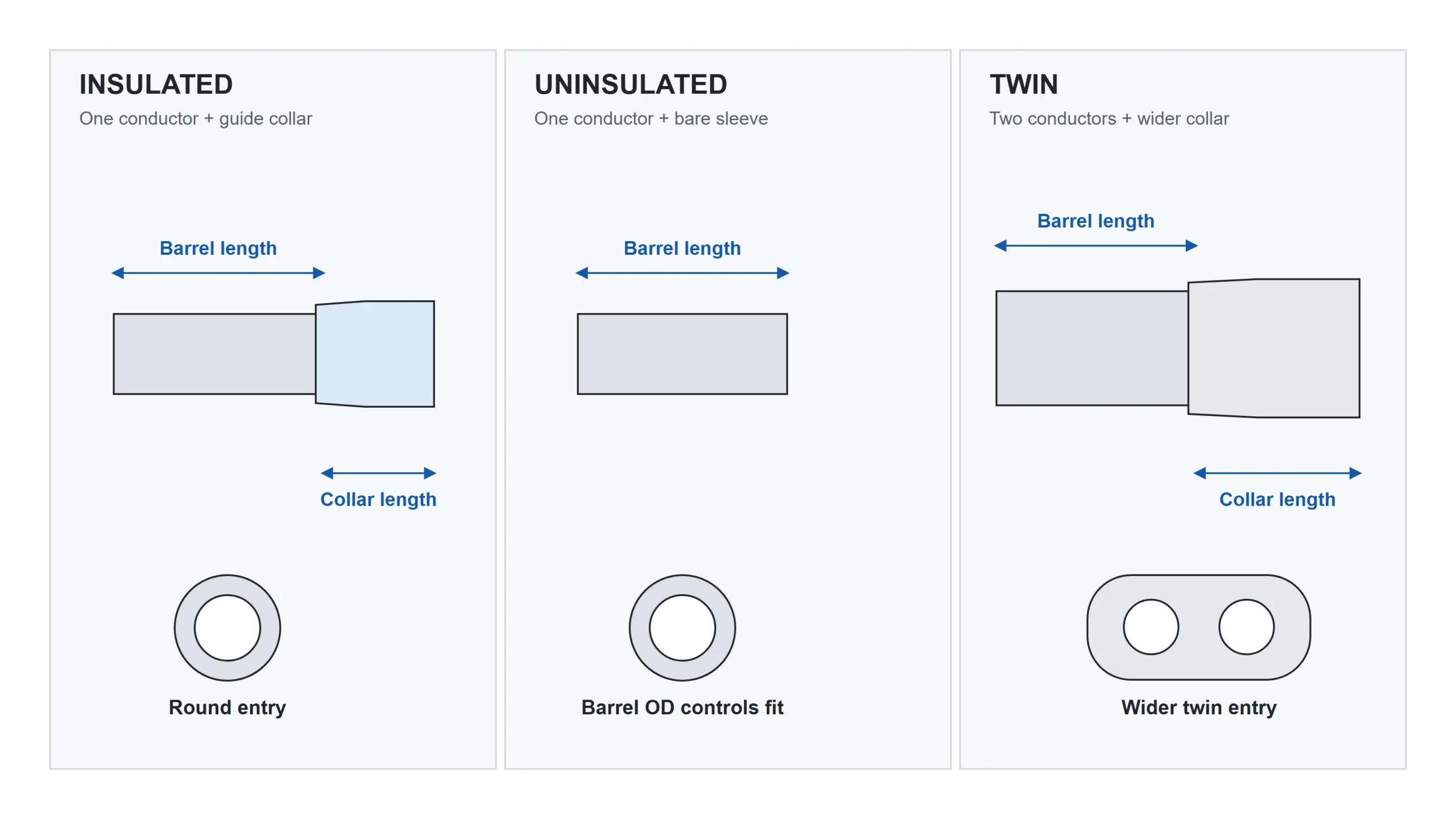
Comparing wire ferrule sizes across the three types starts with the metal barrel dimensions for a given cross-section. What changes is the collar and entry geometry. If that choice has not been made yet, start with the wire ferrule and bootlace ferrule range. Every dimension referred to below (pin length, overall length, collar width and height, barrel bore) is then tabulated size by size on the series pages.
Insulated ferrules (DIN 46228-4) have a plastic collar extending beyond the barrel. The collar adds 2–4 mm to overall length and widens the entry point. The actual entry diameter you need to clear at the terminal face is the collar OD, not the barrel OD. Check terminal entry specs before assuming an insulated ferrule fits where an uninsulated one did.
Uninsulated ferrules (DIN 46228-1) are bare copper sleeves with no collar. Overall length is shorter by the collar dimension. Where terminal entry is tight or the design standard calls for bare sleeves, uninsulated ferrules are the default. Visually they carry no color identification, so bin discipline matters more.
Twin ferrules take two conductors of the same cross-section into a single barrel: one connection point, two wires. The barrel width is roughly double a single ferrule at the same gauge, and not every terminal accepts them. Spring-cage terminals generally accept twins well; screw terminals need to be verified against the manufacturer’s datasheet. Never mix conductor sizes in a twin ferrule: the smaller wire will sit loose in the barrel and crimp poorly.
| Type | Standard | Collar | Entry Width | Color ID |
|---|---|---|---|---|
| Insulated | DIN 46228-4 | Yes | Collar OD | Yes |
| Uninsulated | DIN 46228-1 | No | Barrel OD | No |
| Twin | DIN 46228-4 | Yes | Wider barrel | Yes |
Figure 2 illustrates the dimensional differences between insulated, uninsulated, and twin ferrules at the same conductor cross-section.
Wire ferrule sizes and barrel length
Cross-section selects the ferrule bore, not its pin length. One conductor size can be available with several pin lengths, so start with the terminal manufacturer’s stated ferrule or strip-length requirements. If the terminal publishes only a strip length, use it to narrow the compatible choices and confirm the pin length rather than assuming the numbers are equal. Conductor preparation is separate: follow the ferrule manufacturer’s stripping instruction. See how to choose ferrule pin length for the full decision method.
Wire ferrule sizes above 50 mm²
Wire ferrule sizes above 50 mm² sit outside the DIN colour table. That is not an omission in most datasheets. There is no standardized collar colour above 50 mm², so any colour you see on a 70 mm², 95 mm², 120 mm² or 150 mm² ferrule is that manufacturer’s own choice.
Two practical consequences:
Never specify a large ferrule by colour. Below 50 mm² a blue collar reliably means 2.5 mm² or 16 mm² or 50 mm² within DIN. Above it, a yellow collar on one brand’s 70 mm² may be another brand’s 150 mm². Order by cross-section and barrel length, and confirm against the part number.
Mixed-brand panels get worse, not better, at large sizes. If a panel is re-terminated years later with a different supplier’s ferrules, the large-conductor colours will not match the originals. Document the cross-sections on the wiring schedule rather than relying on what the installer can see.
Insulated ferrules are commonly manufactured up to 150 mm² (HE150-32), and uninsulated (bare) sleeves up to 185 mm² (HEN185-32). Above 50 mm² the crimp also moves to hex or deep-indent profiles and needs a hydraulic or long-arm tool. A standard control-panel crimper will not close these sleeves.
Wire ferrule sizes across DIN, French NF, and UL colour systems
Wire ferrule sizes do not map to one universal colour system. The same cross-section has different collar colours in different markets, and all of them can be correct.
Major manufacturers publish two or three parallel colour series side by side:
- DIN 46228-4 (German, colour table per DIN 47002), the dominant European and global reference
- NF C 63-023 (French), used in France and parts of French-influenced markets
- UL 486F (North American), a listing standard that does not define a colour system at all
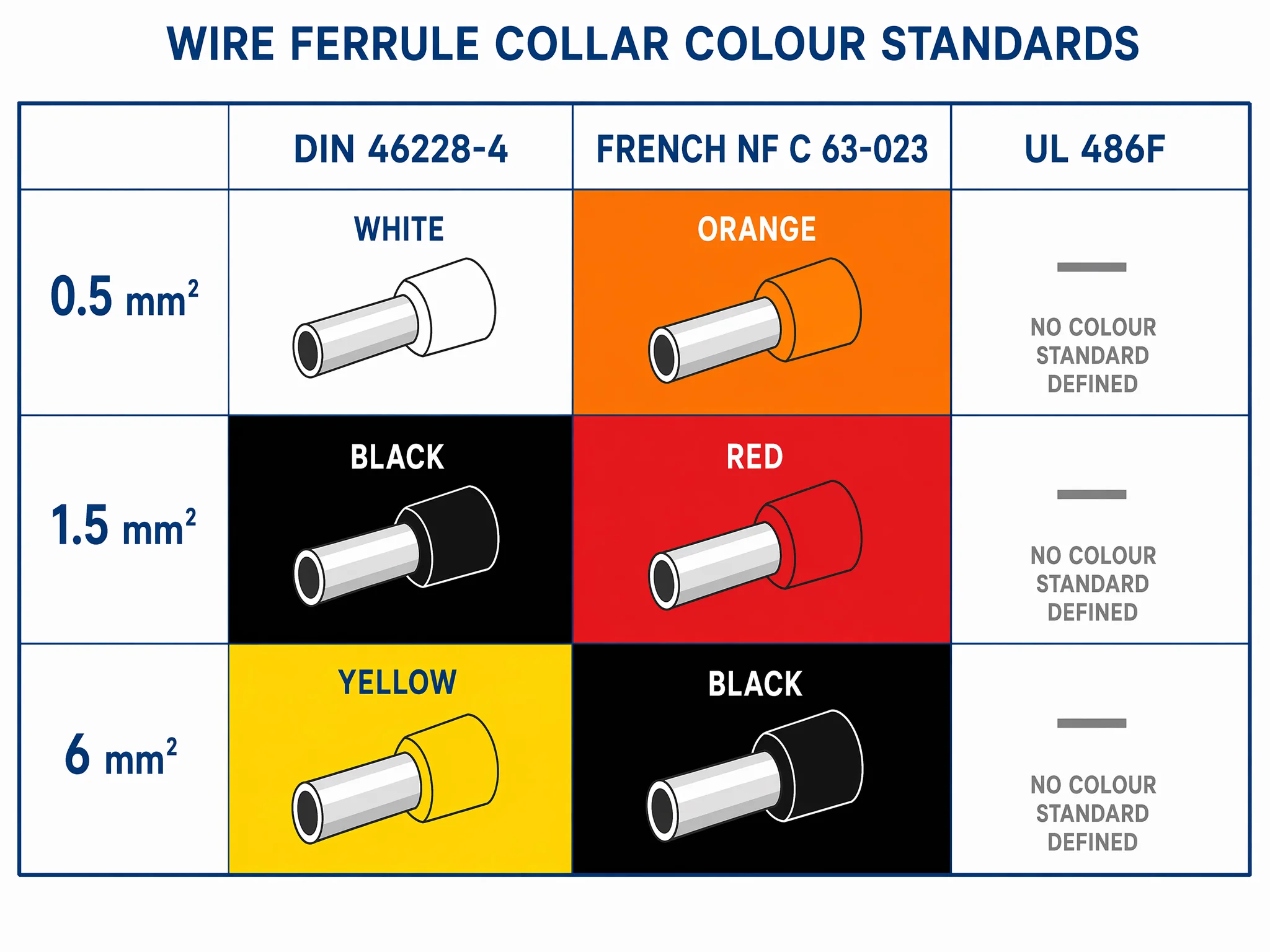
Two parallel standards are why a 1.5 mm² ferrule arrives black from one supplier and red from another. Neither is wrong. Black is DIN; red is a common French-market colour at that size.
| Cross-Section | DIN 46228-4 | Common French (NF) colour |
|---|---|---|
| 0.50 mm² | White | Orange |
| 1.50 mm² | Black | Red |
| 6.00 mm² | Yellow | Black |
On the French series: unlike DIN, the NF colour set is not consistently published as a complete cross-section table, and manufacturers stock only the sizes their customers actually order. The three above are the ones you will most often meet in practice. If a project specifies French colours, confirm the full list with your supplier against part numbers rather than assuming a published chart applies.
What this means when you order. Specify the standard, not the colour: “2.5 mm², 10 mm barrel, DIN 46228-4 colour” is unambiguous. “Blue 2.5 mm² ferrules” is not. It happens to be right under DIN and wrong under NF. On a drawing or a bill of materials, always cite the cross-section and the standard together.
Figure 3 shows how the same three cross-sections carry different collar colours under the DIN and French series, and why UL sits outside the comparison entirely.
Standards governing wire ferrule sizes: DIN 46228 vs UL 486F
Most datasheets use DIN 46228 to define wire ferrule sizes. North American panel shops working under UL 508A certification will also encounter UL 486F. The two standards are not interchangeable, and they do not use the same color system.
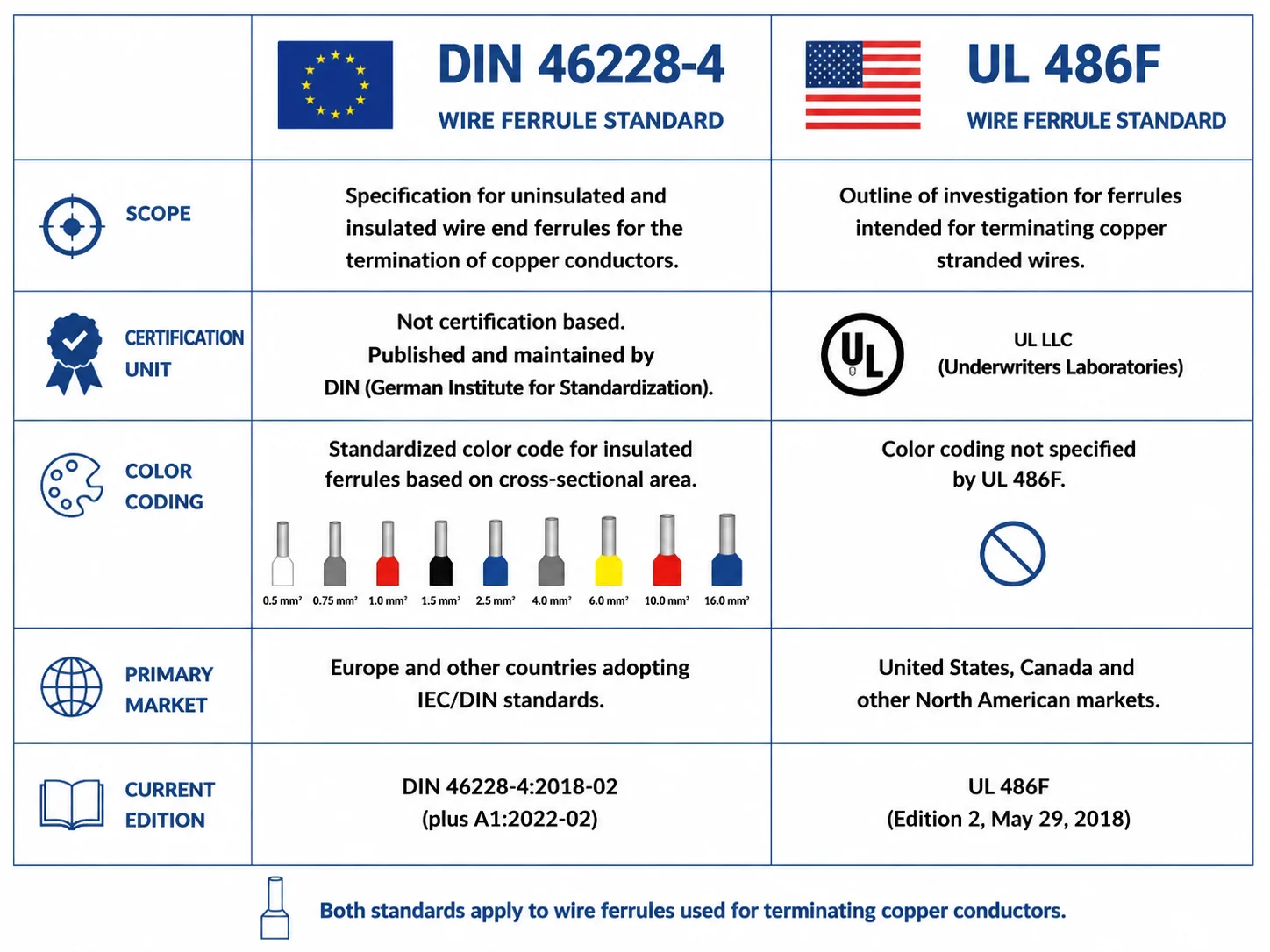
DIN 46228 is a product conformance standard. It defines ferrule dimensions, material requirements, and test methods. Part 1 covers uninsulated ferrules; Part 4 covers insulated ferrules with plastic collars. The 2020 revision (DIN 46228-4:2020-03{target=”_blank” rel=”noopener noreferrer”}, with a 2023 corrigendum) added a maximum sleeve hardness requirement of 105 HV, a manufacturing quality control measure that prevents overly hard copper sleeves from crimping inconsistently. Compliance is declared by the manufacturer against the standard.
UL 486F works differently. It’s a listed-system standard: the ferrule and crimping tool are tested and certified together as a matched pair. A ferrule that passes UL 486F testing with Tool A is not automatically certified with Tool B. For UL 508A panel shops, this matters; an inspector can reject a panel if the ferrule-tool combination isn’t from a UL 486F listed pairing{target=”_blank” rel=”noopener noreferrer”}, regardless of how the crimp looks.
Color coding: DIN 46228-4 defines a specific cross-section-to-color table, from 0.5 mm² to 50 mm². UL 486F does not specify a colour system at all. It is a listing standard for the ferrule-and-tool pair, not a marking standard. Products built for the North American market may therefore follow DIN colours, French NF colours, AWG-based schemes, or manufacturer-specific coding. Never assume colour means the same thing across both systems.
| DIN 46228-4 | UL 486F | |
|---|---|---|
| Scope | Product conformance | System listing |
| Certification unit | Ferrule alone | Ferrule + crimping tool |
| Color coding | Defined, 0.5–50 mm² | Not defined at all |
| Primary market | Europe, global | North America |
| Current edition | 2020-03 + 2023 corrigendum | 2024 third edition |
If your project requires both European sizing consistency and North American compliance, specify both standards explicitly in procurement, and confirm the crimping tool is part of a UL-listed pairing for the ferrule you’re buying.
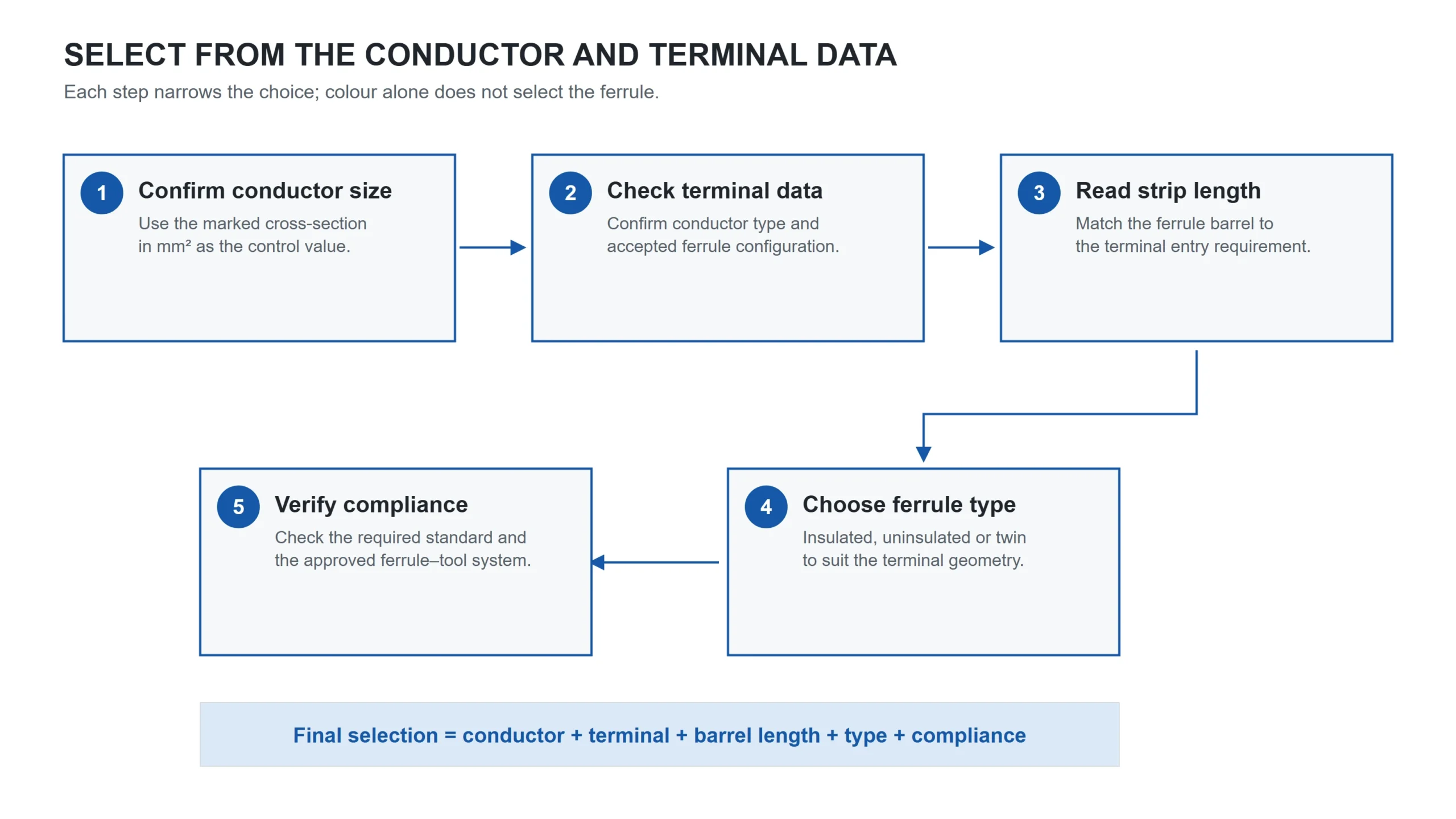
How to select the right wire ferrule sizes in 5 steps
Selecting wire ferrule sizes takes two minutes when you work through the checks in order. Most errors come from skipping steps: grabbing by color, guessing on barrel length, or ignoring the terminal datasheet.
Step 1: Confirm your conductor cross-section Measure in mm² or AWG. Don’t estimate. A 1.5 mm² conductor crimped into a 2.5 mm² ferrule will sit loose in the barrel regardless of how the crimp looks from outside.
Step 2: Check your terminal’s accepted conductor type Some terminals accept fine-stranded conductors directly. Others require ferrules. Spring-cage terminals in particular often specify whether ferrules are permitted, preferred, or mandatory. Find this in the terminal datasheet, not the product photo.
Step 3: Read the terminal requirements Use a stated ferrule length directly. If the terminal publishes only a strip length, treat it as the compatibility basis and confirm the appropriate pin length rather than assuming the two dimensions are equal.
Step 4: Choose insulated, uninsulated, or twin Insulated for most control panel work. Uninsulated where entry geometry is tight or the design standard specifies bare sleeves. Twin only when two same-gauge conductors share one connection point. Confirm the terminal accepts twin ferrules before crimping.
Step 5: Verify compliance requirements CE-marked installation or European export: reference DIN 46228-4:2020-03. UL 508A certified panel shop: confirm the ferrule and your crimping tool form a UL 486F listed pairing. Both markets: specify both standards in procurement.
FAQ
Which wire ferrule sizes fit 14 AWG wire?
For 14 AWG, standard wire ferrule sizes point to a 2.5 mm² ferrule. Under DIN 46228-4, it has a blue insulation collar. Every pin length Termnex lists at this cross-section is on the 2.5 mm² bootlace ferrule page; the terminal manufacturer’s requirement decides between them.
Is a 4 gauge wire ferrule the same as a 4 AWG ferrule?
Yes. Gauge and AWG are two names for the same wire size — 4 gauge and 4 AWG both mean 25 mm², and 0 gauge and 1/0 AWG both mean 50 mm². There is no separate “4 gauge” or “0 gauge” part number; the ferrule is marked in mm² and listed under 25 mm² or 50 mm² on the Termnex catalogue.
Which wire ferrule sizes fit 2.5 mm² cable?
For 2.5 mm² cable, the matching wire ferrule sizes are labelled 2.5 mm², with a blue collar under DIN 46228-4. In North American catalogues the same part is listed for 14 AWG. Several pin lengths may be available at this cross-section, and the terminal manufacturer’s ferrule or strip-length requirements decide which one applies. The names differ by market, but bootlace ferrule, wire ferrule, cable ferrule and cord end terminal are the same component.
Why does the same color appear on different wire ferrule sizes?
DIN 46228-4 reuses colors across its standardized 0.5–50 mm² range. Gray covers 0.75 mm² and 4.00 mm². Red appears at 1.00 mm², 10.00 mm², and 35.00 mm². Blue appears at 2.50 mm², 16.00 mm², and 50.00 mm². The color is a visual aid within a working size range, not a unique identifier across all sizes. Always read the size marking printed on the ferrule collar. Color alone is not reliable when your panel uses multiple wire gauges.
Why did my 1.5 mm² ferrules arrive red instead of black?
Because they follow the French colour series rather than DIN. Under DIN 46228-4 a 1.5 mm² collar is black; the common French-market colour at that size is red. Neither supplier is wrong; two colour standards coexist. The same happens at 0.5 mm² (white under DIN, orange under the French series) and 6 mm² (yellow under DIN, black under the French series). Check the cross-section marking on the collar, and specify the standard by name on your next order.
Can I use a DIN 46228-4 ferrule in a UL 508A certified panel?
Possibly, but not automatically. UL 508A panels require ferrules from a UL 486F listed ferrule-and-tool pairing. A ferrule marked DIN 46228-4 compliant may or may not appear in the UL Product iQ database. Check the UL listing before using it in a certified panel shop. An inspector can reject the panel if the pairing isn’t listed, regardless of crimp quality.
What is the difference between barrel length and strip length?
Barrel or pin length is a ferrule dimension. Strip length is how much insulation is removed from the conductor. Do not apply a universal equality between them: follow the ferrule manufacturer’s stripping instruction for conductor preparation, and use the terminal manufacturer’s connection data to confirm compatibility.
Turning a chart row into an order
The chart gives the cross-section. An order also needs the pin length, the colour system your drawing cites, and where the panel ships. Termnex publishes those details per size, including the range above where the insulated series stops. Send the sizes you are terminating along with those three details, and the reply is keyed to catalogue part numbers. Contact us.