

Cable entry for panels & equipment
Cable Glands and Cord Grips
Compare cable glands, cable entry glands and cord grips for cables entering panels, enclosures and equipment. Choose the construction and material, then confirm the cable outside diameter, mounting thread and the sealing requirement.
Product overview
What is a cable gland?
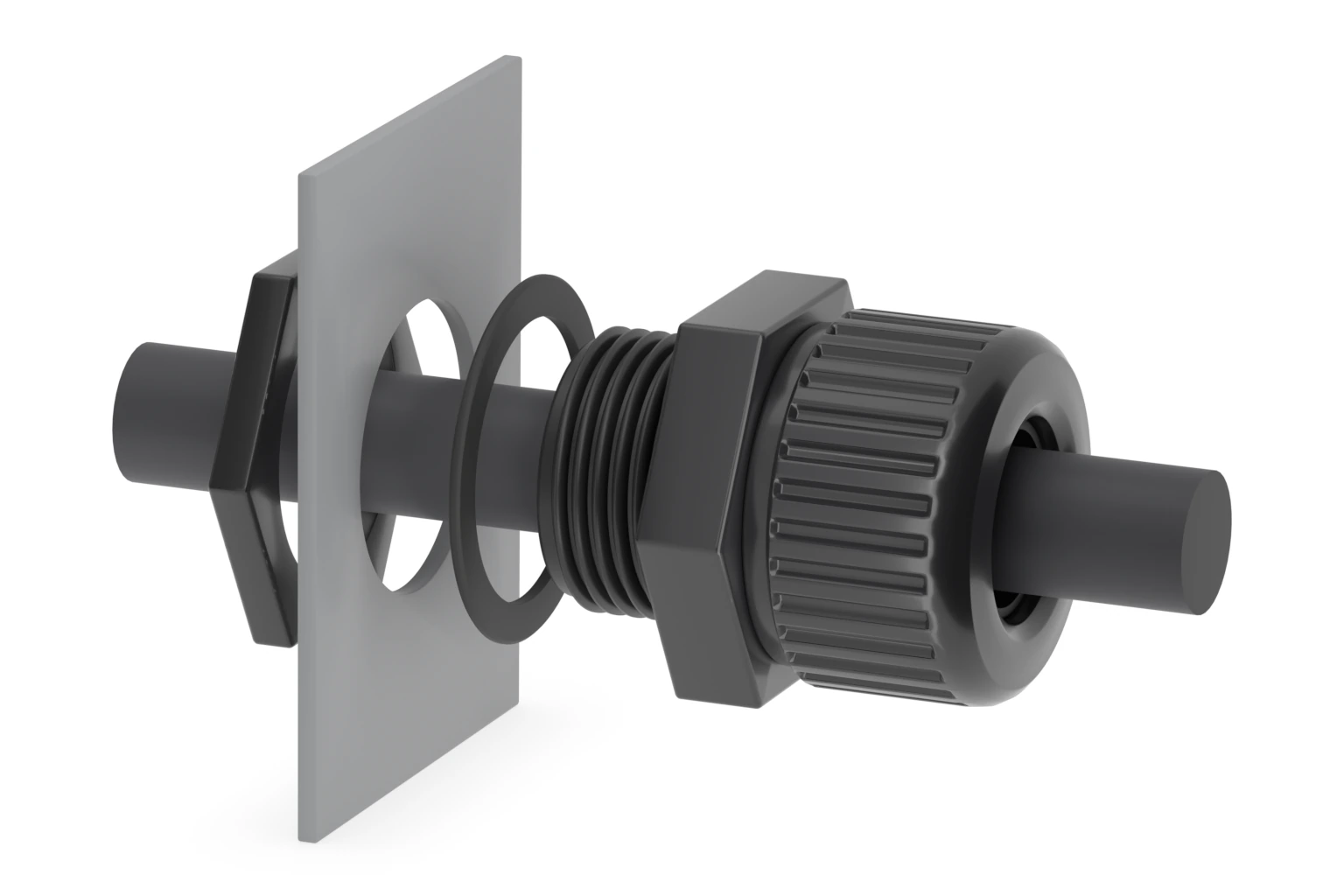
A cable gland is a fitting used where a cable enters an enclosure or piece of equipment. Depending on the model and installation, it can hold the cable, provide strain relief and support the required entry seal. Waterproof cable gland and watertight cable gland describe that sealing role; the achievable IP rating is defined per model and installation, not by the product category.
Cable gland connector and cable entry gland are common catalogue terms. North American buyers may also search for a cord grip or strain-relief cable gland. The names can cover different constructions or approvals, so select by the cable range, thread and documented function rather than the name alone.
Product routes
Choose nylon, brass or multi-hole
Start with the enclosure specification and the operating environment. For a single cable, choose a body material and a standard single-hole design. For several separate cables through one opening, take the multi-hole route and specify every cable diameter. Thread system and size are options inside all three routes.
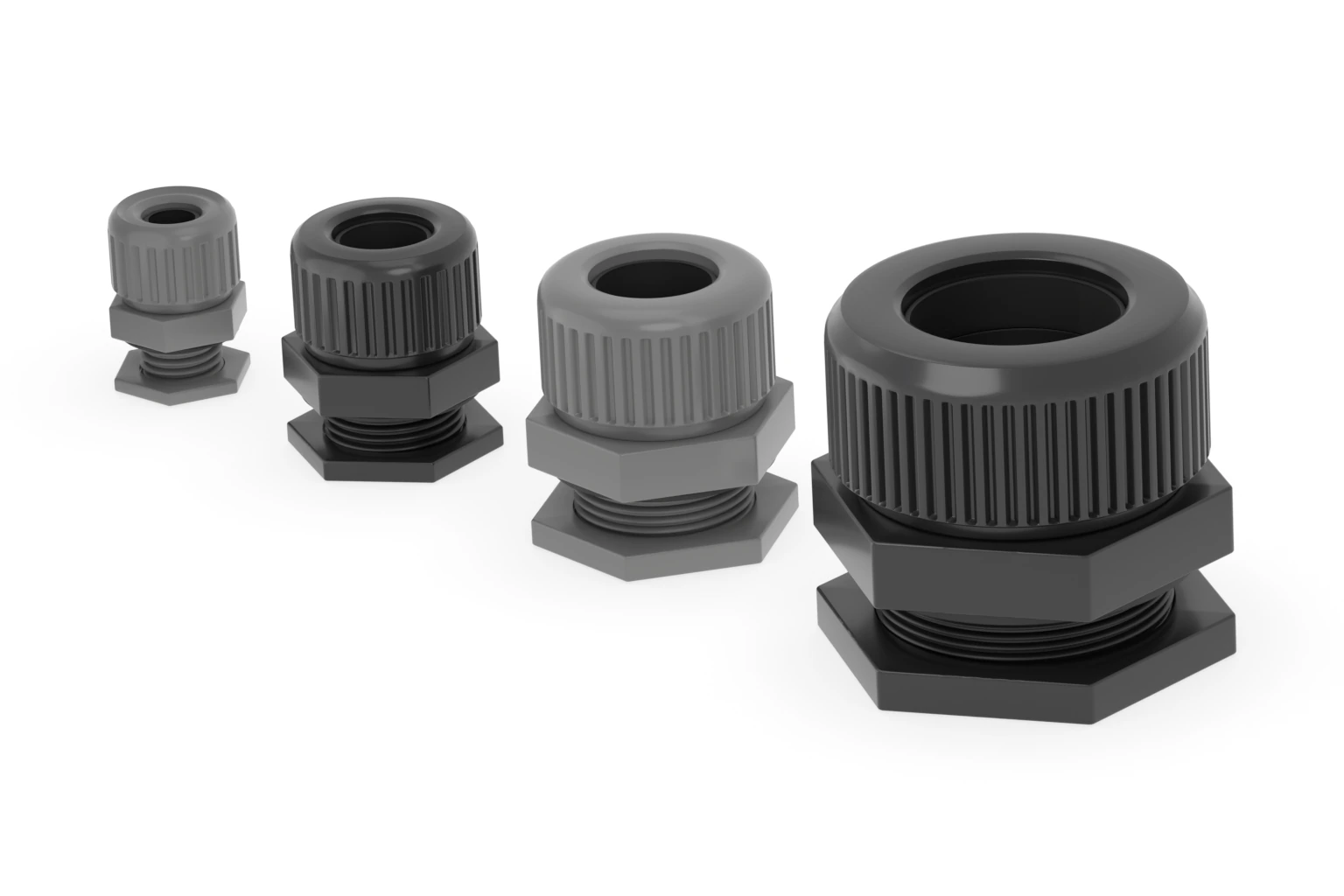
PA66 body · Black or grey · Metric, PG & NPT
Nylon and Plastic Cable Glands
Nylon cable glands are the non-metallic option in the current range, with a PA66 body and EPDM sealing components. Buyers also search for plastic cable glands; compare the cable clamping range and mounting dimensions for the chosen model.
- Entry options
- Standard single-hole; nylon bodies also run in the multi-hole route
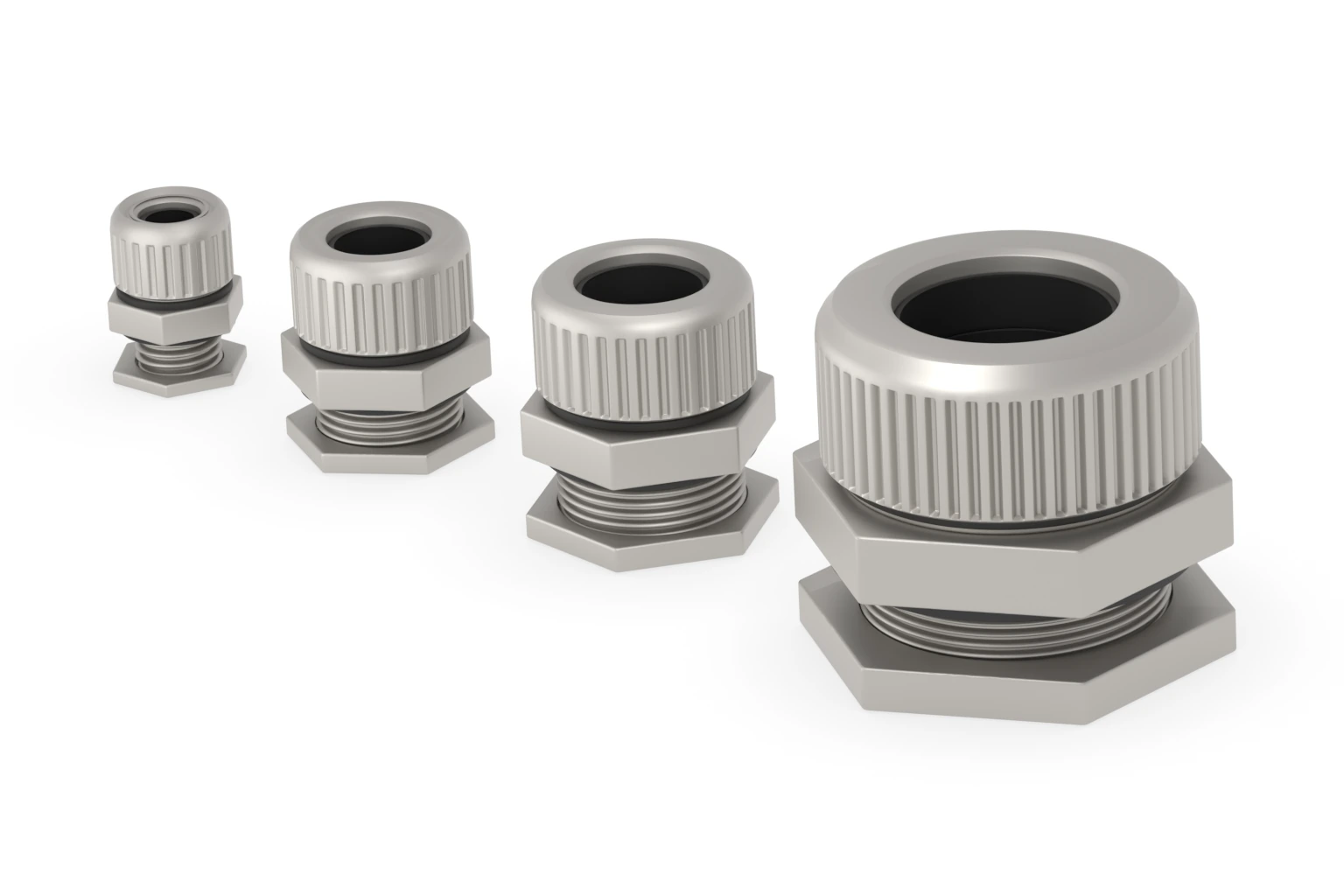
Nickel-plated brass · Metric, PG & NPT
Nickel-Plated Brass Cable Glands
This metal cable gland option uses a nickel-plated brass body with EPDM sealing components. Select it where the project calls for brass, and check any earthing or shielding requirements separately.
- Entry options
- Standard single-hole; metal multi-hole models on enquiry
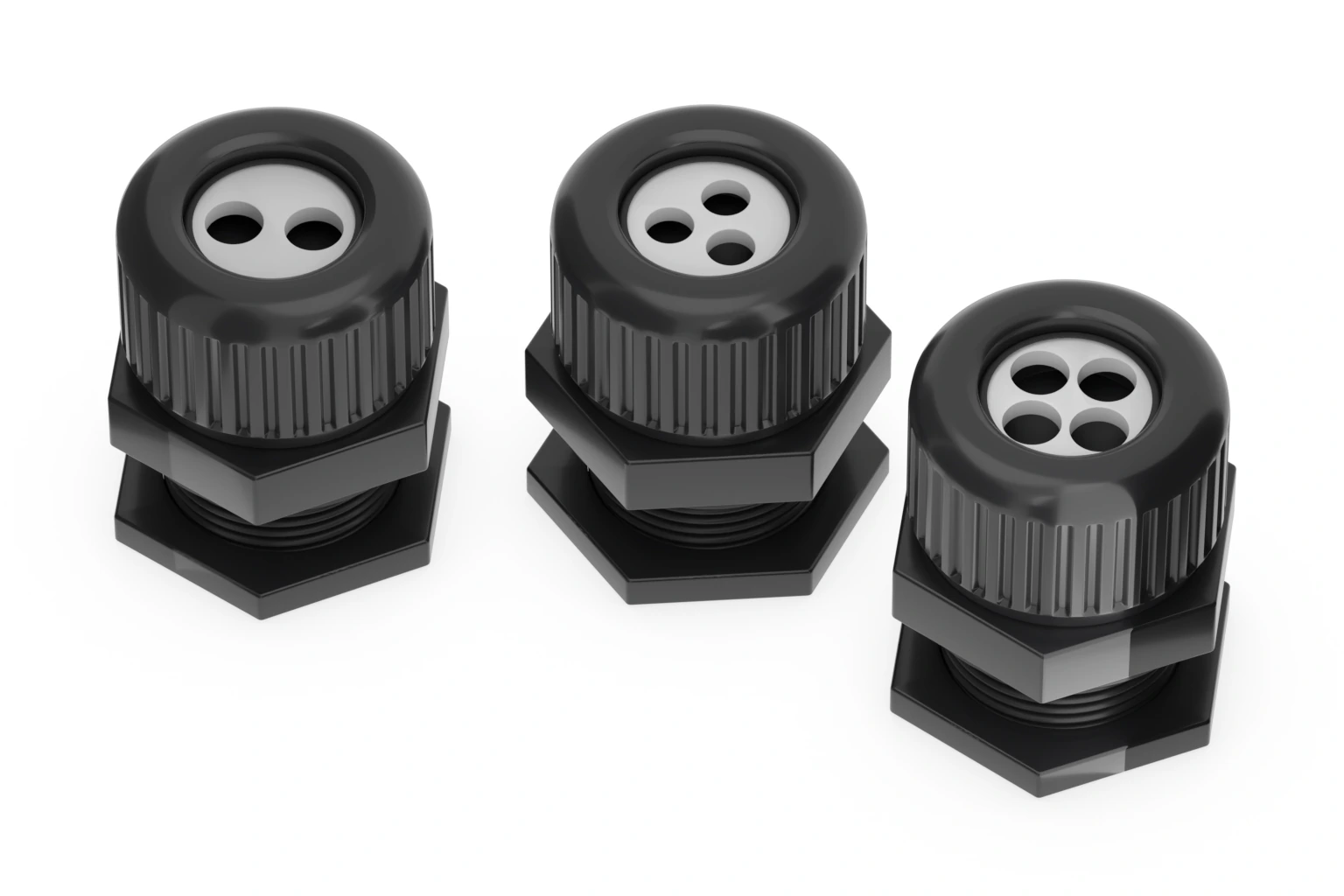
2, 3 & 4-hole inserts · Nylon or metal body
Multi-Hole Cable Glands
Route several cables through one cable gland using a sealing insert with individual holes. Specify the number of cables and the outside diameter of each; metal-bodied versions are subject to model confirmation.
- Send us
- Hole count, each cable diameter and mounting thread
One product, both descriptions. A multi-hole gland still has a body material. It is listed as its own route because it is selected by hole count and by each cable diameter, not by material alone.
Material, thread and entry design are separate specification fields. Available combinations depend on the series. An ordinary gland supplied as separate parts is not a split cable gland.
Before choosing a size
Match the cable, thread and enclosure
Check 01
Cable outside diameter
Use the diameter over the cable jacket. For multi-hole designs, list every cable separately and confirm the matching insert.
Check 02
Mounting thread & depth
State the complete thread designation, plus panel thickness and available mounting space. Metric sizes are written with the pitch, such as M20 × 1.5, and commonly run M12 to M32; PG sizes run PG7 to PG21; NPT is stated as 1/2 NPT or 3/4 NPT. Cable range and thread size are separate dimensions.
Check 03
Application requirements
Include the operating environment and any required IP rating or certification. Confirm the supporting documents for the selected model before ordering.
Size, thread & cable construction
Use the right route for the final selection
Cable gland size chart
Match the cable outside diameter to the model’s clamping range, then check the mounting thread. A gland marked M20 does not automatically fit a 20 mm cable.
Metric, PG and NPT threads
These thread systems are not interchangeable by name. Confirm the complete designation, pitch where applicable, entry hole and usable thread length.
Armoured, SWA and SY cable glands
Armoured cable requires a gland construction selected for the cable and its armour or braided screen, not just a nylon-or-brass body choice. UK projects usually specify SWA or SY cable at this point. Send the cable construction, armour or screen details and entry specification for a model-level check.
For a product-first comparison, browse the nylon, brass and multi-hole ranges. For the underlying function and selection method, read the cable gland guide.
Project enquiry
Send the cable details. We’ll help narrow the options.
Include body material, entry design, cable outside diameter, mounting thread, panel thickness, quantity and destination country. Add any accessories needed, such as locknuts, blanking plugs or thread adaptors.
Pricing, availability and lead time are confirmed for the selected model and order quantity.
Frequently asked questions
Cable gland selection FAQ
Are cable glands, cord grips and cable entry glands the same thing?
These terms often overlap in catalogues. Cable gland is common internationally, while cord grip and strain-relief cable gland appear often in North American searches. The exact construction, sealing performance and approvals can differ, so compare the documented cable range, mounting thread and function for the selected model.
Are nylon, brass and multi-hole three separate routes?
Yes for this Termnex catalogue plan. Nylon and brass are the two main body-material routes, while multi-hole is a dedicated entry-design route that can contain either nylon or nickel-plated brass bodies. Thread, cable range and hole count remain model-level fields.
Does M20 mean the gland fits a 20 mm cable?
No. M20 describes the nominal mounting thread diameter. The cable clamping range is a separate specification and varies by model. Check both the complete thread designation and the cable outside diameter.
Can I use the same gland for armoured, SWA or SY cable?
Do not select an armoured cable gland from body material alone. The gland construction must match the cable and its armour or braided screen, together with the installation requirements. SWA and SY cables are specified this way in the UK. Provide the cable construction and entry details so the exact model can be checked.
Is a gland with removable parts a split cable gland?
No. A conventional gland also has removable parts, such as its cap and locknut. A split design opens around the cable so it can be fitted without feeding the cable end through the assembled gland.
Which cable glands are waterproof, and are IP ratings the same across the range?
Waterproof and watertight describe the sealing function rather than one fixed specification, and no blanket rating is applied to this range. State the IP rating the installation requires, IP66 or IP68 for example, and any separately certified construction such as ATEX or explosion-proof, then confirm the selected model’s documentation and installation conditions before ordering.
Do you supply cable gland accessories such as blanking plugs, reducers and locknuts?
Entry hardware is normally specified alongside the gland: locknuts, sealing washers, blanking plugs for unused holes, and thread reducers or adaptors where the panel hole does not match the gland thread. Send the thread designations and hole sizes with the enquiry so availability can be checked item by item.