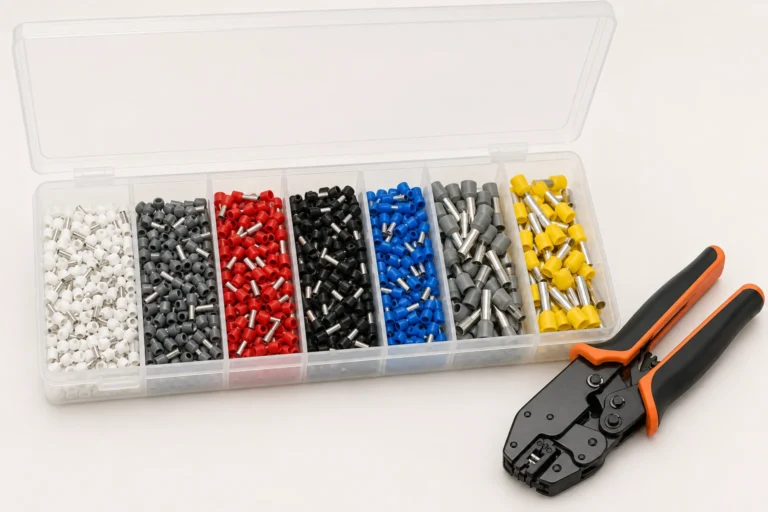

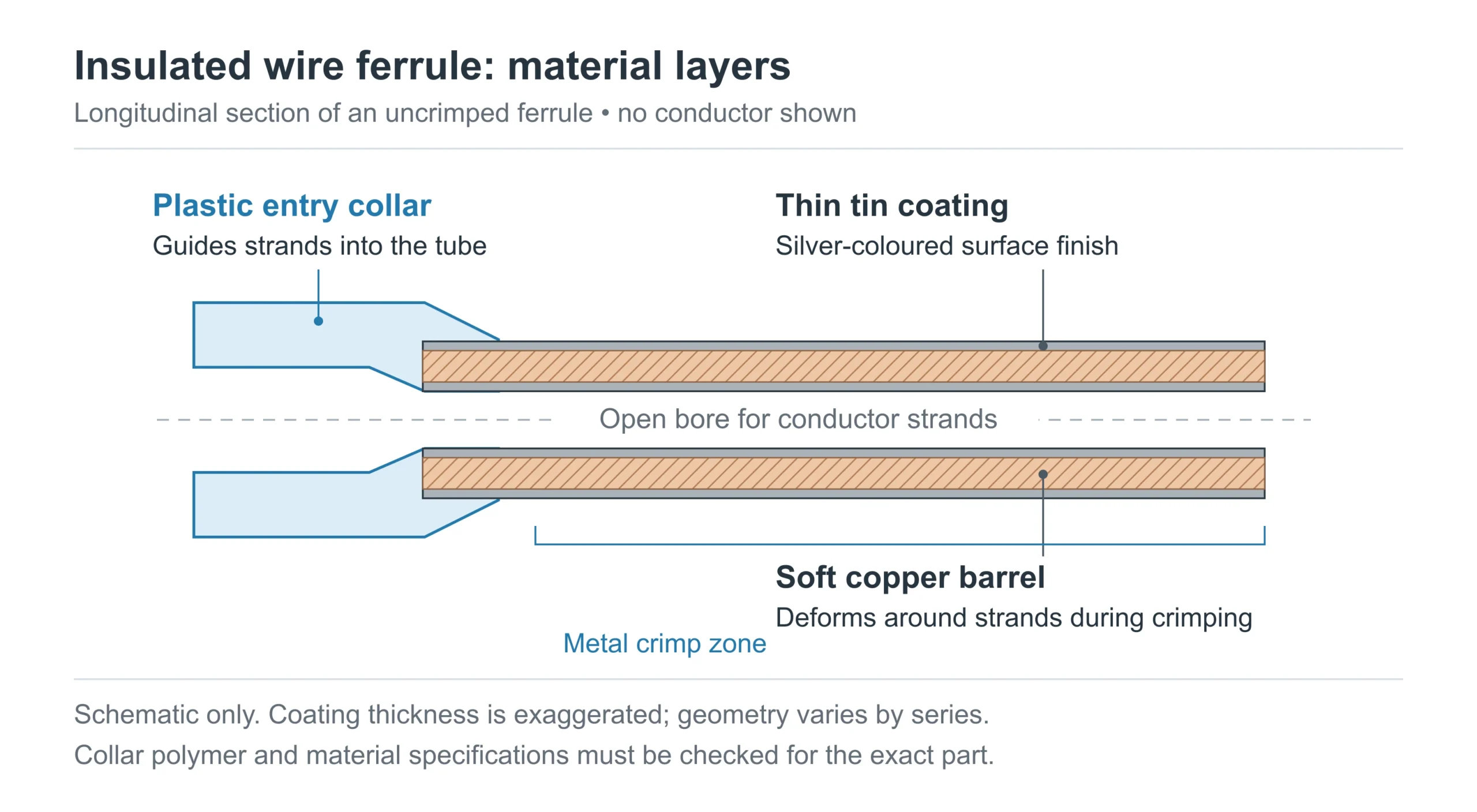
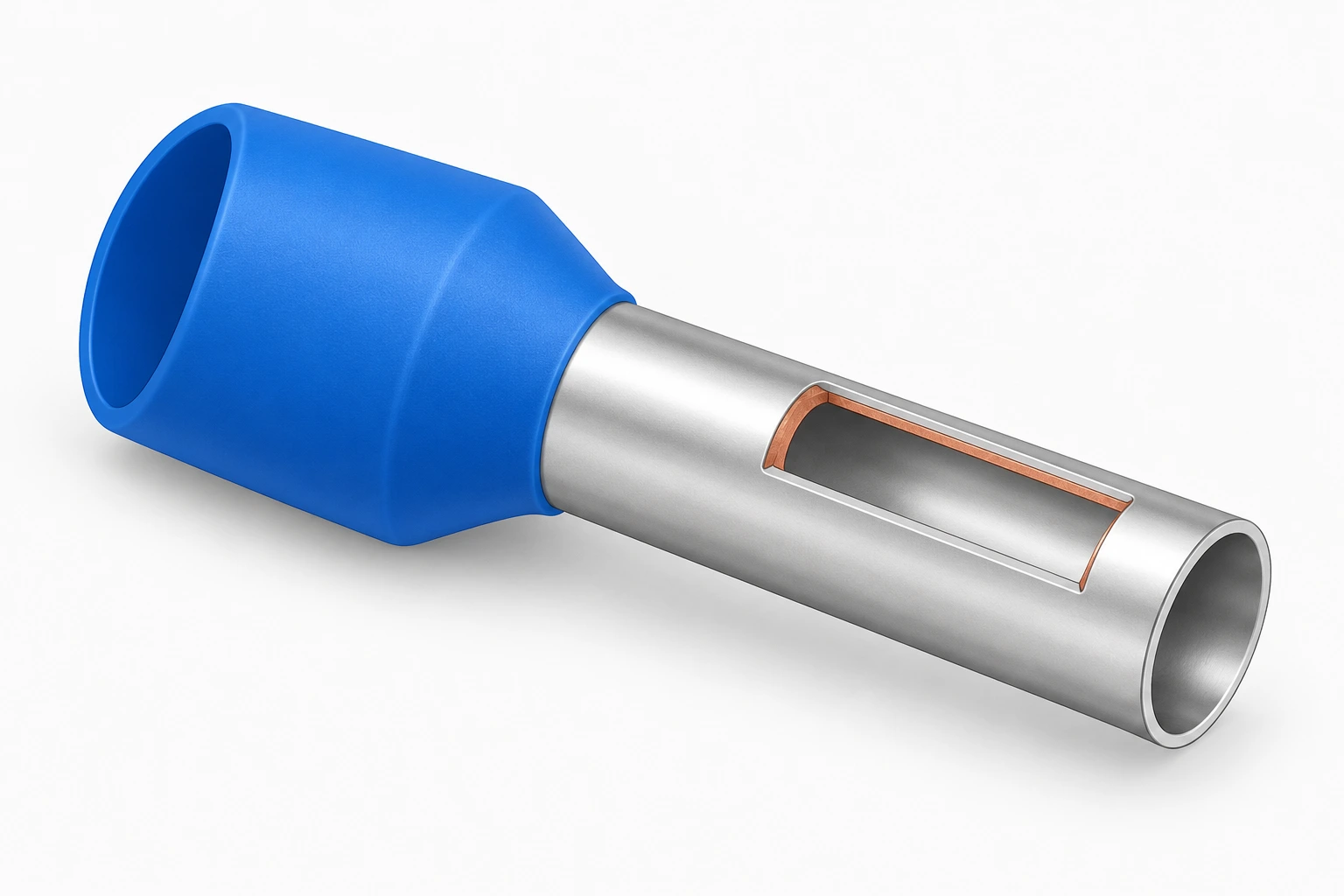
Electrical copper wire ferrules are soft copper tubes with a thin tin coating. The copper carries the current and squeezes down around the strands when you crimp it. The tin keeps the copper from tarnishing, and it is why the barrel looks silver instead of copper-coloured. Insulated ferrules add a plastic collar that guides the strands in and shows the wire size by colour.
What copper wire ferrules are made of
An insulated wire-end ferrule has three parts, each with its own job.
| Part | Common material | What it does |
|---|---|---|
| Barrel | Soft electrolytic copper | Compacts around the strands during crimping and goes into the terminal |
| Coating | Tin, a few micrometres thick | Protects the copper surface and gives the barrel its silver colour |
| Entry collar | Polypropylene or PA66 nylon | Guides strands into the tube and carries the size colour |
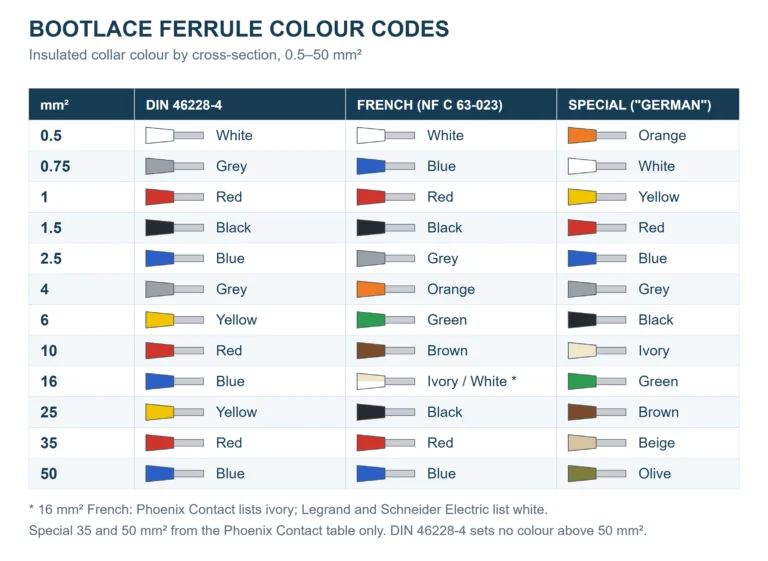
The crimping die only presses the metal barrel. The collar sits over the cable insulation at the entry end, outside the crimp zone, and its colour tells you the conductor size within the maker’s colour code.
Non-insulated copper wire ferrules have no collar, and the barrel is usually still tin-plated copper. So “bare ferrule” in a catalogue normally means no collar, not uncoated copper.
Why copper wire ferrules need a soft barrel
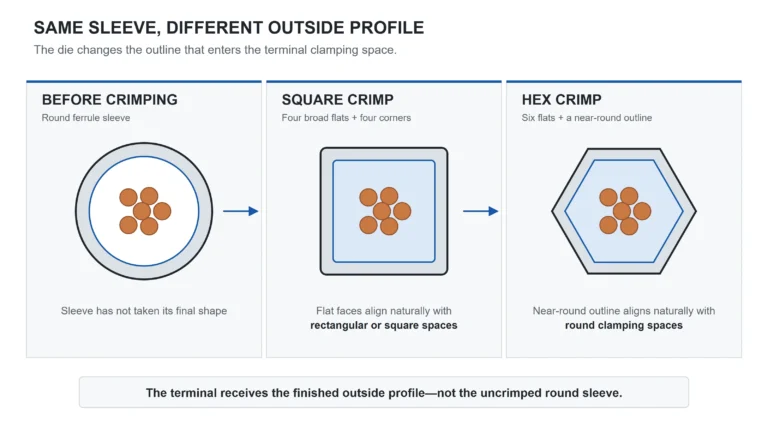
A ferrule has two jobs: carry current, and survive being crushed. During crimping, the thin tube is pressed around the strands and stays in that shape for the life of the connection.
Copper does both well. Its conductivity is close to the 100% IACS reference, about three to four times that of brass. It is also ductile, meaning it bends and flows without cracking. After crimping, the barrel holds the strands together as one solid pin, and the terminal clamps on the outside of it.
That ductility depends on how the copper was processed. Drawing copper into thin tube work-hardens it. Annealing, a controlled heat treatment, makes it soft again, and ferrule barrels are annealed for that reason. A barrel left too hard can crack at the corners of a square or hex crimp. Cracks also come from the wrong ferrule size or a worn die, so check those two before blaming the material.
Ferrule makers usually specify the barrel as soft, tin-plated electrolytic copper, often written E-Cu. Read a datasheet the same way: base metal first, then the finish.
Why copper wire ferrules are tin-plated
Bare copper tarnishes. In air it grows an oxide film, and in damp or polluted air it goes dark with oxides and sulphides. That film raises contact resistance where the terminal clamp presses on the ferrule. Tin plating covers the copper so the surface stays clean in storage and in the panel.
Tin oxidises too, but its oxide film is thin and brittle, and tin itself is soft. When a screw or spring clamp bears down, the film cracks and the clamp reaches clean metal. That gives a low, stable contact resistance. It is the same reason crimp lugs and terminal clamps are usually tin-plated.
The tin layer is only a few micrometres thick, so the copper underneath still does the conducting and the deforming. Plating cannot rescue a bad crimp, though. A ferrule one size too big, or crimped with the wrong die, will still close loosely around the strands. The guide to correct ferrule crimping covers sizing and tooling.
If your drawing calls for a minimum plating thickness, put it on the purchase order with the test method. Catalogues vary: some state a thickness, many just say “tin-plated”.
What the silver finish does not prove
Tin-plated copper, tin-plated brass and tin-plated steel all look the same from the outside. The colour tells you about the surface and nothing about the metal underneath.
Product names add to the confusion, because several industries use the word ferrule:
| Description | What it usually means |
|---|---|
| Tinned copper or tin-plated copper wire-end ferrule | Copper barrel, tin finish. This is the standard electrical part. |
| Bare or non-insulated ferrule | No plastic collar. The barrel is normally still tin-plated. |
| Bare copper ferrule | Either uncoated copper or a loose name for a non-insulated part. Ask which. |
| Brass or aluminium ferrule | Often a hose fitting, wire-rope sleeve or other mechanical part, not a wire-end ferrule. |
A steel wire-rope sleeve and a wire-end ferrule look alike in a parts bin, but the rope sleeve is made for swaging steel cable and has no place in a terminal block.
You can check a sample yourself in a minute. A magnet catches steel. Then scrape or file the edge of the barrel: pink metal under the silver means copper, yellow means brass, and grey-white all the way through means aluminium. That settles the base metal. Copper grade and plating thickness need a lab.
How to verify copper wire ferrule material before buying
For copper wire ferrules, start with the datasheet for the exact series. Three fields answer the material question: barrel material, plating and collar polymer. A proper datasheet lists all three; if one is missing, ask for it.
Then check the rest of the order:
- Conductor cross-section, and whether it is a single or twin ferrule.
- Pin length, with a drawing if terminal fit is tight.
- The dimensional standard, such as DIN 46228, and any listing the quoted model has to carry.
- Plating thickness or material test reports, if your specification calls for them.
Material and fit are separate checks. The wire ferrule size chart covers cross-section and length.
Know what each document proves. A material safety data sheet lists the declared materials and their hazards. A RoHS report covers restricted substances such as lead and cadmium. Dimensions, crimp performance and certifications each need their own document, so ask for the one that matches the requirement you have to meet.
If material is disputed or a contract requires proof, send samples for testing. Handheld XRF mostly reads the tin surface, so the lab needs a cut cross-section to measure the copper base and the plating thickness separately.
Termnex wire ferrules use tin-plated copper barrels, and the insulated series uses PA66 nylon collars.
Specify the material with the ferrule size
When you request copper wire ferrules, list the barrel and plating requirement alongside the conductor sizes, pin lengths and single or twin configuration. Add quantity, destination and any standard or certification you need. Termnex will match the models to your list and send the material documents that come with them. Contact us.