
A square vs hex ferrule crimp is not a contest with one permanent winner. The useful question is whether the finished crimped shape fits the terminal’s clamping space. Square profiles naturally suit rectangular openings; hex profiles naturally suit round ones. In many terminals either works. The difference becomes important when clearance is tight, especially at the terminal’s maximum accepted conductor size.
Square vs hex ferrule crimp: the quick answer
Start with the terminal manufacturer’s instructions. If the datasheet names a ferrule, tool system or crimp profile, use it. A general comparison cannot overrule a specification for the connection in front of you.
If no profile is stated, use the clamping-space geometry as the next filter:
| Terminal clamping space | Profile likely to fit naturally | What to verify |
|---|---|---|
| Rectangular or square | Square | The terminal accepts the ferrule type and conductor size after crimping |
| Round drilled opening | Hex | The finished ferrule fits the bore at the selected cross-section |
| Conductor-centred round space | Hex | The terminal maker permits ferrules and does not specify its own tooling system |
| Opening not shown in the datasheet | Neither by assumption | Ask the terminal manufacturer or obtain the internal dimensions |
The square vs hex ferrule crimp choice is a fit rule, not a strength ranking. Four flats do not automatically make a crimp weaker, and six flats do not automatically make it stronger. Those claims need comparative testing on the ferrule, conductor, tool and terminal combination. Face count alone does not supply the answer.
The terminal sees the crimped shape, not the die label
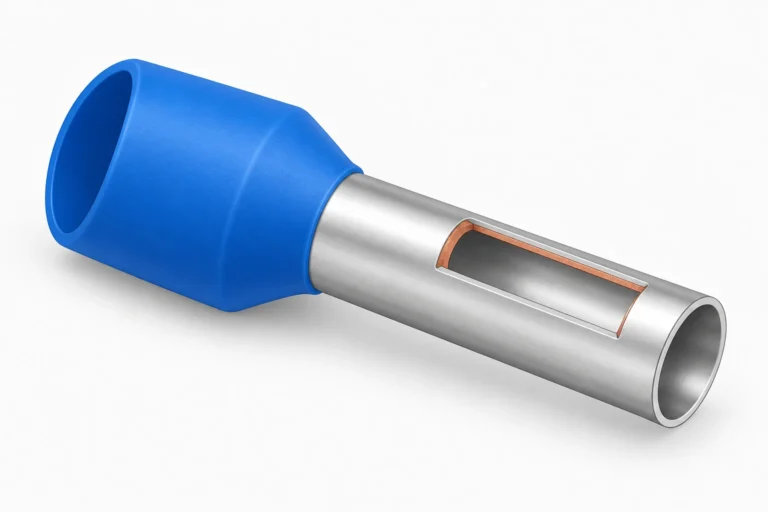
A square vs hex ferrule crimp comparison starts with the same round metal sleeve. The die closes that sleeve around the conductor and gives its outside surface a new outline. A square four-indent tool leaves four broad flats and four corners. A hexagonal die leaves six narrower flats and a shape closer to a circle.
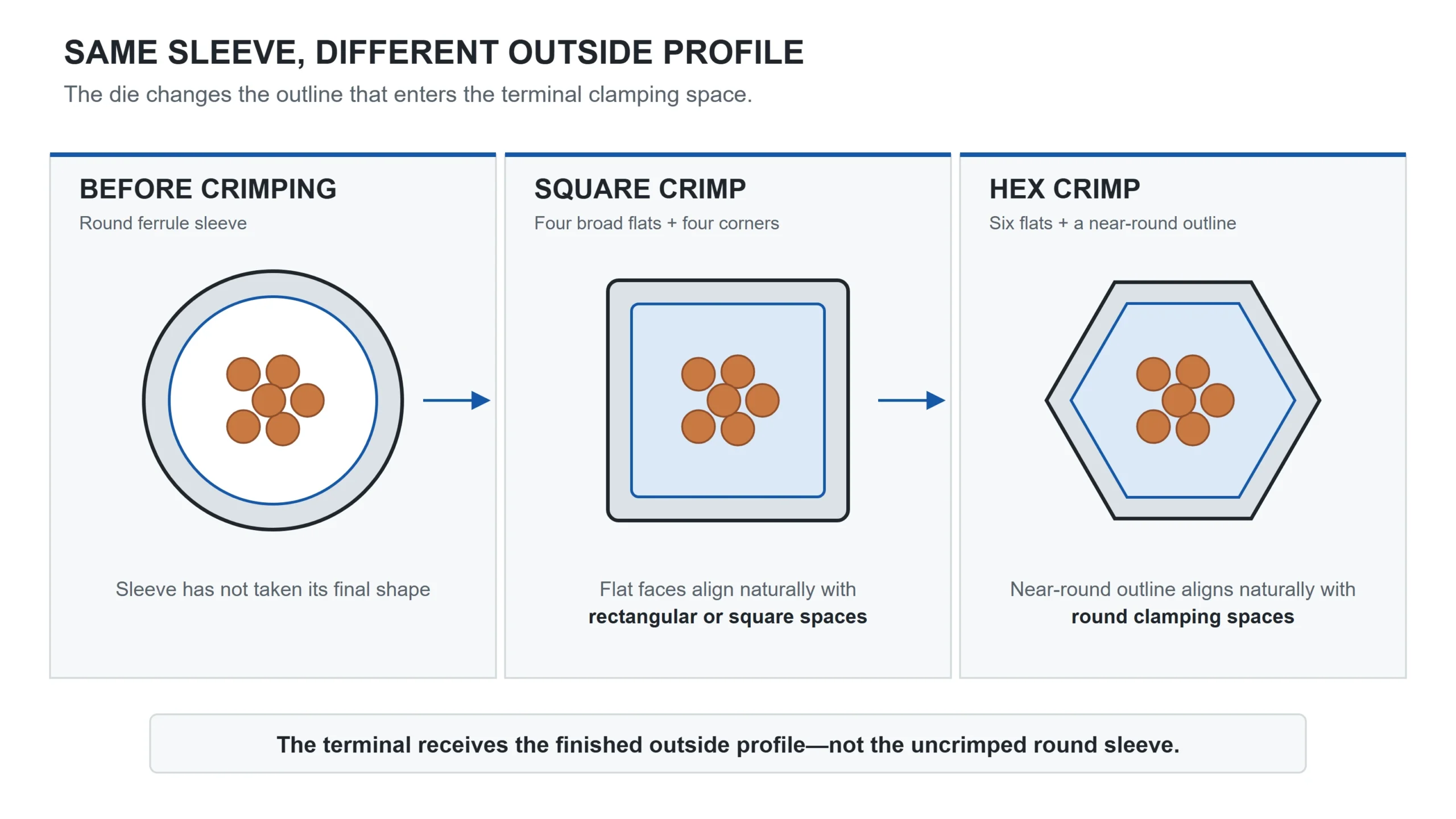
The terminal receives that finished outline. It does not care how a tool was marketed, how many sizes came in the kit or which profile looks neater on the bench. It cares whether the crimped ferrule can enter the intended space and sit where the connection was designed to clamp it.
Conductor size and crimp profile therefore answer different questions. Cross-section selects the ferrule bore and the tool range. Profile changes the outside shape. A tool can cover the correct square-millimetre range and still produce an awkward fit for a particular terminal geometry.
The comparison stops at that selection decision. Stripping, operating the tool and checking the finished crimp are covered in the ferrule crimping guide.
When a square crimp is the better fit
For a square vs hex ferrule crimp choice involving a rectangular clamping space, square is the natural starting point. Its flat faces use the available width and height in the same directions as the opening, which is why square four-indent tools are common in control-panel work.
Look for three signals:
- The terminal drawing shows a rectangular or square conductor space.
- The terminal maker’s accessory or preparation data shows a square-crimped ferrule.
- The specified tool or die produces a square profile for the conductor range you are using.
Do not convert that into “square fits every DIN-rail terminal.” Terminal mechanism and opening shape are separate properties. A screw connection may use a round, rectangular or otherwise shaped conductor space; a spring connection is no guarantee of a square opening either. The drawing or manufacturer instruction settles the point, not the terminal-family label.
Square also is not a licence to ignore size. The crimped ferrule still has to fall inside the terminal’s permitted ferruled-conductor range. A terminal rating for bare stranded wire does not automatically prove it accepts the same maximum cross-section with a ferrule added.
When a hex crimp is the better fit
In a round clamping space, the square vs hex ferrule crimp choice often favours hex. Six flats produce an outline closer to the circle of a drilled bore, so the profile can use a round opening without the four pronounced corners of a square crimp.
Typical examples include round holes in distribution blocks and screw terminals that centre the conductor inside a circular space. The same three checks still apply: confirm that the terminal accepts ferrules, that the conductor size is permitted with a ferrule, and that the tool maker supports the sleeve type and range.
What hex does not prove is equally important. It does not prove a higher pull-out force, lower electrical resistance, better vibration performance or a more gas-tight connection. Any of those comparisons would need matched samples and a controlled test. A six-sided result can be the better geometric fit and still be a poor crimp if the ferrule, conductor or die range is wrong.
Nor does a terminal block reject hex merely because square tools are common in panel shops. If the terminal manufacturer permits the ferrule and the finished profile fits its clamping space, a hex crimp can be acceptable. Check the actual connection rather than applying a workshop habit as a universal rule.
Why the maximum conductor size changes the answer
At smaller cross-sections, the square vs hex ferrule crimp difference can disappear into spare clearance. Two technicians can use different tools on similar-looking connections and both report that their ferrules fit. Their experience may be accurate without establishing a rule for the whole terminal range.
The situation changes near the maximum cross-section accepted by the terminal. Clearance is now smallest. In a round space, the corners of a square profile may meet the wall even when the ferrule and terminal carry the same nominal conductor-size marking. A near-round hex profile may pass because its outside outline follows the available space more closely.
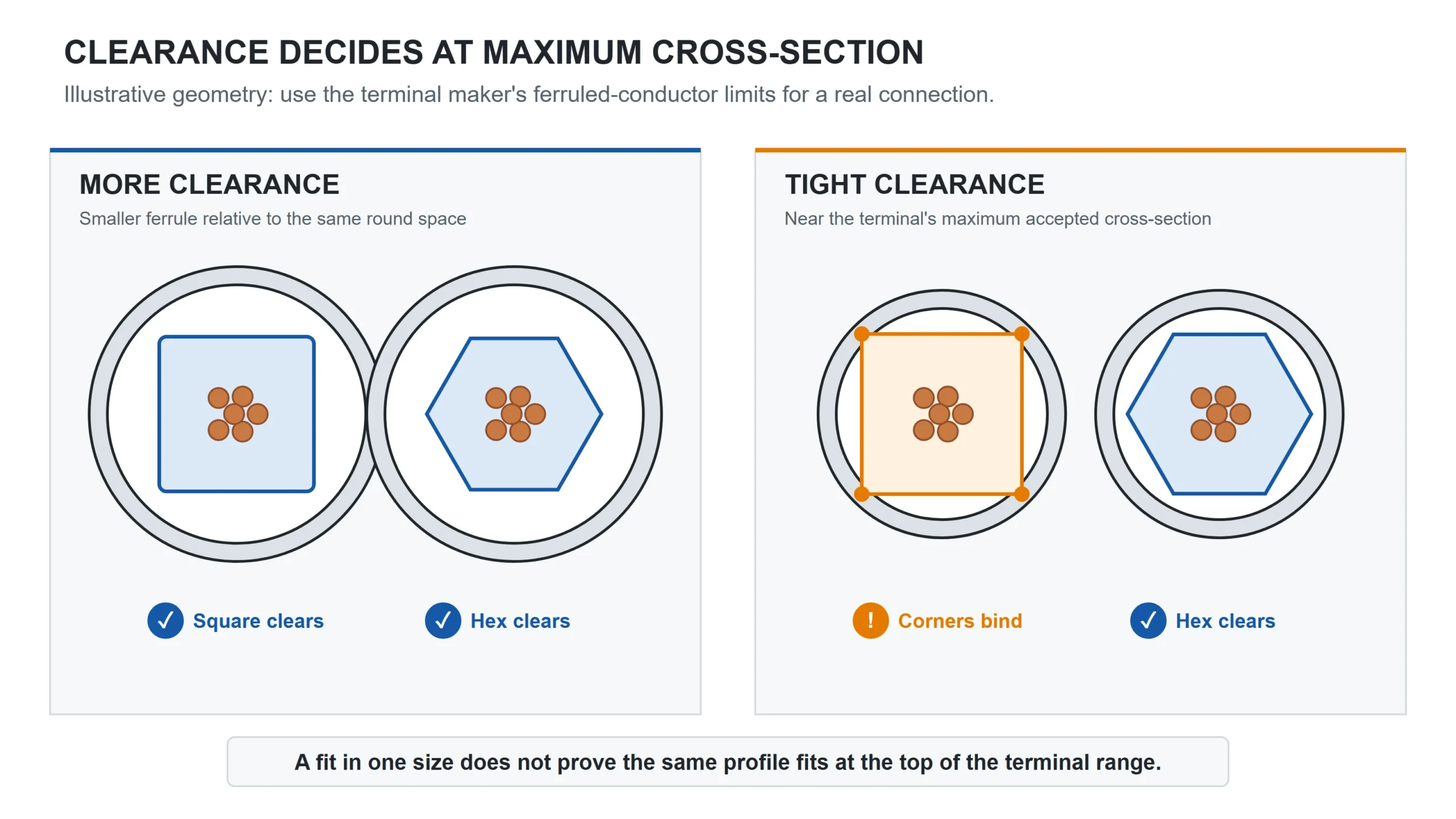
That does not mean a hex crimp always rescues an oversized combination. Nominal cross-section is not an insertion-diameter guarantee, and terminal data may list different limits for bare, ferruled and solid conductors. Use this sequence:
- Confirm that the terminal permits a ferrule on the conductor class.
- Read the permitted cross-section for a ferruled conductor, not only the headline conductor range.
- Follow a stated ferrule, die or tool requirement where one exists.
- If the terminal is being used at its upper limit and the internal shape is unclear, obtain confirmation before ordering the tool or production quantity.
The last step is not overcautious. One unanswered geometry question is cheap; repeating a poor fit across a panel or harness batch is not.
Profile is only one part of choosing the crimper
A sound square vs hex ferrule crimp decision still leaves five checks before a tool belongs on the job:
- Ferrule type. Confirm that the die is intended for wire ferrules rather than cable lugs, open-barrel terminals or insulated pre-insulated terminals.
- Conductor range. The smallest and largest ferrules in the job must fall inside the tool maker’s stated range.
- Terminal requirement. A manufacturer-specified tool or die system takes priority over a general-purpose crimper.
- Cycle control. For a ratchet tool, check how the full cycle and emergency release work rather than treating “ratchet” as a quality grade by itself.
- Production needs. Throughput, changeover, calibration or inspection requirements can matter more than whether a hand tool has four or six indenters.
The broader differences between ratchet, fixed-die, interchangeable-die and powered systems are covered in the guide to crimping tool types and uses.
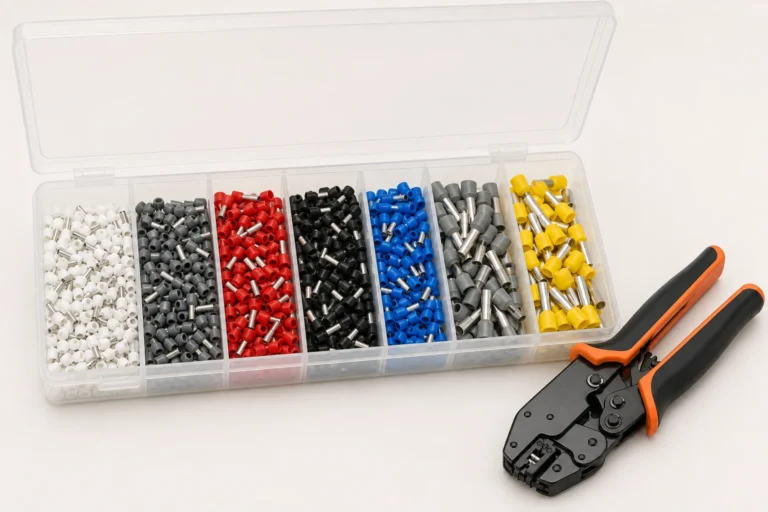
Termnex currently lists square four-indent ferrule tools in two manufacturer-rated ranges: 0.25–6 mm² and 6–35 mm². Those ratings identify the stated capacity; they are not a blanket compatibility claim for every terminal in that range. See the ferrule crimping tools page when a square profile is the confirmed choice.
FAQ
These square vs hex ferrule crimp questions cover the points that remain after terminal geometry and tool range are settled.
Does DIN 46228 require a square or hex crimp?
No. DIN 46228 describes wire ferrules and their dimensional system; it is not a rule that selects a square or hex die for every connection. Crimp profile is chosen from the ferrule, tool and terminal requirements, with the terminal’s clamping space deciding fit.
Can a hex-crimped ferrule go into a terminal block?
Yes, when the terminal accepts ferrules of that size and the finished hex profile fits its clamping space. “Terminal block” covers many internal geometries, so the product family name alone cannot approve or reject the profile.
Is a square or hex ferrule crimp stronger?
Neither can be declared stronger from its shape alone. Pull-out force and connection performance depend on the conductor, ferrule, die dimensions, tool condition and completed crimp. Choose profile for compatibility unless a controlled comparison or the connection specification gives you another reason.
Do I need a different ferrule for a hex crimper?
Not simply because the die is hexagonal. Many ferrule sleeves are formed into the required outside profile during crimping. The ferrule type and cross-section must still be inside the tool manufacturer’s approved range, and any ferrule-specific tooling instruction takes priority.
Match the crimper to the terminal before ordering
To settle a square vs hex ferrule crimp choice, send the conductor cross-section, ferrule type, terminal manufacturer and model, and the tool range you need. A terminal drawing that shows the conductor space is even better. Termnex can then match the ferrule and square-profile tool range without pretending one crimp shape fits every connection. Contact us.