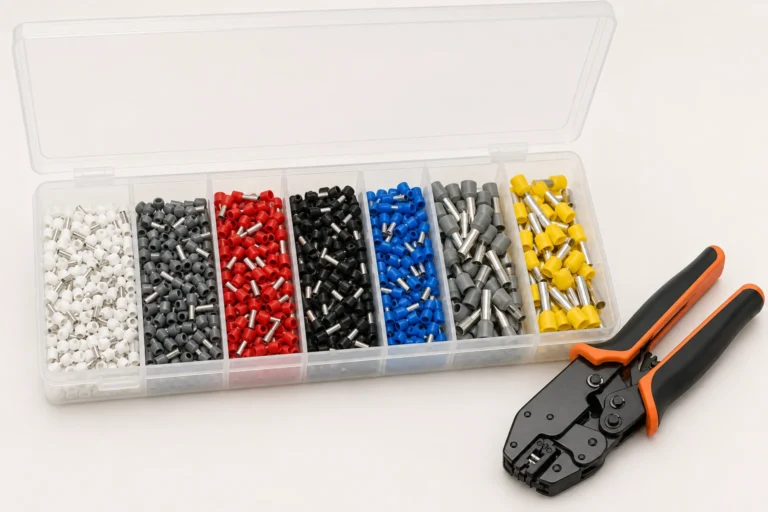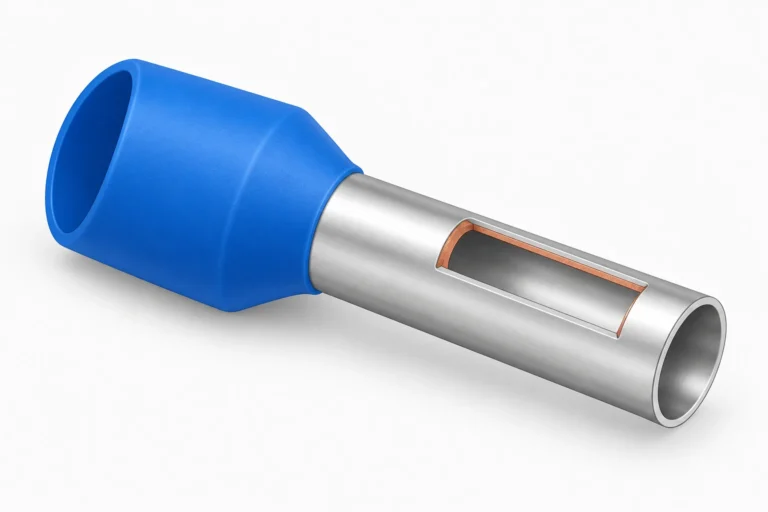

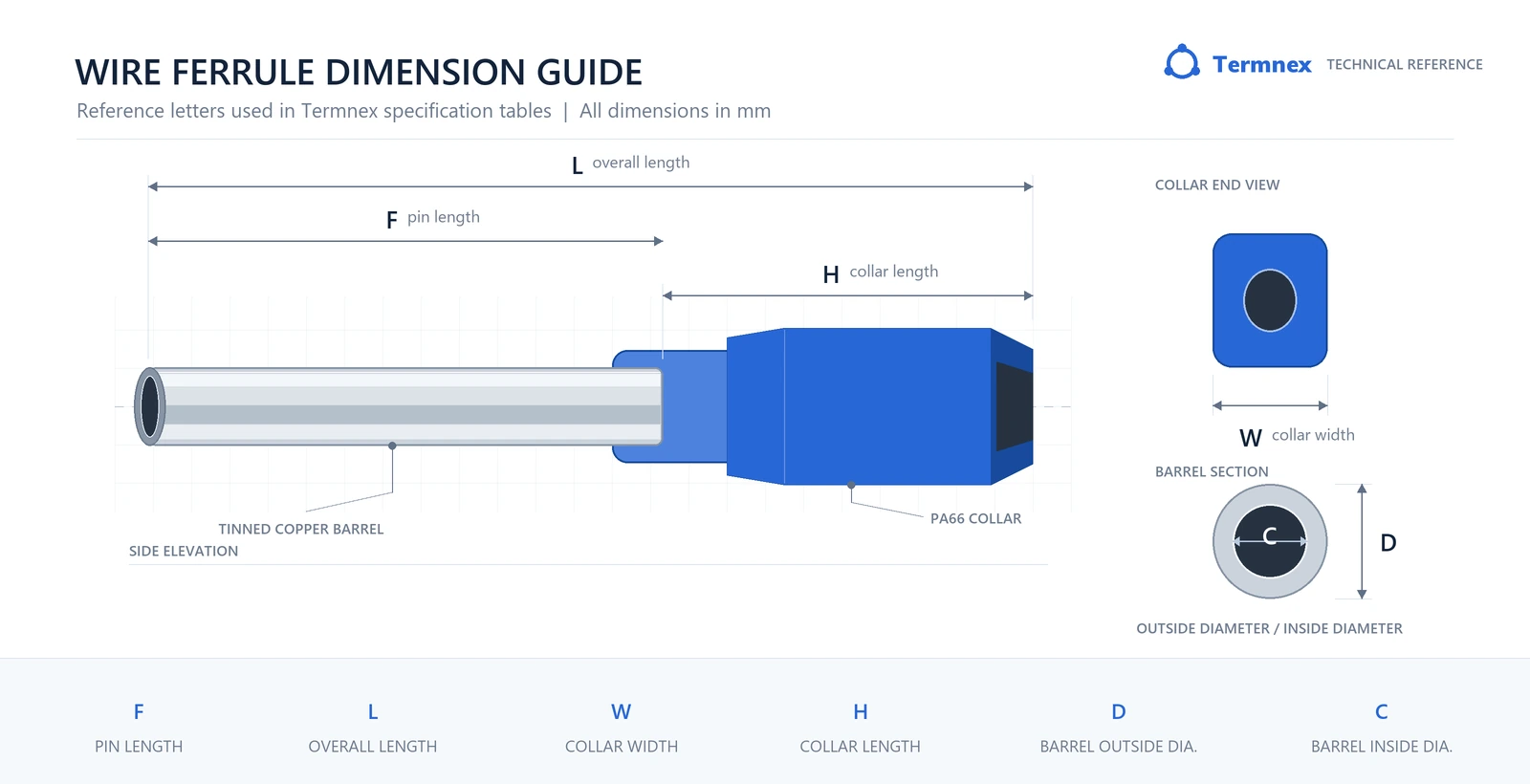
Ferrule pin length is the length of the exposed metal sleeve, measured from the collar face to the pin nose. Choose it from the terminal, not the wire: if the terminal states a stripping length, pick the ferrule whose pin length matches it. Wire size only sets the bore, and every common cross-section is made in several pin lengths. Datasheets quote both pin length and overall length, so check which one you are reading.
Start with what the terminal manufacturer requires
The terminal sets the ferrule pin length. Its stripping length tells you how much bare conductor it expects to take in, and many terminals print that figure on the housing. With a ferrule, the metal pin goes into the terminal in place of the bare strands, while the collar stays outside. So the pin should match the stripping length. WAGO’s instructions say the same thing: the ferrule length must correspond to the specified strip length.
Wire size has already done its job by this point: it chose the bore. It says nothing about how deep the terminal wants the pin to go. Wire ferrule, bootlace ferrule and cord end terminal are three names for the same part, and the rule is the same for all of them.
You will meet one of three situations:
- The terminal names a ferrule. Some datasheets list an acceptable ferrule length or a specific ferrule range next to the conductor range. Use it.
- The terminal gives a stripping length. Pick the ferrule with the matching pin length. A terminal that says 10 mm takes a 10 mm pin. If your range has no exact match, ask the terminal maker which neighbouring length it accepts.
- Neither is published. Ask the terminal maker for the stripping length or a recommended ferrule. Measuring the entry opening will not tell you where the clamp sits behind it, so one email is the reliable route. You will buy these by the thousand, so it is worth asking once.
Check that the terminal accepts ferrules at all, and at which cross-sections. That varies between terminal families, even from the same manufacturer, so a length that worked on the last panel is not automatically right for the next one.
Catalogue rules like “use 8 mm for small conductors” describe what many panels use. 8 mm and 10 mm pins do cover most DIN-rail terminal blocks, but the stripping length of the terminal you are wiring is the number that decides it.
What goes wrong when the ferrule pin length is wrong
The two mistakes fail in different ways.
A pin that is too long sticks out of the terminal. Bare metal is left exposed in front of the terminal face, where the insulation should be, and that live metal can be touched or can reduce the spacing to the next terminal.
A pin that is too short does not reach the full clamping zone. The clamp may grip only the tip of the pin, or bear on the collar, and the connection is not reliably tight.
How each shows up depends on the terminal’s design, but both are avoided the same way: match the pin length to the terminal’s stated requirement before you order.
Why one conductor size comes in several pin lengths
Six Termnex parts are catalogued for a 1.5 mm² conductor. They share the same bore and collar geometry. Only the pin length changes.
| Part | Pin length | Overall length |
|---|---|---|
| HE1506 | 6 mm | 12.3 mm |
| HE1508 | 8 mm | 14.5 mm |
| HE1510 | 10 mm | 16.5 mm |
| HE1512 | 12 mm | 18.5 mm |
| HE1515 | 15 mm | 21.5 mm |
| HE1518 | 18 mm | 24.5 mm |
The Termnex reference chart lists 8, 10, 12 and 18 mm for 1.5 mm²; the catalogue adds 6 mm and 15 mm. If a length is missing from the chart, check the 1.5 mm² bootlace ferrule page before assuming it is unavailable.
Three dimensions decide whether a ferrule fits, and the wire size sets only one of them:
- Bore has to take the stripped conductor. Cross-section fixes it.
- Collar outside diameter has to pass the terminal entry. Check it separately.
- Pin length has to suit the terminal’s clamping depth.
In the table above, the first two stay the same and only pin length changes. Choosing by wire size alone picks one of the six rows at random, and the catalogue gives no warning, because all six are listed for the same 1.5 mm² conductor.
So the order of work is:
- Read the terminal’s stripping length or ferrule requirement.
- Use the conductor cross-section to choose the bore.
- Check the collar diameter against the terminal entry.
- Pick the pin length that matches the terminal, then follow the ferrule crimping guide for wire preparation and crimping.
When it is not the pin length
A ferrule that will not seat is often blamed on length because changing length is the easiest thing to try. Check these first:
| Symptom | Likely cause | Next check |
|---|---|---|
| Ferrule will not enter the terminal at all | A ferrule adds diameter, so a terminal’s maximum size with a ferrule is smaller than with bare wire. An insulated collar can reduce it further by stopping full insertion. | The terminal’s conductor range for ferruled conductors |
| A correctly sized ferrule binds after crimping | Crimp shape against clamping space. At the top of a terminal’s range, a square crimp may not fit a round clamping space. | Die profile on the crimping tool |
| Conductor will not take a ferrule cleanly | Solid single-strand wire. Ferrules are made for stranded conductors. | Conductor class on the cable specification |
| Collar will not pass the terminal face | Collar outside diameter too large for the terminal entry | Collar dimension on the ferrule drawing |
| Ferrule is loose on the conductor | Wrong cross-section, not wrong length | The conductor’s marked size against the wire ferrule size guide |
Work through them in that order. Cross-section and conductor class come from the cable, collar size from the ferrule drawing, crimp shape from the tool. Pin length depends on terminal data, so change it last.
Nominal cross-section is defined by electrical resistance, not measured diameter. Two conductors marked 1.5 mm² can differ slightly in size and sit differently in the same bore, which is another reason to rule out the conductor before blaming the length.
FAQ
What is the standard ferrule pin length?
There is no single standard length. Each cross-section is made in several pin lengths, and the terminal’s stripping length decides which one you need. For 1.5 mm², the Termnex catalogue runs from 6 mm to 18 mm.
How do you measure ferrule pin length?
Measure the metal sleeve from the collar face to the pin nose. Overall length is longer because it includes the collar. Suppliers label these dimensions differently, so read the drawing. The wire ferrule size chart explains the dimension letters.
Should ferrule pin length match the strip length?
Match the pin length to the terminal’s stated stripping length. The insulation you strip off the wire before crimping is a different number: for an insulated ferrule it is a little longer than the pin, because part of the conductor sits inside the collar. Follow the ferrule maker’s stripping instruction for that one.
Is a 10 mm ferrule better than an 8 mm ferrule?
Neither is better. They suit different terminals: a terminal with a 10 mm stripping length takes the 10 mm pin, and one with 8 mm takes the 8 mm pin. A 10 mm pin in an 8 mm terminal leaves bare metal outside the terminal face.
Does wire gauge determine ferrule pin length?
No. Wire gauge sets the bore, which is why a 1.5 mm² ferrule will not take a 2.5 mm² conductor. Each bore comes in several pin lengths, and the terminal decides between them.
Does bootlace ferrule pin length mean the same thing?
Yes. Bootlace ferrule is the usual UK name for the same part, and pin length is measured the same way.
Ordering once the terminal has answered
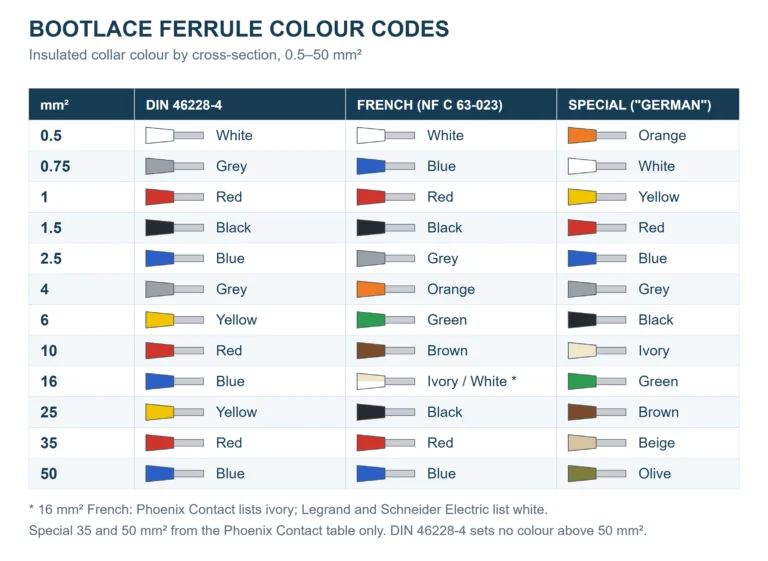
An order needs two numbers: the conductor cross-section and the ferrule pin length the terminal calls for. The Termnex wire ferrule range covers insulated, twin and non-insulated ferrules, with several pin lengths at common sizes. Send both figures, plus the colour code your drawing uses, and we will match the part numbers. Contact us.