
A waterproof cable gland keeps water out up to its IP rating, so choose the rating by how water will reach the entry. IP66 covers rain and powerful hose jets, IP68 covers continuous immersion at a pressure and time the maker has to state, and IP69K covers hot, high-pressure washdown. An IP68 cable gland has not necessarily been tested against jets, so a gland that faces both hosing and immersion needs both codes, written IP66/IP68. Whichever code you choose, it only holds when the seal suits the cable, the cable sits inside the gland’s clamping range, and the gland is sealed to the enclosure and tightened the way its maker specifies.
How a cable gland keeps water out
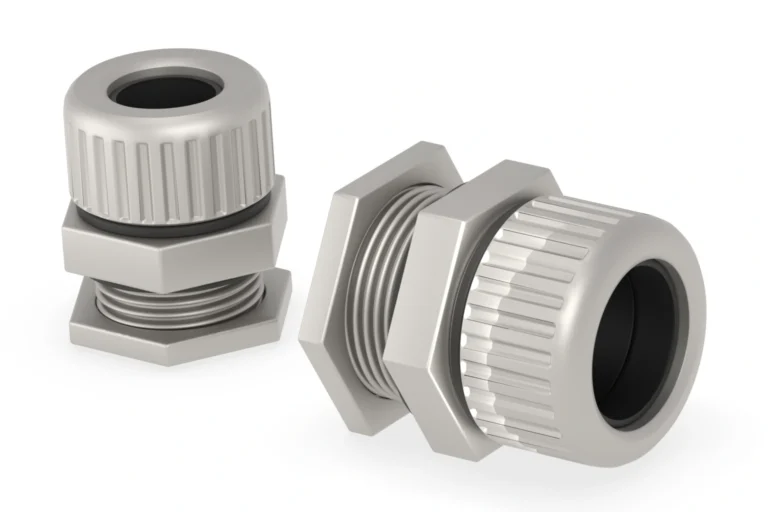
An ordinary compression gland, the kind fitted to most control panels and junction boxes, has four places where water can get past once it is in an enclosure wall. The gland closes three of them.
- Between the cable sheath and the gland. The dome nut squeezes a rubber seal insert around the sheath. This is the main seal and the one the IP rating is mostly about.
- Between the gland body and the enclosure face. An O-ring or flat sealing washer under the body closes this gap when the locknut or the tapped thread pulls the body tight against the wall.
- Along the entry thread. A parallel metric or PG thread relies on the face seal. A tapered NPT thread screwed into a tapped hub seals on the thread itself.
- Inside the cable. Water that gets into the cable somewhere else can run along the conductors, under the sheath and straight through the gland into the box.
A compression gland grips only the outside of the sheath, so it has no effect on water travelling inside the cable. Barrier glands, filled with a setting compound around the individual cores, do close that path; they are used mainly on hazardous-area equipment. On ordinary installations, the answer is to keep water out of the cable at its other end. The parts of a cable gland explains how the taper in the dome nut closes the seal insert, if you want the mechanism in more detail.

Which IP rating your installation needs
Start from the water the gland will actually see. The table gives a sensible rating for common locations; the next section explains what each code tests.
| Installation | Water at the entry | Rating to ask for |
|---|---|---|
| Indoor cabinet in a dry room | Dust, the odd drip | IP54 or IP65; any sealed gland meets this |
| Outdoor wall box, rooftop, solar combiner box | Rain, wind-driven rain, hose cleaning | IP66 |
| Ground-level box, pit or trench that can flood | Rain plus short immersion | IP66/IP67, or IP66/IP68 rated for the flood depth |
| Pump, fountain, pool light, anything permanently under water | Continuous immersion | IP68 rated for continuous immersion at the working depth |
| Food and beverage plant, washdown area | Hot high-pressure cleaning, cleaning chemicals | IP66/IP69K, adding IP68 if the equipment can also stand in water |
| Ship deck, offshore platform | Spray, waves, hose-down | IP66, or IP66/IP68 where water can stand over the entry |
Salt water is a material question more than a rating question, and the section on nylon and brass below deals with it.
Two rules sit on top of the table. Where a gland faces both jets and immersion, ask for both codes, because a single IP68 does not cover jets. And the gland has to match each kind of protection the enclosure claims, whatever the digits say: an IP66 enclosure needs glands tested against jets, and an IP68-only gland has not shown that, even though 8 is the bigger number.
In North America, enclosures are rated by NEMA type: Type 4X covers hose-directed water and corrosion, and Type 6P covers prolonged submersion. When a project calls for a Type 4X or 6P enclosure, choose glands whose own documentation states that they keep that Type rating when installed as instructed. An IP66 or IP68 marking is not enough, because a NEMA type also covers tests the IP code does not, such as corrosion and external icing.
IP66, IP67, IP68 and IP69K: what each one tests
An IP code has two digits. The first is for solids; on a cable gland it is almost always 6, meaning dust-tight, checked by holding the sample under partial vacuum in a cloud of fine dust for up to eight hours. The second digit is for water, and that is where the codes differ.
| Code | Water test | What it suits at a gland |
|---|---|---|
| IP65 | Water jet from a 6.3 mm nozzle, 12.5 l/min, from 2.5–3 m, at least 3 min | Sheltered outdoor equipment, low-pressure hosing |
| IP66 | Water jet from a 12.5 mm nozzle, 100 l/min, from 2.5–3 m, at least 3 min | Driving rain, sea spray, hose-down |
| IP67 | Immersion with the lowest point 1 m below the surface for 30 min | Temporary flooding, standing water |
| IP68 | Continuous immersion under conditions the manufacturer sets, which must be harder than IP67 | Pits, pumps, buried boxes, submerged equipment |
| IP69K | Water at 80 °C and roughly 80–100 bar, from 10–15 cm, at four angles | Food and beverage washdown, vehicle wash bays |
IP65 to IP68 come from IEC 60529. IP69K comes from the road-vehicle standard ISO 20653; IEC 60529 has since added a similar IPX9 test, and gland datasheets list IP69 or IP69K depending on which one the gland was tested to.
Up to the sixth level, each water code includes the ones below it, so an IP66 gland also passes IP65. The immersion codes break that chain. IEC 60529 treats a product marked only IP67 or IP68 as untested against water jets, because sitting under water and being hit by a jet load a seal in different ways. A product that passes both is marked with both, such as IP66/IP68, and a gland for food plants may read IP66/IP68/IP69K. When a datasheet shows a single IP68, assume the gland was tested under water only.
For cable glands, the product standard IEC 62444 uses these same water tests and is strict about the result: the gland passes only if no water has entered. A gland’s IP rating therefore means a dry interior under the test conditions, with the gland fitted and tightened as its maker specifies. It is still a short test on a new gland, which is why the conditions behind an IP68 claim matter.
What “IP68” on a cable gland datasheet means
IP68 has no fixed depth. IEC 60529 only requires the immersion test to be harder than IP67’s 1 m for 30 min and leaves the actual conditions to the manufacturer and the user. Two glands that both say IP68 can have been tested at very different levels.
Gland makers usually state the conditions as a pressure and a time. IP68 – 5 bar (30 min) is a common rating for plastic glands; some metal and high-spec glands go to 10 bar or more. Pressure converts to depth at roughly 1 bar per 10 m of water, so a 5 bar rating is equivalent to about 50 m of water. The test is done with the gland mounted in a plate and tightened onto a test mandrel or cable, normally at the smallest and largest diameters of its clamping range, using the maker’s specified torque. The rating belongs to that set-up.
Some catalogues shorten the rating to forms such as IP68-5 or IP68-10. Ask what the number means. Ten metres and ten bar differ by a factor of ten, and neither tells you the duration.
For a pump pit a couple of metres deep, a 5 bar rating is far more than the water pressure will ever be, and the rating is rarely the weak point. Permanent submersion is a different case, because the test runs for minutes and the installation runs for years. For fountains, pool lighting, borehole pumps and anything else that stays under water, ask the gland supplier these questions before you order:
- the test pressure or depth, and how long it was held;
- whether the gland is rated for continuous immersion at your depth, beyond the short type test;
- which cable diameters the test covered;
- whether the result comes from a third-party laboratory or the maker’s own test.
Use a cable built for permanent immersion as well, such as H07RN8-F rubber cable. A sheath that absorbs water over time lets the cable leak from the inside, however good the gland is.
Why waterproof cable glands still leak
Most wet enclosures have glands that were rated for the job. The water got in because of how the gland was chosen for the cable, how it was fitted, or because it came from somewhere the gland was never meant to seal.
The cable does not suit the seal
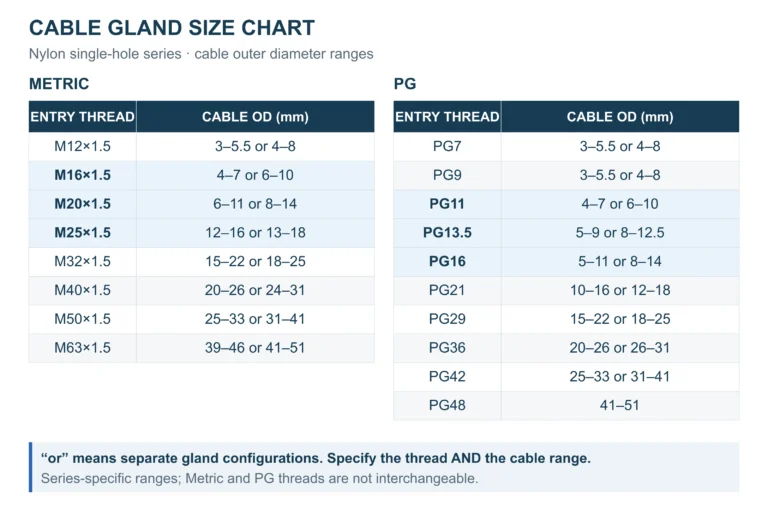
A seal insert is rated across its stated clamping range, ends included, so the cable’s actual outer diameter has to fall inside that range. Measure the cable rather than trusting its nominal size: sheath tolerances and slightly oval cable can push a diameter that looked safe over the edge. Picking a range that puts your cable near the middle leaves room for that. If the seal will not grip or the nut will not close, the gland or insert is the wrong size, and more torque will not fix it. The cable gland size chart lists the ranges by thread size.
A round seal suits a round sheath. Flat cable needs a gland with a flat-cable seal shaped to its section, and a cable with a ridged, braided or badly out-of-round sheath leaves channels that a round insert cannot close.
Two cables pushed through one round seal leave a gap along the line where they touch. Use a multi-hole cable gland with a separate hole for each cable, and close any unused hole with a sealing pin.
The face seal is missing or sitting on a poor surface
The seal between the gland body and the enclosure is the one most often left out, because it sits under the body and nobody sees it once the gland is in. Fit the O-ring or washer that comes with the gland, on the outside face. It needs a flat, clean surface to seal against: textured powder coat, a burr around the drilled hole or a thin panel that bows as the locknut is tightened can all leave a gap. On a tapered NPT hub, use the thread sealing method the gland maker specifies.
The dome nut is too loose or too tight
A loose dome nut leaves the seal resting on the sheath without gripping it. An overtightened one can crack a nylon dome or push the insert out of shape so it seals unevenly. Tighten to the torque or method the maker gives for that model. A cable that cannot be pulled out shows the gland is gripping, but it does not prove the seal is compressed to its rating, so where the rating matters and the datasheet is silent, ask the maker.
Water reaches the gland along the cable
Rain running down the outside of a cable collects on whatever it reaches first. Put cable entries on the underside of an outdoor enclosure and leave a drip loop below the box, so water falls off the lowest point of the loop instead of sitting on the seal.
Water inside the cable is harder to see. A cable whose far end is cut, jointed or terminated in a wet place can carry water along its cores for metres and deliver it into a perfectly sealed box. Seal that end with a sealed connector, a heat-shrink end cap or a resin joint, because the gland at the enclosure cannot stop it.
Condensation forms inside the box
A sealed enclosure can collect water with every gland perfectly tight. The air inside carries moisture, and when the lid or a wall cools below the dew point of that air, the moisture condenses on it. Outdoor boxes that heat up in the sun and cool at night go through this every day, and the swings in temperature also push air out and draw it back in through any weak seal, which brings in more moisture.
Three different parts deal with this, and each does one job.
- A pressure-equalising vent is a gland-sized fitting with a membrane that lets air through and keeps liquid water out. It removes the pressure difference, so the seals are not loaded and humid air is not drawn in through them. Mount it where its maker says; many designs are meant for a vertical side wall.
- A drain at the lowest point lets condensed water out of the box.
A vent or drain is another hole in the enclosure, so it needs the same water protection as the glands: a vent rated IP55 undoes the IP66 glands next to it. Check its rating and mounting position against the enclosure’s requirement before you fit it.
- An anti-condensation heater keeps the inside above the dew point. A vent does not dry the air, so where condensation keeps forming, the heater is the fix.

Nylon or brass for a waterproof cable gland
The rubber seal does the waterproofing, so a nylon gland and a brass gland of the same design and rating seal equally well. Choose the body for the rest of the job.
Nylon (PA66) glands are light, do not corrode and cost the least, and they are the natural choice for plastic enclosures. For equipment in full sun, use black UV-stabilised nylon. Nylon is the weaker choice where the gland can be knocked, especially in the cold.
Nickel-plated brass glands suit metal enclosures, places where the gland can be hit, higher temperatures and EMC versions that earth the cable screen. The plating copes with outdoor weather and salt spray. For glands that sit in seawater or chlorinated pool water all the time, stainless steel 316 is the safer body.
The seal compound matters as much as the body. EPDM is the usual seal for water, weather and UV, but it swells in oil; nitrile (NBR) suits oily places, and silicone holds up at high temperature. Check the seal against anything else in the water, such as the cleaning chemicals in a food plant.
Termnex supplies nylon cable glands in Metric, PG and NPT threads, and nickel-plated brass cable glands for metal enclosures.
How to install a waterproof cable gland
- Check the cable’s outer diameter and shape against the gland’s seal, aiming for the middle of the clamping range.
- Make the entry: drill to the thread’s clearance size or tap the thread, then deburr the hole and clean the face around it.
- Seal the body to the enclosure the way the gland is designed: for a metric or PG gland, fit the O-ring or sealing washer on the outside face and tighten the body with its locknut or into the tapped hole; for an NPT gland in a tapped hub, use the thread sealant the maker specifies. Use the maker’s torque for the body.
- Pass the cable through the dome nut and seal insert before you terminate the far end.
- Bring the cable to the gland from below, with a drip loop.
- Tighten the dome nut to the torque or method the maker gives for that model, then check that the cable cannot be turned or pulled. Where a rating matters and the datasheet gives no method, ask the maker for it.
- Close unused entries with blanking plugs of at least the same IP rating, and fit any vent or drain with a rating that suits the enclosure’s duty.
FAQ
Is IP69K better than IP68?
Neither is higher than the other. IP69K tests short bursts of hot, high-pressure jets, and IP68 tests immersion. A gland that faces washdown and can also stand in water needs both codes on its datasheet.
What is the difference between a waterproof and a watertight cable gland?
There is no difference in practice. Watertight is more common in North American and marine use and waterproof elsewhere; both mean a sealed gland, and its IP or NEMA rating tells you how much water it will take.
Does a waterproof cable gland need thread sealant?
A metric or PG gland seals with its O-ring or washer on the enclosure face, so its thread needs no sealant. An NPT gland screwed into a tapped hub seals on its tapered thread and normally needs the sealant or tape its maker specifies. On a nylon gland, check that the sealant is safe for nylon.
Ordering glands for a wet installation
Send us the IP code the installation needs, with the depth or pressure and the duration if the glands will be under water. Add each cable’s outer diameter and shape, the entry thread and wall thickness, the enclosure material and the quantity. We will match nylon or brass glands to each entry and confirm the documentation for that rating on the specific models before you order. Contact us with the list.