
Should you use ferrules on stranded wire? Usually yes on fine-stranded conductors, but the answer depends on the terminal, not on a rule. None of the standards reviewed here imposes a blanket ferrule mandate, and a few terminals work better without one. What follows is the decision, terminal by terminal.
Should you use ferrules on stranded wire? the short answer by terminal type
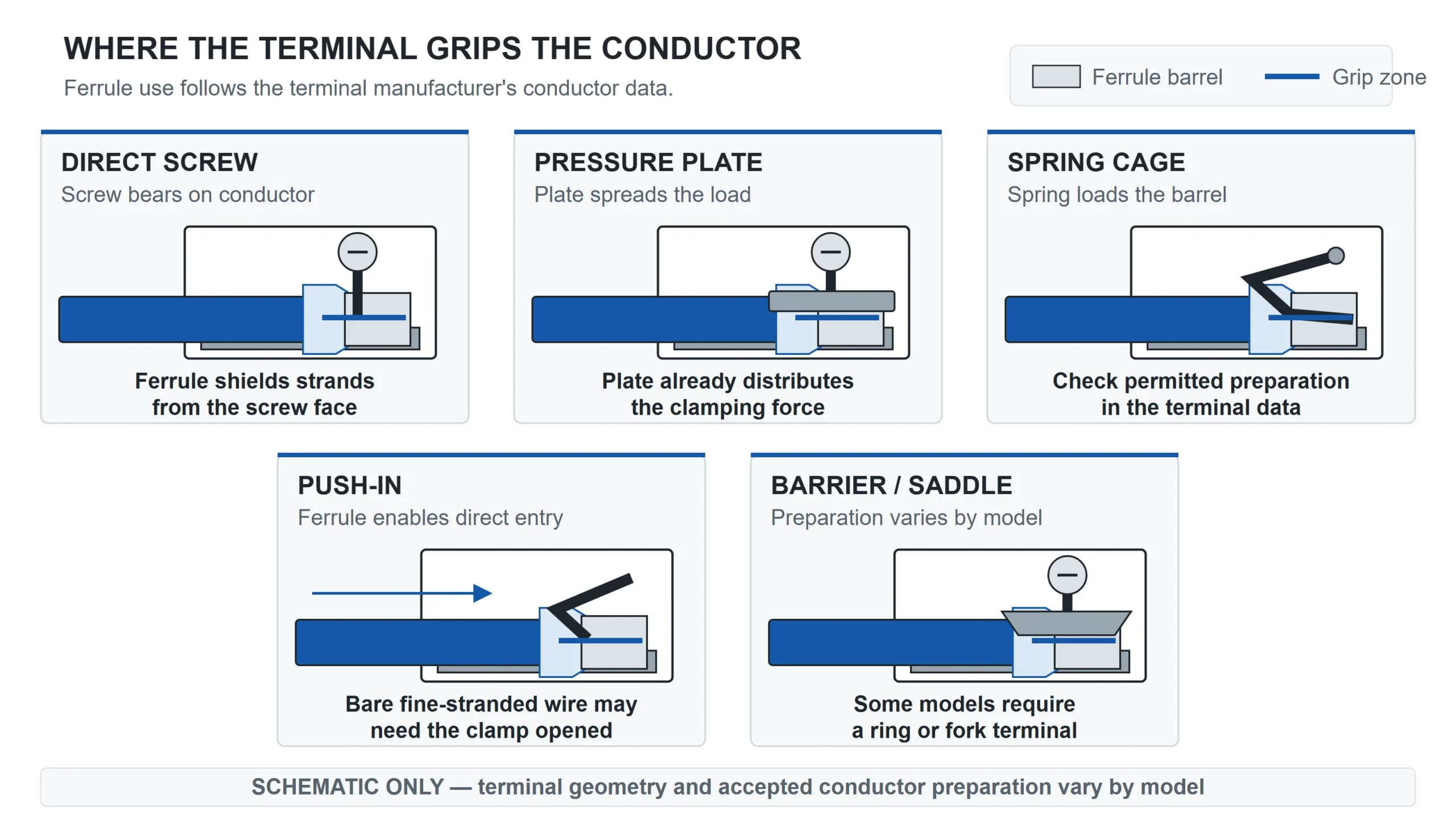
Use a ferrule on fine-stranded wire wherever the terminal clamps the conductor directly with a screw, and wherever a bare conductor is too limp to enter the clamp. Skip it on solid conductors. On spring-cage terminals the terminal manufacturer’s own conductor data decides, because practice there is divided among experienced panel builders.
| Terminal type | Ferrule on fine-stranded wire | Why |
|---|---|---|
| Screw clamp, screw bears on the conductor | Yes | The screw shears and splays strands; the ferrule takes the load |
| Screw clamp with a pressure plate or wire protector | Optional | The plate already spreads the clamping load |
| Spring cage / cage clamp | Check the terminal data first | Contested, for reasons worth reading |
| Push-in | Often the practical choice | A ferrule stiffens the conductor enough to push in directly; bare fine-stranded wire usually means opening the clamp with a tool first |
| Barrier / saddle | Follow the terminal’s specified preparation | Some take a ferrule, others are built for a ring or fork terminal |
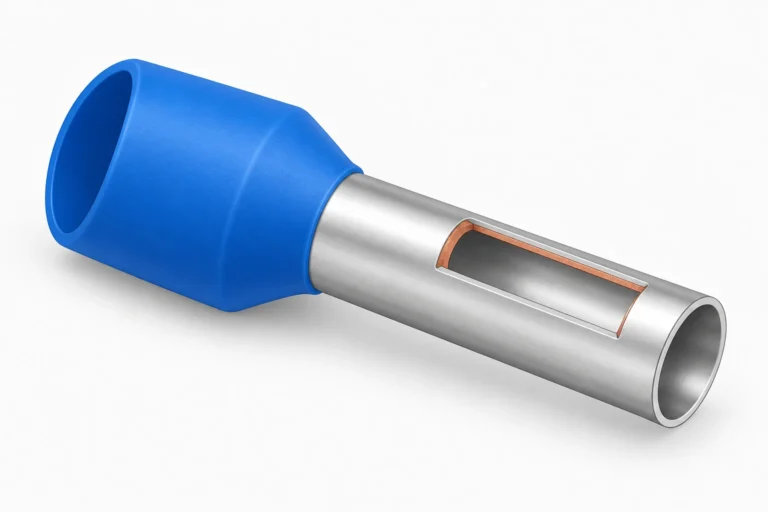
A wire ferrule, also called a bootlace ferrule or cord end terminal, is a tinned copper tube crimped onto a stripped conductor so the strands enter the terminal as one compacted body instead of loose wires.
Notice what the table does not contain: the word “required”. Every row is a statement about what works, not about what a standard compels. The next section explains why that distinction matters more than most panel builders expect.
What the standards actually say
Search this question and you will find someone insisting that ferrules are mandatory on stranded wire in North America, and that a control panel without them fails inspection. The available clause text and technical literature say otherwise. Five standards across three jurisdictions all stop at the same place.
| Standard | What it says | Ferrule required? |
|---|---|---|
| EN 60999-1 / VDE 0609 | Terminals must reliably accept rigid solid, rigid stranded and flexible conductors with no pre-treatment | No |
| IEC 60947-7-1 | The manufacturer shall specify conductor pre-treatment where it matters for a reliable connection | No, it defers to the terminal maker |
| BS 7671 526.9.1 | Suitable terminals shall be used or the conductor ends treated | No |
| NFPA 79 13.1.1.8 | Requires strand retention where the terminal does not already retain the strands | No |
| UL 508A 29.3.4 | Lists seven permitted connection methods; wire inserted directly into a pressure wire terminal is (a), a wiring ferrule is (g) | No |
Read together, every one of these makes the ferrule one way to satisfy a requirement, never the requirement itself. The requirement is always the same thing stated in different words: the strands must be retained, and the terminal must suit the conductor. A clamp-type terminal rated for fine-stranded wire already does both, which is exactly why the codes require strand retention instead of naming a part.
UL 508A is worth quoting closely because it is the source most often invoked and least often read. Clause 29.3.4 lists seven ways to connect a conductor to a component terminal. A wiring ferrule is one of them. Wire inserted directly into a pressure wire terminal is another, and it is listed first. Neither is privileged over the other.
A note on how far to trust the table above, because the sources behind it are not equally direct. The UL 508A clauses come from UL documentation itself. The EN and IEC positions reach this article through Phoenix Contact’s published technical article instead of the clause text, the BS 7671 reference through an IET engineering discussion, and the NFPA 79 wording through secondary sources. Treat those four as accurately reported, not quoted.
The spring-cage argument, and what both sides agree on
Ask a room of panel builders whether ferrules belong in spring-cage terminals and the room splits. The split is real, both sides argue from experience, and pretending otherwise would be the least useful thing this article could do.
The case against
A crimped ferrule is a defined, fairly rigid shape, and a spring cage does not crush it. Contact is limited to where the barrel meets the clamp. A bare fine-stranded conductor, by contrast, flattens under the spring and spreads contact across many strands.
Practitioners in industrial forums report drifting temperature readings on spring-cage analogue inputs that stopped once the ferrules were cut off. Others report spring-terminal failures on ferruled conductors carrying real current, and ferrules that would not stay seated in small-pitch push-in blocks at all.
The case for
Phoenix Contact’s position is that conductor pre-treatment quality matters most on screwless spring-cage terminals, because a screw can compensate for a poor crimp with brute clamping force and a spring cannot. Their own comparison at 2.5 mm² has a correctly crimped conductor testing slightly better than an untreated flexible one. The reasoning: oxide on individual strand surfaces is an insulator, and a correct crimp breaks it open into a gas-tight body.
Both accounts are credible, and the honest reading is that they describe different installations, with the same physics underneath. The reported failures may come from crimp quality, from ferrule sizing, or from the terminal not being built to take a ferrule at all. Field reports cannot separate those causes, and more than one may be acting at once.
What both camps agree on is narrower than either headline, and more useful:
- The terminal manufacturer’s permitted conductor preparation is the deciding document, not a general rule about ferrules. Some spring-cage and push-in blocks are designed around ferrules; some small-pitch blocks retain them poorly.
- Where a ferrule goes into a spring-cage terminal, sizing and crimp tooling stop being optional discipline. A spring cannot mask a bad crimp the way a screw can, which makes the crimp matter more here, not less.
Analogue signal circuits are where practitioners most consistently report trouble, and where reading the terminal data before crimping costs nothing.
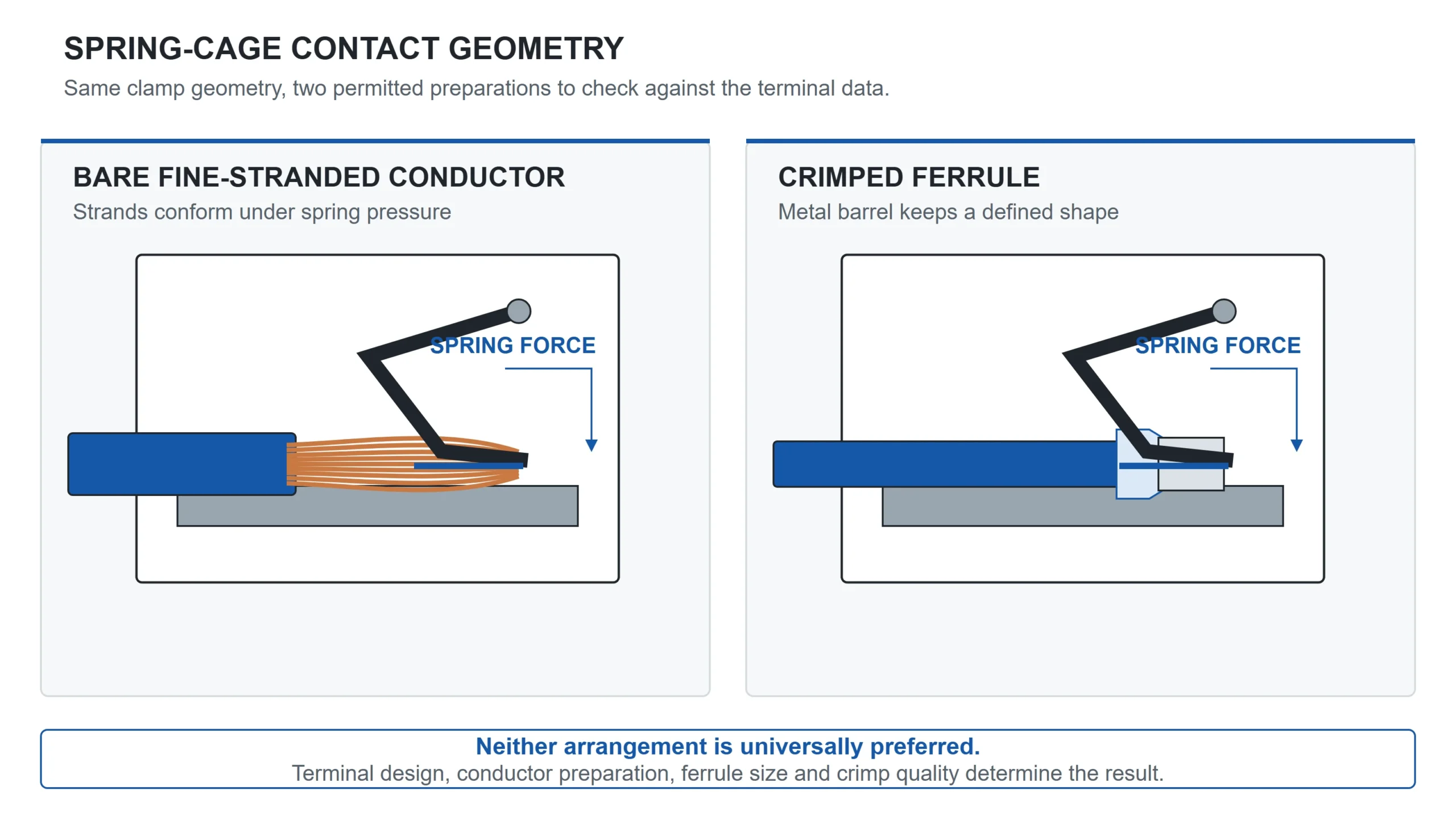
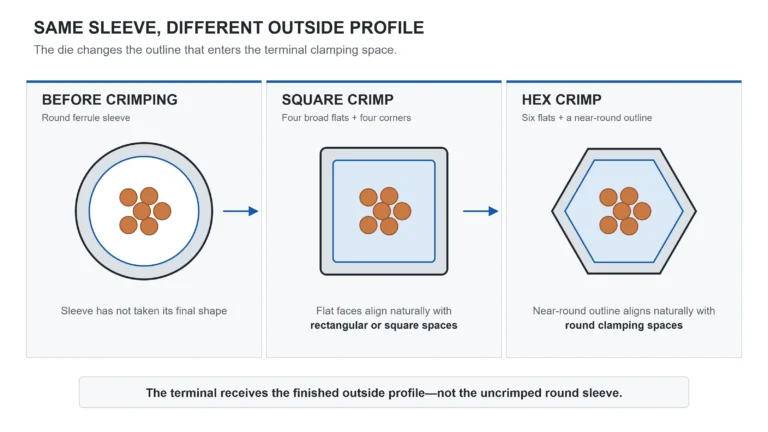
As shown in Figure 2, the two arrangements load the clamp differently. Which one suits a given terminal is a question for its datasheet.
When to leave the ferrule off
Two cases are firm, with a clause behind each. Two more come up constantly in practice and deserve a check, without rising to a rule.
On solid conductors
There is nothing to bundle. UL 508A 29.3.6(a) states that a wiring ferrule shall be used with stranded copper wire only, which makes this the one exception with a clause attached. On a solid conductor a ferrule adds a transition point and can reduce the terminal’s grip without improving anything.
Where the manufacturer’s conductor data does not permit one
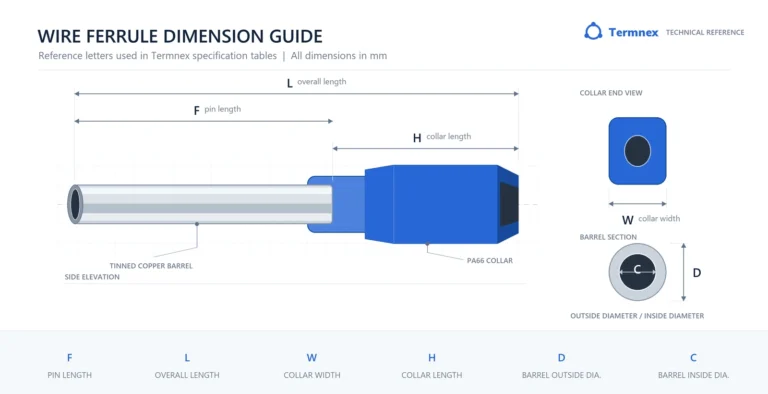
Practitioners report that some small-pitch push-in blocks retain a ferrule poorly or not at all: standard-length ferrules sitting too short to be gripped, and longer ones held so firmly that removal damages the terminal. Where the manufacturer’s conductor data excludes ferrules, or does not permit that preparation for the size in question, the decision is already made. Read the full conductor table; the wiring pictogram is not enough, because a pictogram that omits a ferrule is not the same as a manufacturer that prohibits one. Either way it ties back to IEC 60947-7-1: the standard hands this decision to the terminal maker. Ferrule length is a selection question in its own right, covered in the wire ferrule sizes guide.
Cases that call for the manufacturer’s guidance
Thermocouple circuits are the first. A tinned copper sleeve adds metal junctions to a circuit whose measurement depends on controlled ones. Whether that matters depends on the extension or compensating cable, on whether the junctions sit at the same temperature, and on how the instrument’s input terminal is built. The instrument manufacturer’s wiring instructions settle it, not a general rule about ferrules.
Corrosive atmospheres are the second. Practitioners describe corrosion products working a ferrule loose from the conductor over time. Corrosion is not a ferrule-specific problem, so the useful framing is that an aggressive atmosphere turns termination material and protection into a deliberate selection.
Wire type or terminal type: which one decides
Most arguments on the subject start with one question: One shop decides by wire type: always ferrule stranded, never ferrule solid. Their systems integrator decides by terminal type: always ferrule screw terminals, never ferrule push-in. Both rules produce sensible panels most of the time, and both fail at the edges.
The answer is both, in order. Conductor class decides whether the question arises at all. Terminal type then decides the answer.
| Conductor class | What it is | Does the question apply? |
|---|---|---|
| Class 1 | Solid | No |
| Class 2 | Rigid stranded, the construction used in fixed installation cable | Rarely; it behaves close to solid in a clamp |
| Class 5 | Flexible | Yes, and this is the main case |
| Class 6 | Extra flexible | Yes, most strongly |
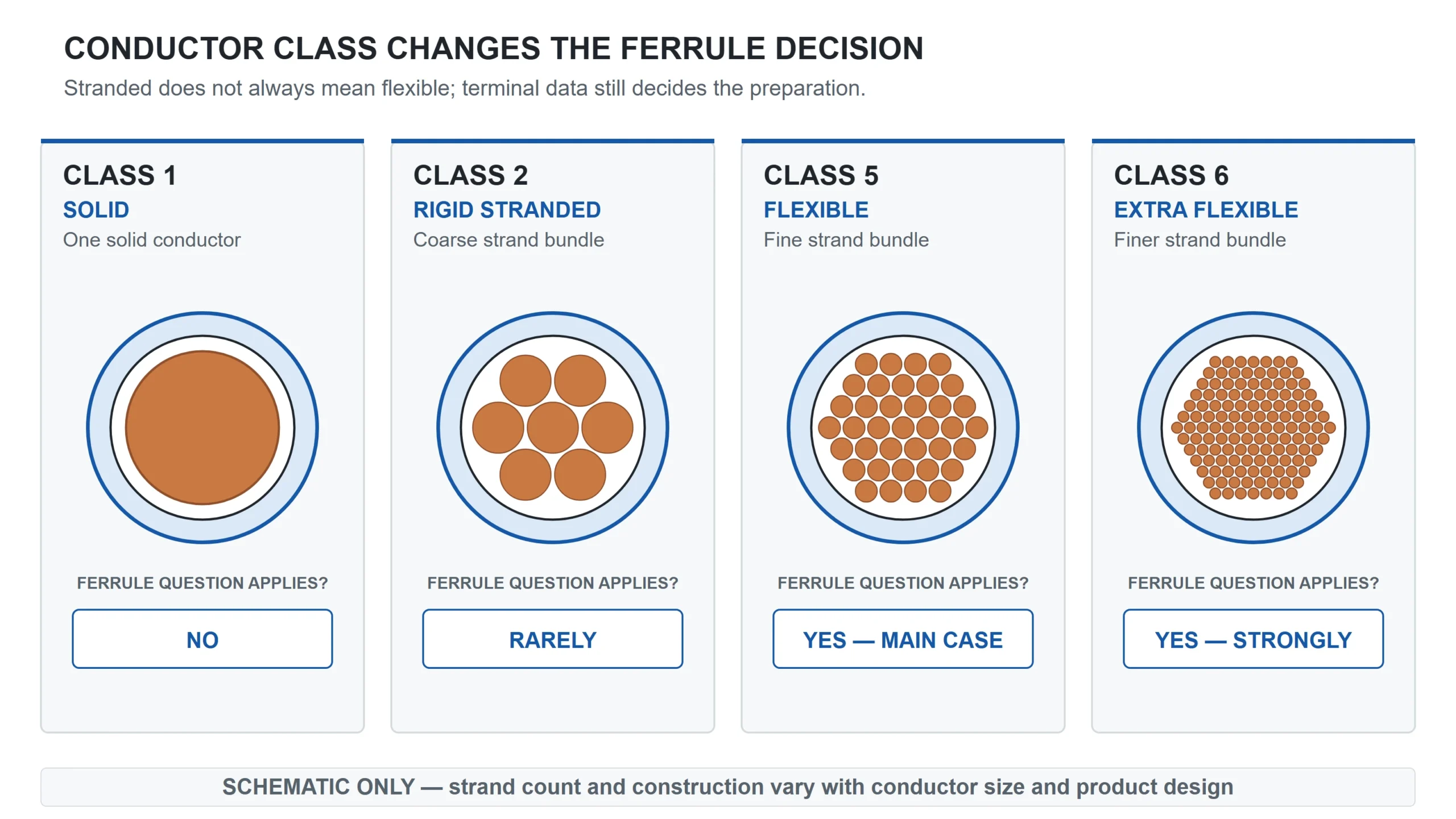
Which settles a terminology problem that derails almost every discussion of the topic. Stranded and flexible are not synonyms. A seven-strand 2.5 mm² installation conductor and a fine-stranded control cable of the same cross-section are both stranded, and only one of them needs help staying inside a clamp.
Practitioners draw a further distinction that published guidance rarely does: flexible cable is bent during installation, flexing cable is bent in service, and they are different products with different constructions. A conductor rated only for installation bending can fail prematurely in a drag chain unless it is rated for continuous flexing, and no ferrule changes that.
What happens if you skip the ferrule
Three mechanisms, none of them automatic.
A strand that escapes the clamp stops carrying current and can bridge to the neighbouring terminal. BS 7671 526.9.1 exists for that reason, and it explains why the requirement is written around retaining strands, and not around fitting a particular part.
Under a screw that bears on the conductor, the load lands on the outer strands first. They splay, and some shear. Repeated rewiring or vibration can compound that strand damage without producing an outright failure, which is what makes this fault type awkward to find: nothing looks wrong, and the panel can simply become less reliable each time someone works in it.
Individual strand surfaces also oxidise, and copper oxide conducts poorly. Phoenix Contact’s explanation is that a correct crimp breaks that layer open mechanically and compacts the strands into a gas-tight body.
None of which is automatic. A clamp-type terminal rated for the conductor already retains the strands, which is precisely why the standards stop where they do, and why “always ferrule everything” is a shop convention with no technical necessity behind it.
The alternatives, and why two of them are worse
Tinning the ends
The original alternative, and it has a specific failure mode. Tin-lead solder becomes highly viscous under sustained pressure and temperature, so a soldered end clamped in a terminal relaxes over time and the contact degrades. The practice was ultimately ruled out by standards for that reason. Anyone reaching for a solder pot to tidy up stranded ends is choosing the one method that was actively removed from the toolbox.
Twisting by hand
Twisting does not survive the clamp. The twist opens under pressure, and handling the bare conductor deposits skin oils on the strand surfaces. Some spring-cage terminals are built for the conductor to enter untwisted and flatten, so a hand twist works against the terminal’s design. Twisting before crimping into a ferrule is a separate question, covered in the ferrule crimping guide.
Bare insertion into a terminal rated for it
Legitimate, and the standards back it. UL 508A 29.3.4(a) lists it first among permitted methods, and EN 60999-1 requires terminals to accept unprepared conductors in the first place. A panel built this way, with terminals chosen for the conductor class, is not a compromise.
If you do use one, what has to be true
Two separate subjects live here, and mixing them causes most of the confusion around ferrules and certification.
Using a ferrule in a UL 508A panel
Clause 29.3.6 sets five conditions.
| Check | Requirement under UL 508A 29.3.6 |
|---|---|
| Conductor | Stranded copper only |
| Connector | Rated for copper and for the number and size of wires crimped |
| Crimping | Ferrule crimped before termination with the tool the ferrule manufacturer recommends |
| Ferrule size | Diameter selected per the manufacturer for the wire count and size |
| Spacing | Uninsulated ferrule length does not reduce required electrical spacings |
Then the part that settles the compliance question. UL 508A Supplement SA, in its component requirements table against 29.3.6, states that ferrules are not required to be Listed or Recognized. Choosing an unlisted ferrule does not by itself put an industrial control panel out of compliance.
What a UL 486F Listing claim means
Separate subject. UL 486F is the product standard ferrules are evaluated under, and a Listing there is narrower than most catalogues imply. The Listing applies to the ferrule and crimping tool as a matched combination, so ferrules from one manufacturer crimped with another manufacturer’s tool sit outside it even when both brands carry UL. That is why 29.3.6(c) names the ferrule manufacturer’s tool specifically. Coverage is also assigned per part number rather than per size band, so a size range is never Listed as a range.
Put the two together and the picture is clear: you are under no obligation to use a Listed ferrule, and if you choose one, the Listing covers less than the marketing suggests.
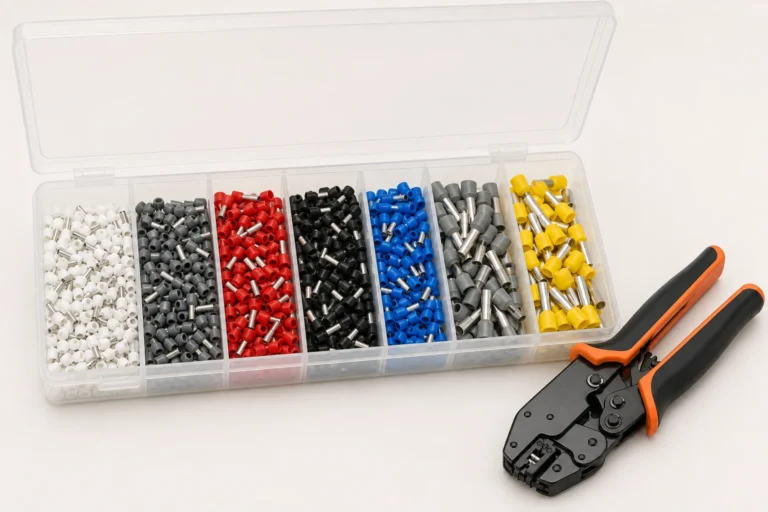
Crimp quality is what carries the connection either way. DIN 46228-4 sets pull-off force and gas-tightness requirements for the crimped joint, and a crimp made with flat-nose pliers or side cutters cannot be assumed to meet either without verification. A ratcheting ferrule crimper that will not release until full compression is reached reduces the risk of an incomplete crimp, but it does not correct the wrong ferrule size, the wrong die or poor conductor preparation. Phoenix Contact’s own framing is that the conductor, the ferrule and the tool have to be coordinated as a set, which is the difference between a ferrule that improves the connection and one that becomes the failure point sceptics describe.
FAQ
Does stranded cable need ferrules?
Not as a rule. Fine-stranded Class 5 and Class 6 conductors benefit from one in most screw and push-in terminals, while rigid stranded Class 2 conductors behave close to solid wire in a clamp. The terminal’s rated conductor preparation is what decides, and none of the standards reviewed here makes a ferrule mandatory.
Should you use bootlace ferrules?
Use bootlace ferrules when the terminal accepts ferrule-terminated stranded conductors and the ferrule improves strand control or repeatable insertion. They are especially useful with fine-stranded wire in many screw and push-in terminals, but they are not a blanket requirement: the terminal manufacturer’s conductor-preparation instructions, the conductor size, and the correct crimp tool decide whether they should be used.
Should you use ferrules on solid wire?
No. UL 508A 29.3.6(a) states that a wiring ferrule shall be used with stranded copper wire only. Solid conductors have no strands to bundle, so a ferrule adds a transition point and can weaken the terminal’s grip without improving the connection.
Are wire ferrules required by code?
No standard reviewed here imposes a blanket requirement. EN 60999-1, IEC 60947-7-1, BS 7671 526.9.1, NFPA 79 13.1.1.8 and UL 508A 29.3.4 all treat a ferrule as one acceptable way of meeting a requirement about retaining strands and matching the terminal to the conductor. UL 508A Supplement SA goes further and states that ferrules need not be Listed or Recognized.
What happens if you don’t use a ferrule?
In a terminal rated for the conductor, usually nothing. In a terminal that clamps fine strands directly with a screw, strands can splay, shear or escape the clamp, which reduces the conducting cross-section and can bridge to an adjacent terminal. Damage of that kind accumulates over rewiring and vibration instead of appearing immediately.
How do you know if a ferrule is the wrong size?
Size comes from the conductor cross-section, the number of wires entering the barrel and the ferrule manufacturer’s tooling table, not from appearance. Once crimped, two visual checks are worth making: the strands should fill the barrel with no more than about 0.5 mm protruding at the end, and the crimped ferrule should not turn or slide on the conductor. A barrel that closes without gripping, or one that cracks at the crimp, can indicate the wrong size or die, though cracking can also come from an unannealed barrel. The insulated versus non-insulated ferrules comparison covers collar selection once the size is settled.
If the answer for your terminals is yes
The decision lands per terminal, so the useful next step is a list of the terminal types in the panel and the conductor sizes going into each. The Termnex wire ferrule range covers insulated and non-insulated ferrules in standard DIN cross-sections, twin versions where two conductors share a clamp, and ratchet crimpers for the common ranges. Send that list and the destination market, and the reply names part numbers against each terminal type. Contact us.