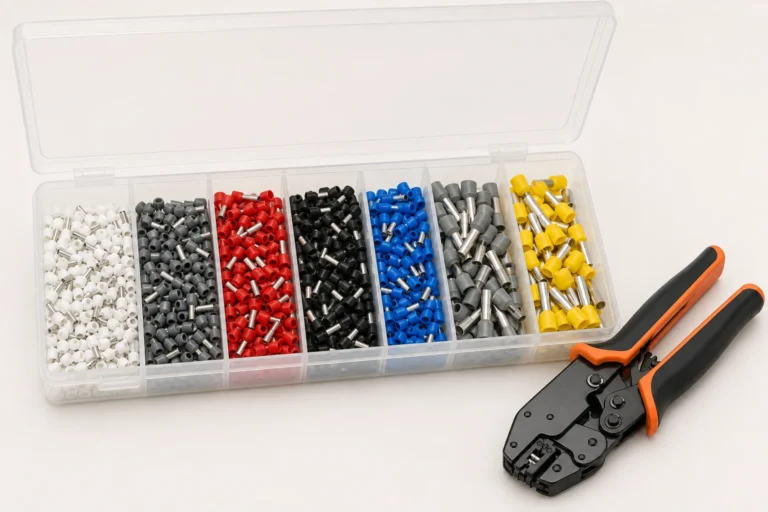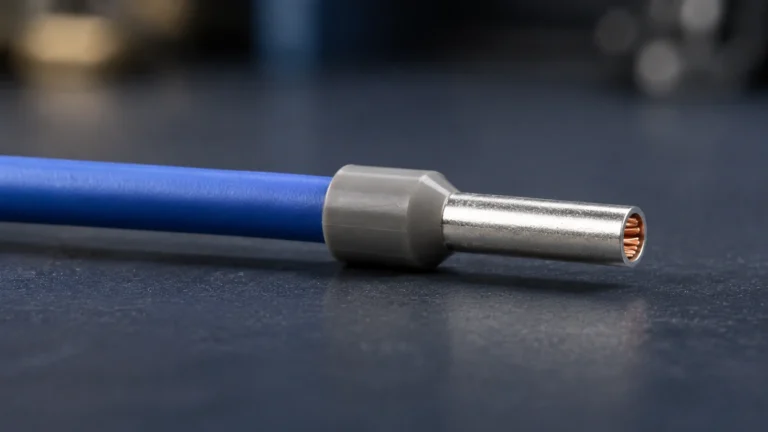

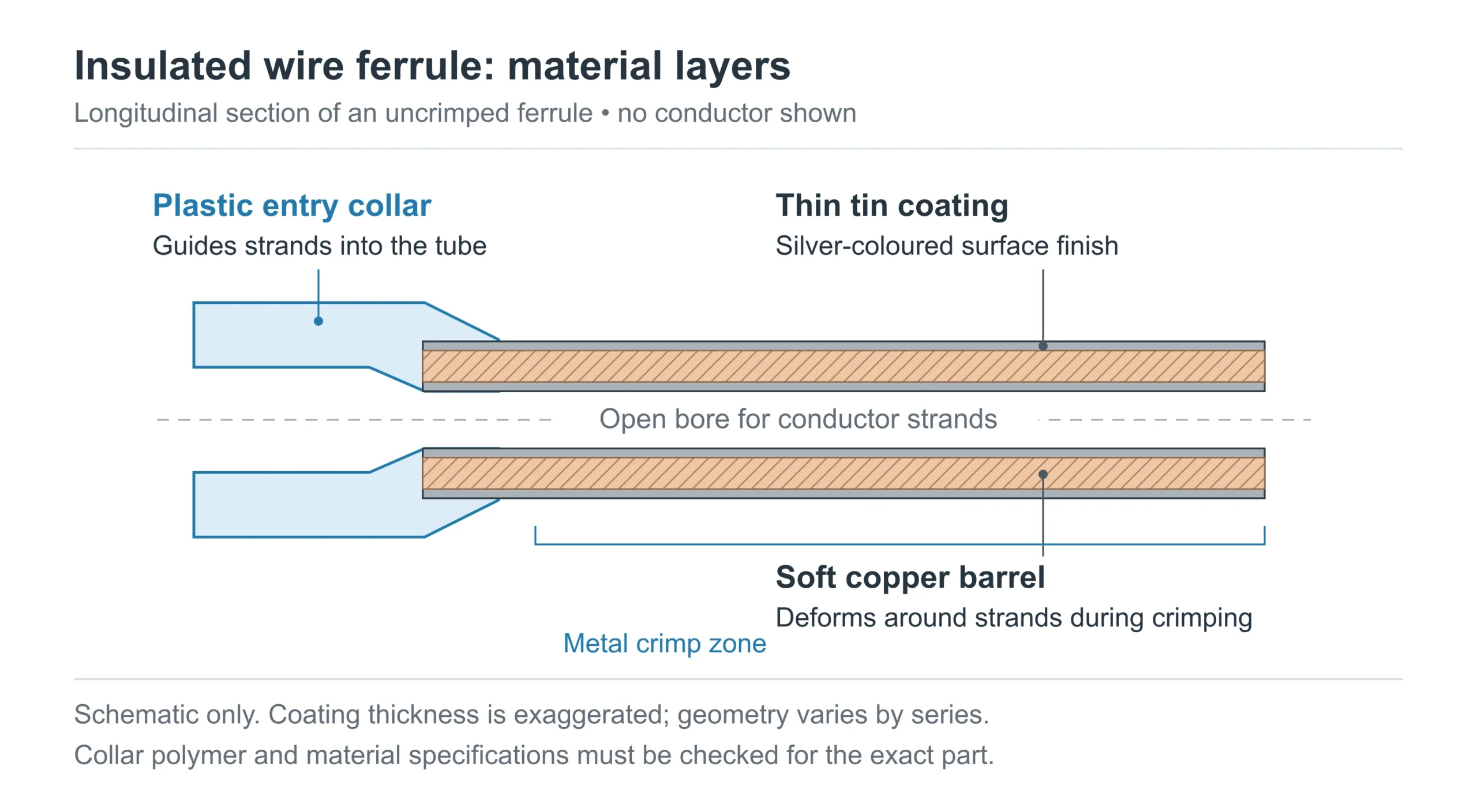
Electrical copper wire ferrules are usually soft copper tubes with a thin tin coating, crimped onto stranded conductors before terminal insertion. Copper provides conductivity and deforms around the strands; tin protects the barrel surface and gives it a silver finish. Insulated versions add a plastic collar to guide the strands and identify size. Confirm base material and coating in the product specification when ordering.
What copper wire ferrules are made of
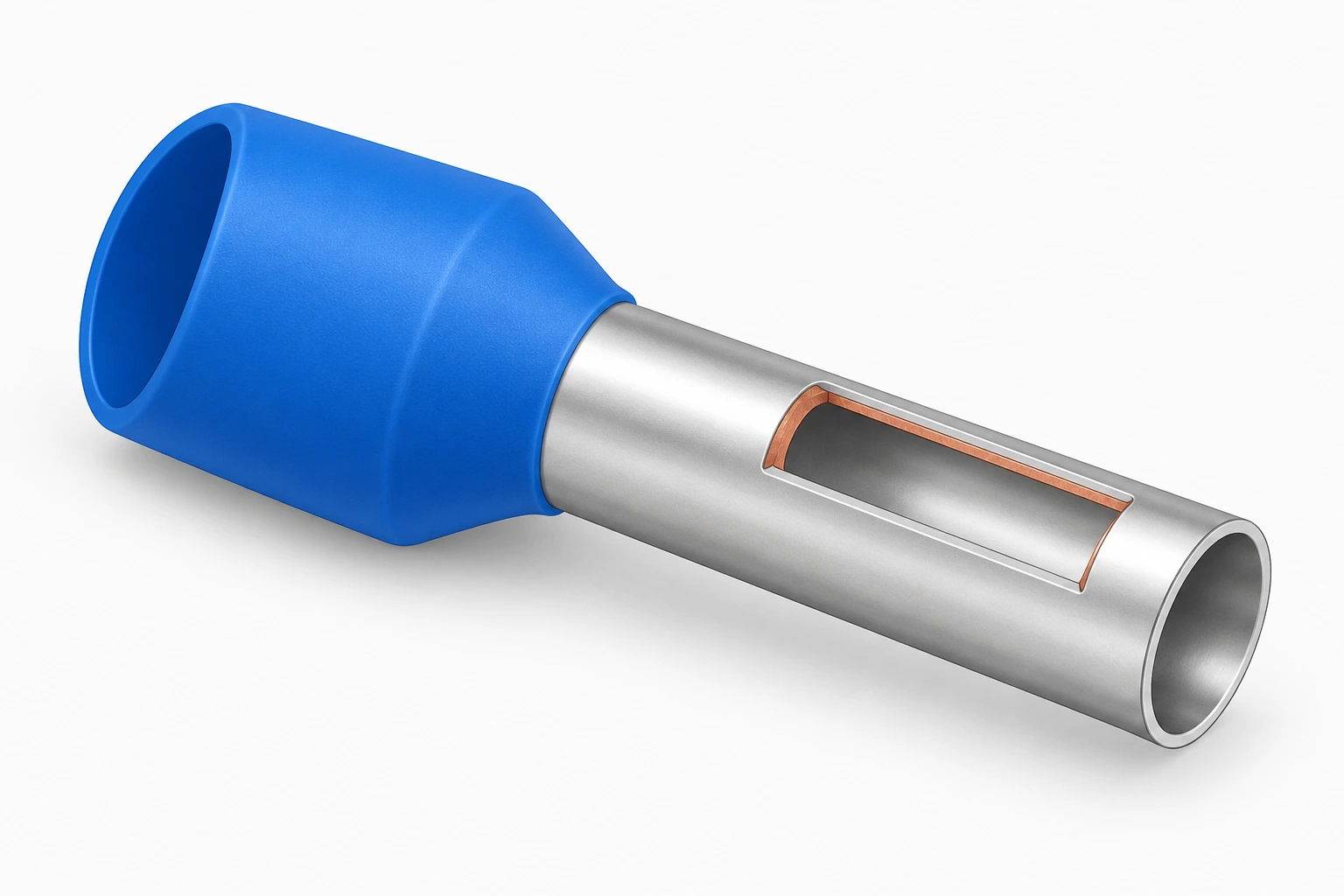
An insulated wire-end ferrule has three material parts. Each does a different job.
| Part | Common material | What it does |
|---|---|---|
| Barrel | Soft copper | Compacts around the strands during crimping and enters the terminal |
| Coating | Tin | Protects the copper surface and gives the barrel its silver appearance |
| Entry collar | Polypropylene or PA66 nylon, depending on the series | Guides strands into the tube and carries the size colour |
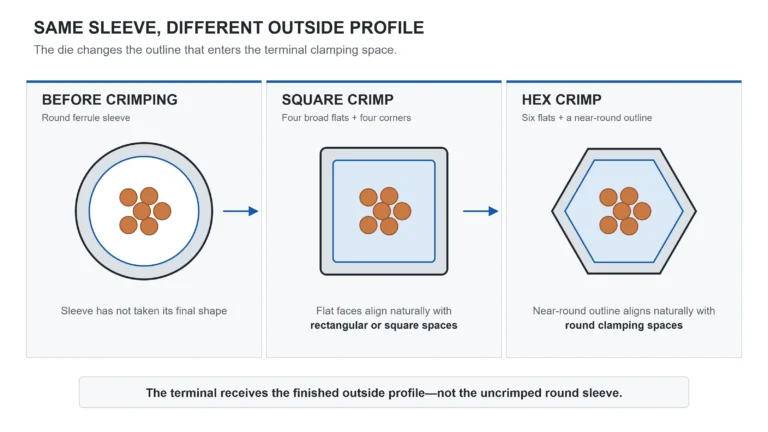
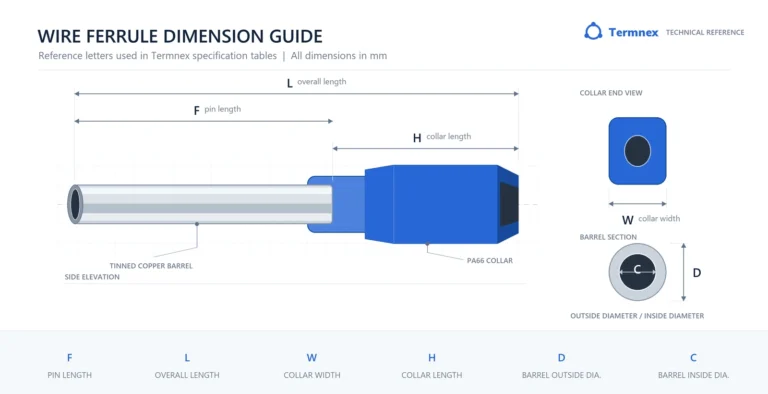
The crimping die compresses the metal barrel. The collar stays around the cable insulation at the entry end, outside the metal crimp zone. Colour helps identify the conductor size within the manufacturer’s colour system.
Non-insulated copper wire ferrules omit the collar. Their barrel can still be tin-plated and silver-coloured. The distinction between collar and coating becomes useful when a catalogue calls a product a “bare ferrule.”
Why copper wire ferrules need a soft barrel
A ferrule must conduct current and survive considerable deformation. During crimping, its thin tube is pressed around the conductor strands and permanently changes shape.
Copper combines good electrical conductivity with ductility: the ability to deform without breaking. The copper barrel supports the strands as a compact termination, with its outside surface available for the terminal to clamp.
The condition of that copper matters. Tube manufacture can work-harden the material, making it less willing to deform. Annealing restores ductility through controlled heat treatment. A barrel that is too hard can crack during crimping, particularly where the die creates tight corners. Incorrect size or tooling can also cause damage, so a cracked ferrule needs investigation before blaming its material.
Phoenix Contact specifies representative ferrules as soft tin-plated electrolytic copper. Its material data separates the copper grade from the tin coating. That is a useful model for reading a specification: identify the base metal first, then its finish.
For purchasing, “copper” identifies a material family. Exact copper grade, composition and processing belong in the supplier’s specification when your project requires them.
Why copper wire ferrules are tin-plated
Copper exposed to air and moisture develops surface oxides. Tin plating covers the barrel with a corrosion-resistant finish, reducing direct exposure of the copper beneath it during storage and service.
The copper tube remains the main body of the ferrule. The thin tin layer changes its exposed surface while preserving the underlying barrel’s conductivity and crimp behaviour. Panduit describes tin-plated copper electrical terminals as corrosion-resistant terminations.
Tin also oxidises. At a correctly made connection, compression creates intimate contact between the mating surfaces. The result depends on the ferrule, conductor preparation and clamping or crimping conditions as well as the finish.
Tin-plated copper wire ferrules still need the right size and tool. Surface protection cannot compensate for a barrel that closes loosely around the strands. A dense, secure crimp depends on the full combination; the guide to correct ferrule crimping covers the preparation and tooling.
Plating thickness is another specification field. Some catalogues state a minimum thickness, while others identify only the coating material. Ask for the required thickness and its verification method when a drawing or purchasing specification calls for one. Avoid transferring a figure from one manufacturer’s series to every ferrule on the market.
What the silver finish does not prove
Silver colour shows the surface appearance. Establishing the base metal, coating type or coating thickness takes a specification or suitable test.
Product names make this harder because several industries use the word ferrule.
| Description | What to clarify before buying |
|---|---|
| Tinned copper or tin-plated copper wire-end ferrule | Copper is the base material; tin is the finish. Confirm the conductor size and barrel dimensions. |
| Bare or non-insulated ferrule | Usually describes the absence of a plastic collar. Check the finish separately. |
| Bare copper ferrule | May mean uncoated copper, or may be used loosely for a non-insulated part. Request the material and coating fields. |
| Brass or aluminium ferrule | May be a hose fitting, wire-rope sleeve or another mechanical part. Check the application and drawing before treating it as an electrical substitute. |
Electrical wire-end ferrules and wire-rope sleeves serve different purposes. A sleeve specified for swaging a steel rope gives no basis for selecting a part for a terminal block.
A magnet test has limited value: it can reveal some steel parts, but copper, brass and aluminium can all give a non-magnetic result. Filing a sample may expose a copper-coloured core; it still leaves grade and coating thickness unresolved. Use those observations to raise a question with the supplier, then settle it through the appropriate document or test.
How to verify copper wire ferrule material before buying
Start with the specification for the exact series or part number. Three material fields normally settle the basic question: barrel material, coating and collar polymer.
Then check the rest of the order:
- Conductor cross-section and number of conductors.
- Barrel or pin length, with a drawing where terminal fit matters.
- Applicable dimensional standard and any required listing for the quoted model.
- Plating thickness or material-test requirements, if your project specifies them.
Material verification and fit are separate checks. The wire ferrule size chart explains cross-section and length selection; a copper barrel still needs to match the conductor and terminal.
A material safety data sheet describes the declared material and its hazards. A RoHS report concerns restricted substances. Neither alone establishes every dimensional, mechanical or certification claim for the finished ferrule. Request the document that answers the requirement in your specification.
The Termnex wire ferrule range uses copper barrels with tin plating; the insulated series uses PA66 nylon collars, as specified in the supplier documentation. Required documents and certification coverage should be matched to the quoted models.
For ordinary orders, that specification check is a practical starting point. If material identity is disputed or a contract requires verification, arrange an appropriate sample test. Analysis of a coated part must distinguish the coating from the substrate; measuring a thin tin layer needs a method calibrated for that coating system.
Specify the material with the ferrule size
When requesting copper wire ferrules, include the barrel and finish requirement alongside the conductor sizes, pin lengths and single or twin configuration. Add quantity, destination and any required standard or certification. Termnex can identify the quoted models and confirm the material documentation supplied with them. Contact us.