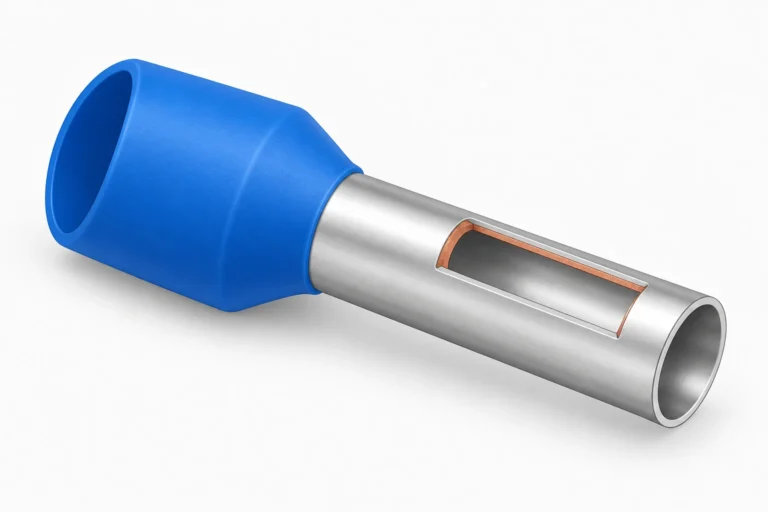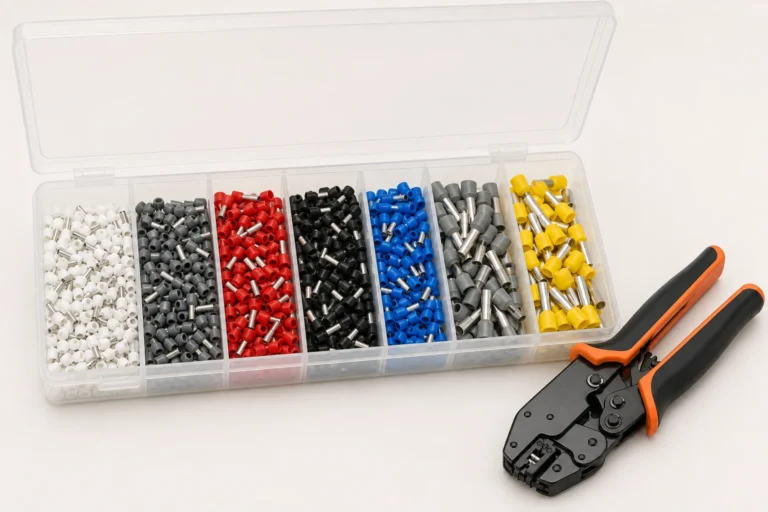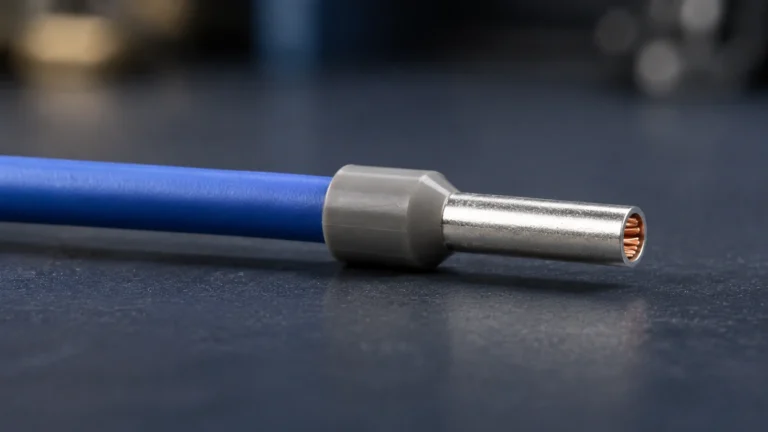

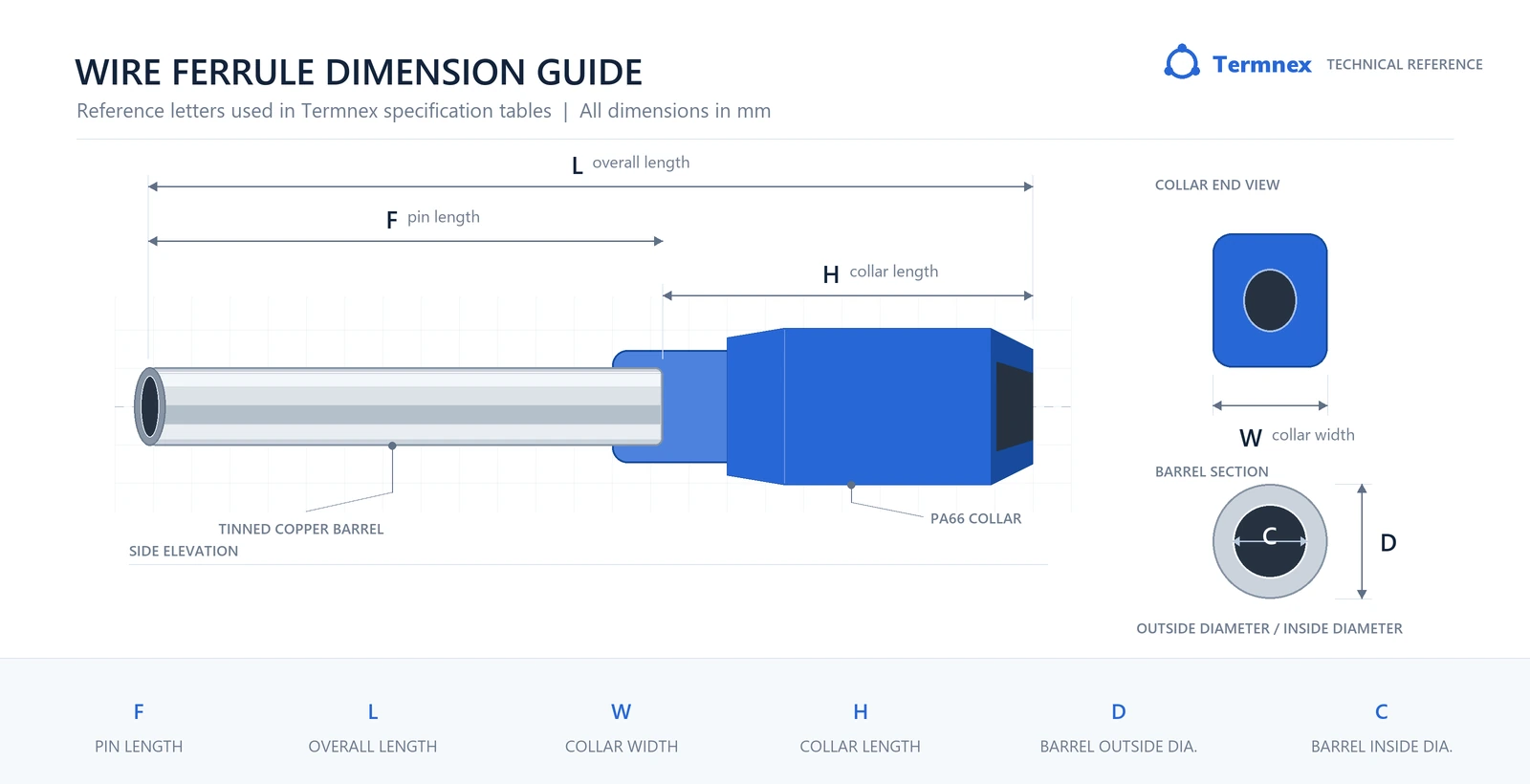
Ferrule pin length measures the exposed metal sleeve from the collar face to the pin nose. Choose it from what the terminal manufacturer requires, not from the wire size. Cross-section fixes the bore; the length stays open, and one conductor size is manufactured in several. Check which dimension a datasheet quotes, because pin length and overall length differ.
Start with what the terminal manufacturer requires
The number comes from the terminal, not from the conductor. Connection data may state a stripping length for a given conductor range, and some connectors carry that figure printed on the housing. Where it is published, it is where ferrule selection starts. It is not, by itself, a pin length, and it should not be treated as one.
Wire size has already done its job by this point. It set the bore the conductor has to fit into. What it cannot tell you is how deep the terminal wants that sleeve to go. The same applies whether the part is sold as a wire ferrule, a bootlace ferrule or a cord end terminal, which are three names for the same component.
Three situations cover almost everything you will meet:
- The terminal states a ferrule requirement. Some connection data lists an acceptable ferrule length, or a specific ferrule range, alongside the conductor range. Follow it. Nothing in a catalogue overrides the connection data for the terminal you are actually wiring.
- The terminal gives a stripping length only. Use it as the compatibility basis for narrowing candidates, then confirm the selection with the terminal manufacturer before you commit to a quantity. A stripping length tells you what the terminal expects to receive. Translating that into a specific ferrule part is a step the terminal maker is better placed to confirm than you are, and it costs one email.
- Neither is published. Ask the terminal manufacturer. There is no reliable shortcut here, and the obvious workarounds do not survive scrutiny: an entry opening you can measure says nothing about the clamping geometry behind it, and a loose ferrule is not the shape a crimped one will be. Ferrules are bought by the thousand, so the question is worth asking once, before the answer turns up across a production batch.
Do not assume blanket approval for ferrule use. Whether a terminal accepts a ferrule at all, and at which cross-sections, is a property of that terminal rather than a general rule about ferrules. Requirements can vary between terminal families from the same manufacturer, which is why a length that worked on the last panel is evidence about that panel and nothing else.
Catalogue advice of the form “use 8 mm for small conductors” is worth treating the same way. Advice like that describes what many panels happen to use, which is a statement about common purchasing, and says nothing about fit on the terminal in front of you. Where the habit coincides with the terminal’s requirement, the outcome is fine. Where it does not, the mismatch is designed into the panel before anyone checks it.
What goes wrong when the ferrule pin length is wrong
Manufacturer instructions describe the failure in two directions, and the two are not symmetrical.
If the prepared conductor is too long for the connection, the required insulation condition is not achieved.
If it is too short, a secure connection is not guaranteed.
How either condition manifests inside a specific terminal depends on that terminal’s design, which is not something you can infer from the outside. The takeaway is narrower than a mental picture of clamps and stops: too long can prevent the required insulation condition, too short does not guarantee the connection, and the terminal manufacturer’s documented requirement is what keeps a selection out of both. Settling that requirement at the ordering stage is easier than establishing it afterwards.
Why one conductor size comes in several pin lengths
Six Termnex parts are catalogued for a 1.5 mm² conductor. They share the same listed bore and collar geometry. The only dimension that changes is how far the sleeve reaches.
| Part | Pin length | Overall length |
|---|---|---|
| HE1506 | 6 mm | 12.3 mm |
| HE1508 | 8 mm | 14.5 mm |
| HE1510 | 10 mm | 16.5 mm |
| HE1512 | 12 mm | 18.5 mm |
| HE1515 | 15 mm | 21.5 mm |
| HE1518 | 18 mm | 24.5 mm |
Reference tables and catalogues do not always carry the same list. The current Termnex reference chart lists 8, 10, 12 and 18 mm for 1.5 mm², and the catalogue additionally lists 6 and 15 mm variants. A length you cannot find on a reference chart is worth checking against the 1.5 mm² bootlace ferrule page before concluding it does not exist.
Three dimensions decide whether a ferrule fits, and the conductor settles only one of them. The bore has to accept the stripped conductor, and cross-section is what fixes it. The collar outside diameter has to pass the terminal entry, a clearance that must be checked separately from the bore. The ferrule pin length has to suit the connection the terminal was built around. Across all six parts in that table the first two are constant, and only the third moves.
That split is what catches people out. Cross-section already decided the bore, so it cannot also decide the length. Selecting from wire size alone picks one row out of six by accident, and the accident is not visible in the catalogue, because all six are catalogued for the same nominal 1.5 mm² conductor.
Working through it:
- Read the terminal’s requirement, or its stripping length, first.
- Confirm the conductor cross-section separately. It selects the bore, not the length.
- Check the collar outside diameter against the terminal entry, which is a different clearance from the bore.
- Where several lengths remain plausible, confirm with the terminal manufacturer instead of defaulting to whatever your stores happen to carry.
- Once the part is chosen, conductor preparation and crimping follow their own rules. The ferrule crimping guide covers stripping length, die selection and crimp inspection.
When it is not the pin length
A ferrule that will not seat is not always a length problem. Changing length is the cheapest thing to try, so it gets tried first, and it is often the wrong lever.
| Symptom | Likely cause | Next check |
|---|---|---|
| Ferrule will not enter the terminal at all | A ferrule increases the diameter of the conductor, so the largest cross-section a terminal accepts bare is not the largest it accepts ferruled. An insulated collar can reduce that further by preventing full insertion. | The terminal’s conductor range for ferruled conductors, not its bare-conductor range |
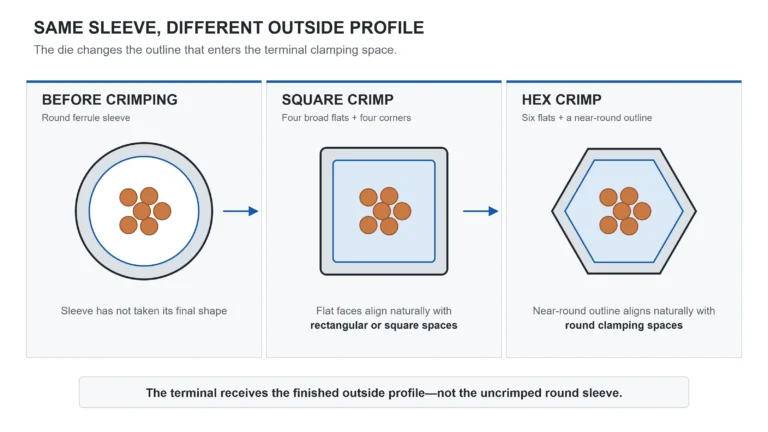
| A correctly sized ferrule binds after crimping | Crimp form against clamping space. At the top of a cross-section range a square crimp will not necessarily fit a round clamping space, and the crimped shape is what has to fit, not the loose ferrule. | Die profile on the crimping tool against the terminal’s clamping space |
| Conductor will not take a ferrule cleanly | Rigid single-strand conductors are generally not crimped into ferrules. Ferrules are designed for stranded conductor classes. | Conductor class on the cable specification |
| Collar will not pass the terminal face | Collar outside diameter against terminal entry, a clearance to be checked separately from both bore and ferrule pin length | Collar dimension on the ferrule drawing |
| Ferrule is loose on the conductor | Wrong cross-section, not wrong length | The conductor’s marked cross-section against the wire ferrule size guide |
Order matters when you are working through this. Cross-section and conductor class are properties of the cable and can be confirmed before anything is crimped. Collar clearance is on the ferrule drawing. Crimp form is a property of the tool and its die. Ferrule pin length is one of several checks that depend on terminal information, which makes it a poor thing to guess at and a sensible one to change last.
Nominal cross-section is also defined by electrical conductance rather than by measured dimensions, so two conductors carrying the same marking can measure differently and sit differently inside the same bore. That is worth eliminating before a fit problem is attributed to the length.
FAQ
What is the standard ferrule pin length?
There is no single standard ferrule pin length. One cross-section is manufactured in several, and the terminal’s stated requirement decides which of them applies to your connection. For 1.5 mm² the listed Termnex catalogue variants run from 6 mm to 18 mm.
How do you measure ferrule pin length?
Measure along the metal sleeve that enters the terminal, from the collar face to the pin nose. That is a shorter figure than the part’s overall length, which includes the collar behind it. Suppliers label these dimensions differently, so read the drawing instead of assuming which number a table is quoting. The wire ferrule size chart sets out the dimension letters.
Should ferrule pin length match the strip length?
The terminal manufacturer’s stated requirement is the starting point for choosing the ferrule. How much insulation you remove from the conductor is a separate number that follows the ferrule manufacturer’s stripping instruction. Keep them apart: they answer different questions, and treating them as one figure is how the wrong part gets ordered.
Is a 10 mm ferrule better than an 8 mm ferrule?
Neither is better. They are different parts for different connection depths, and what the terminal manufacturer specifies decides between them. A 10 mm pin in a terminal built around a shorter connection is the wrong part, however good the crimp.
Does wire gauge determine ferrule pin length?
No. Cross-section fixes the bore, which is why a 1.5 mm² ferrule will not take a 2.5 mm² conductor. Several pin lengths remain available at that same bore, and gauge cannot choose between them.
Does bootlace ferrule pin length mean the same thing?
Yes. Bootlace ferrule is the usual UK name for the same component, and the pin length is the same dimension measured the same way. Vendors label it differently on drawings, which matters more than the name on the box.
Ordering once the terminal has answered
The terminal decides the length, so an order needs both numbers: the conductor cross-section and the pin length that terminal calls for. The Termnex wire ferrule range groups the available cross-sections by insulated, twin and non-insulated type, with several pin lengths at common sizes. Send both figures plus the colour system your drawing cites, and we will point at the part numbers that match. Contact us.