
Keep stranded wire free of solder wherever it goes under a screw clamp or into a crimp. Tinned wire ends, where solder has been melted into the strands, creep under constant clamp pressure, so the connection slowly loses its grip as load and temperature cycle. BS 7671 rules out tinning the whole end at screw terminals, and IPC/WHMA-A-620 keeps solder-tinned strands out of crimps and screw connections. Crimp a correctly sized ferrule onto bare strands instead. Spring clamps are more tolerant, so follow the terminal maker’s data there. Factory tinned-copper wire, with each strand plated before stranding, is a different product and takes ferrules like plain copper.
Why tinned wire ends work loose in screw terminals
Solder flowed into a stranded end fills the gaps between strands and sets into one solid slug of copper and solder. A screw terminal then clamps that slug. The force that should press copper strands against each other and against the terminal body now presses largely on solder.

Solder and copper behave very differently under a steady load. The useful measure is how hot a metal is relative to its own melting point, counted in kelvin. A room at 20 °C (293 K) already puts tin-lead solder at about 64% of its melting point. The same room puts copper at about 22%. For many metals, creep (slow deformation under a constant stress) becomes a significant engineering concern once the temperature reaches about 40% of the absolute melting point.
| Material | Melting point | Room temperature as a share of melting point (in kelvin) | Creep under a steady clamp at normal terminal temperatures |
|---|---|---|---|
| Copper strands | 1,085 °C | about 0.22 | Negligible |
| Tin-lead solder (63/37) | 183 °C | about 0.64 | Significant |
| Lead-free solder (SAC305) | 217–220 °C | about 0.60 | Significant |
Under a screw, the solder therefore flows slowly out of the highest-pressure zone. Clamp force falls and the contact area shrinks. A smaller contact carries the same current through more resistance, so the joint runs warmer, and warmer solder creeps faster. Each pass round that loop makes the next one worse.
Two further effects add to it. Tightening the screw can crack the slug and open voids between strands that were bonded a moment earlier. Solder also expands with heat faster than copper, roughly 21–25 ppm/K against about 17 ppm/K, so every load or ambient temperature cycle shifts the joint a little further from its original fit.
Retightening restores the clamp force for a while. The screw is still pressing on the same soft metal, though, and the same creep starts again. A loose tinned end found during maintenance needs re-terminating; the FAQ below covers how.
What the standards say about tinning stranded wire
Each standard below governs a different kind of work, so the one that applies depends on the job. Read together, they point the same way at screw clamps and crimps.
| Standard | Scope | What it says about solder-tinned ends | Practical meaning for this connection |
|---|---|---|---|
| BS 7671, Regulation 526.9 | Electrical installations in the UK | Multi-wire and fine-wire conductor ends need a suitable terminal or a suitable end treatment; tinning the whole end is not permitted at screw terminals because the solder cold-flows | At screw terminals, use a ferrule or a terminal designed for the conductor |
| IEC 60204-1 and NFPA 79 | Electrical equipment of machines | Where a terminal does not retain the strands, another retaining means is required, and solder is not accepted as that means | A crimped ferrule is the usual retaining means; a terminal that retains strands itself needs none |
| IPC/WHMA-A-620 | Cable and wire harness assemblies | Excludes solder-tinned stranded wire from crimp terminations and from under screws | Crimp, and fit ferrules, on bare strands |
| IPC J-STD-001 | Soldered electrical and electronic assemblies | Same exclusion for crimps and threaded fasteners | Tin only where the termination itself is soldered |
| EN 60999-1 and EN 60335-1, as cited by WAGO | Terminal clamping units; household appliances | Limits on soldered conductor ends apply to screw-type clamps, and EN 60335-1 names spring clamps as one solution | Spring clamps are treated separately, as covered below |
The IET’s Wiring Matters explanation of BS 7671 Regulation 526.9 gives the reasoning in plain terms: soldering the whole end used to be common, and solder cold-flowing around the screw is why it stopped being acceptable.
The standards target the solder and leave the replacement to the terminal. The last column is the engineering consequence, which in practice means a ferrule where the terminal needs one and bare strands where the terminal is rated for them.
Should wires be tinned before crimping?
No. An ordinary crimp, including a ferrule crimp, is designed around bare strands. The die squeezes the strands against each other and against the barrel until they form a dense, gas-tight body, and the tool and its settings were developed and checked on that kind of conductor end.
Solder changes the starting point. A tinned end has a different diameter, and its strands are bonded, so they cannot shift and pack the way loose strands do under the die. The crimp also traps solder inside a joint that stays under stress for its whole service life, and that solder creeps for the same reasons it does under a screw. IPC/WHMA-A-620 and J-STD-001 both keep solder-tinned strands out of crimp terminations for this reason.
Wicking causes a second problem further back. Solder runs up the strands beyond the crimp and leaves a stiff section with flexible wire behind it. Under vibration the bending concentrates where stiff meets flexible, and strands break there, just behind the crimp, where a break is hardest to see.
A ferrule pressed over a solder-tinned end takes on every one of these problems. Ferrules go onto freshly stripped, bare strands.
Spring-clamp and push-in terminals
Spring clamps are more forgiving. A spring keeps pushing as the material beneath it slowly gives way, so it makes up for some of the creep that loosens a screw. WAGO’s product FAQ on its PCB terminal blocks permits solder-tinned ends in its screwless spring clamps in stationary installations for that reason. On vibrating equipment such as engines, WAGO allows only the tip to be tinned, to stop splaying, and the fully tinned end is out. That is one maker’s documented position for its own products, and other spring and push-in terminals set their own conditions.
The practical default is simpler. Where the terminal is rated for flexible conductors, insert bare strands, opening the clamp with the release if the design needs it. Where the terminal data calls for a ferrule, crimp one that matches the cross-section, strip length and ferrule length the data gives. A ferrule also does the job some installers use solder for, which is stiffening a flexible end so it pushes straight into a push-in terminal.
“Tinned” can mean three different things
Three quite different products are all described as tinned, which causes real confusion when buying cable and ferrules. Only one of them causes the problems above.
| What is called “tinned” | How it is made | Fine in a screw clamp or crimp? | What to watch |
|---|---|---|---|
| Solder-tinned wire end | Solder melted into the stripped end by the installer, bonding the strands into one slug | Keep it out of screw clamps and crimps; spring clamps per the maker’s data | The wicked length behind the end |
| Tinned-copper conductor | Each strand tin-plated at the factory before stranding; common in marine and outdoor cable | Yes. The strands stay separate and behave like plain copper | Size the ferrule by cross-section, as for any copper conductor |
| Tin-plated ferrule barrel | Thin tin finish on the copper ferrule tube | Yes. It is the normal ferrule finish | Correct size and crimp, as for any ferrule |

The difference is structure, and colour is no guide because all three look silver. In a tinned-copper conductor each strand carries its own thin plating, and the strands can still move and pack under a crimp die or a clamp. A solder-tinned end has lost that freedom, because solder fills the space between strands and locks them together. A marine cable made from tinned copper therefore takes ferrules and screw terminals normally, and a tin-plated copper ferrule is the standard product.
Where tinning is the right preparation
Tinning has a proper job: preparing a wire for a joint that will itself be soldered. A pre-tinned wire takes solder quickly and evenly, which shortens the time the iron sits on the wire. Typical cases:
- solder cups on connectors such as D-sub and circular types
- PCB pads and through-holes
- turret, tag and eyelet terminals
In each of these the solder joint is the connection, and nothing clamps or crimps the solder afterwards. Keep the tinned length as short as the joint needs, so the rest of the wire stays flexible. Mesh splices are the exception to watch: the finished joint is soldered, but the strands have to interlace first, so the workmanship standards exclude pre-tinning them as well.
What to use instead of tinning
Most installers tin stranded ends to stop strands splaying as the wire goes into a terminal. A crimped ferrule solves that permanently and leaves copper under the clamp.
- Decide terminal by terminal whether a ferrule is needed. Terminals rated for flexible conductors accept bare strands, and the guide to whether stranded wire needs a ferrule works through the choice by terminal type.
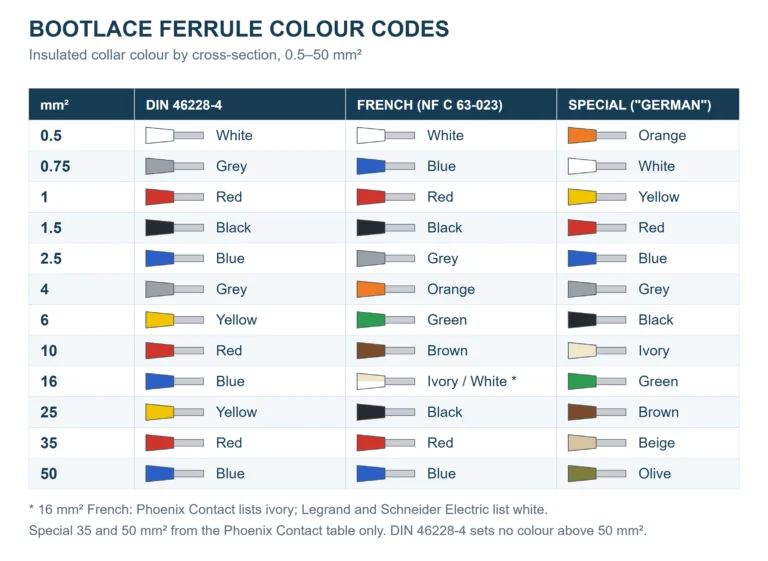
- Match the ferrule to the conductor cross-section with a wire ferrule size chart in mm² and AWG, and check that the pin length suits the terminal’s clamping depth.
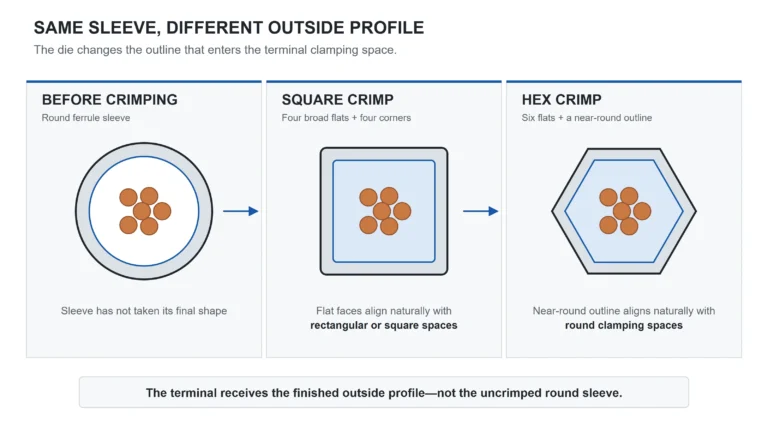
- Crimp with a tool and die made for ferrules, following the step-by-step ferrule crimping method. Flat pliers and screw pressure leave the ferrule unformed.
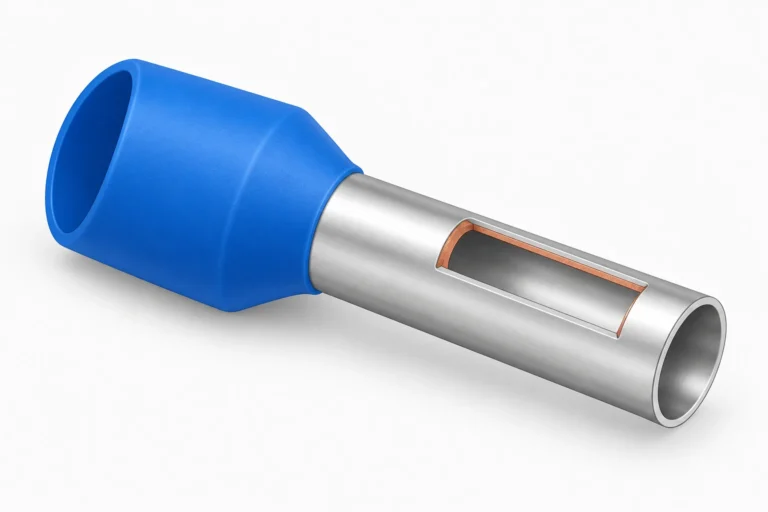
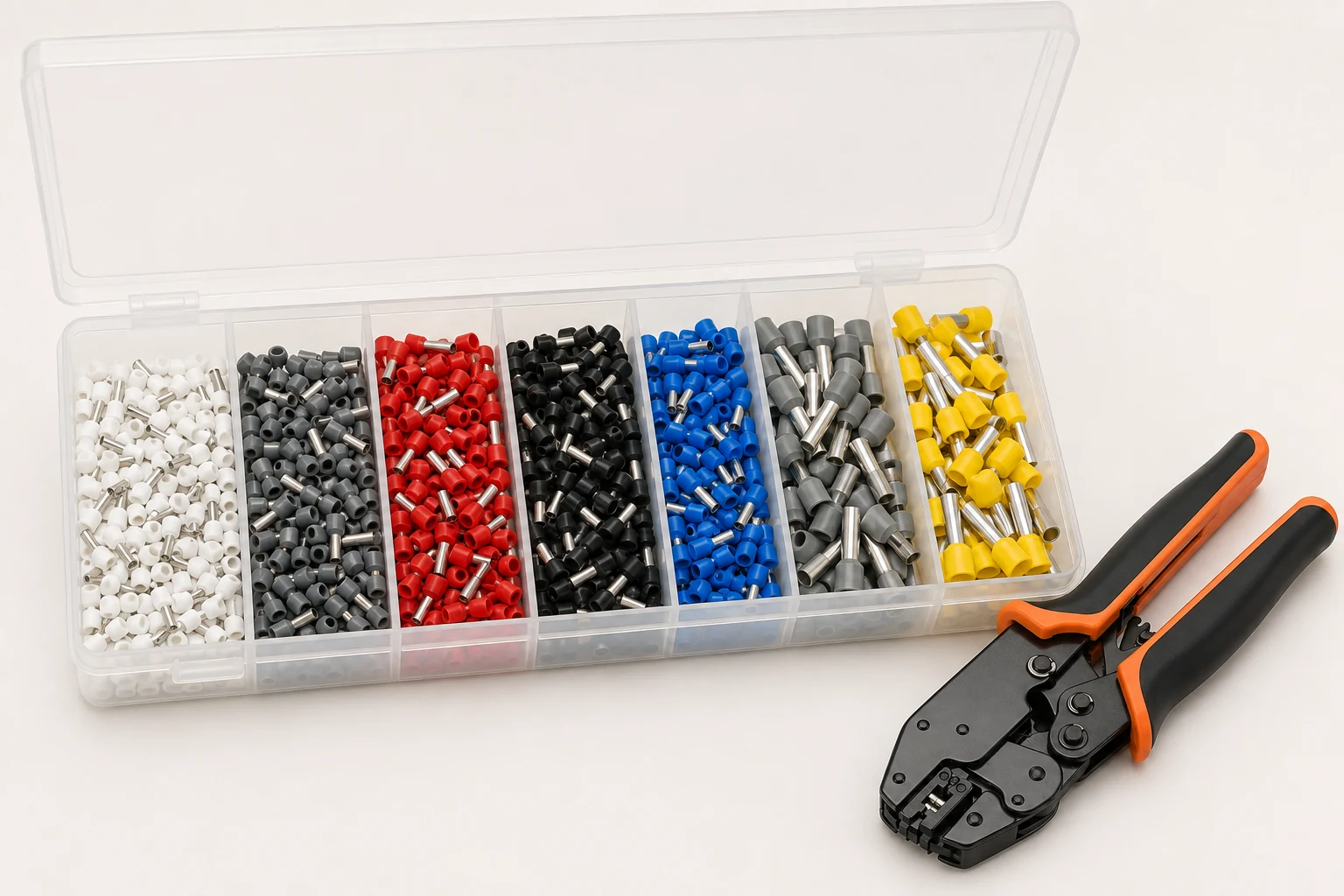
Termnex wire ferrules come in insulated, twin and non-insulated types, all with tin-plated copper barrels. A shop that has tinned ends by habit often has no ferrule crimper yet, and the ferrule crimping tools page covers a square-profile hand crimper for 0.25–6 mm² control wiring and a larger one up to 35 mm².
FAQ
Is it OK to tin just the tip of a stranded wire?
For screw connections and ordinary crimps, the part under pressure should carry no added solder, so a tip-only tin has to stop short of the clamped length. BS 7671 targets tinning the whole conductor end. Solder wicks along the strands quickly, which makes that hard to control, and bare strands in a suitable terminal or a crimped ferrule are simpler ways to stop fraying. Spring clamps follow the terminal maker’s conditions; WAGO, for example, allows tip-only tinning in its spring clamps on vibrating equipment.
How do you fix tinned wire ends already in a screw terminal?
Cut the wire back past the soldered and wicked length, strip fresh copper, and terminate it again with a ferrule or bare strands as the terminal allows. Tighten the screw to the terminal maker’s torque value. Retightening the old tinned end only holds until the solder creeps again. For tinned ends in a spring clamp, check the terminal maker’s conditions for the installation before deciding to re-terminate.
Moving a panel off tinned ends
Switching a whole practice from solder to ferrules usually means stocking several sizes at once. A mixed-size wire ferrule kit covers the common control-wiring cross-sections in one box. To get a quote, contact us with the conductor sizes and whether they are standard or fine-stranded, the terminal types on the job, and a rough quantity per size, and we will suggest a kit or loose packs to match.