
A twin wire ferrule (also called a double bootlace ferrule) takes two conductors into a single oblong crimp sleeve so both land on one terminal point. Panel builders reach for them in daisy chains and jumper connections, but a twin ferrule only works when the terminal manufacturer’s data sheet lists that clamping point for two conductors at the relevant size.
How a twin wire ferrule works
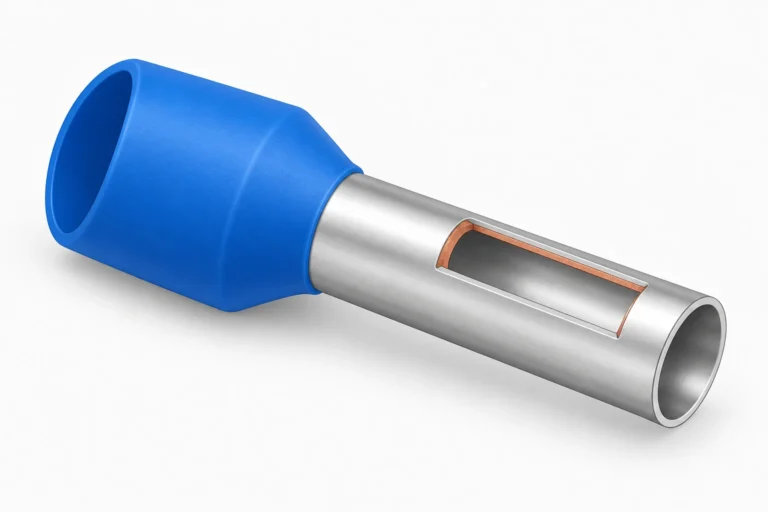
A standard wire ferrule has a round metal barrel sized for one conductor, with a plastic collar at the entry end. A twin wire ferrule keeps the same two-part construction but widens both parts: the plastic collar carries two separate conical entry funnels, one per conductor, and those funnels feed into a single wider oblong (oval) metal sleeve that both conductors share.
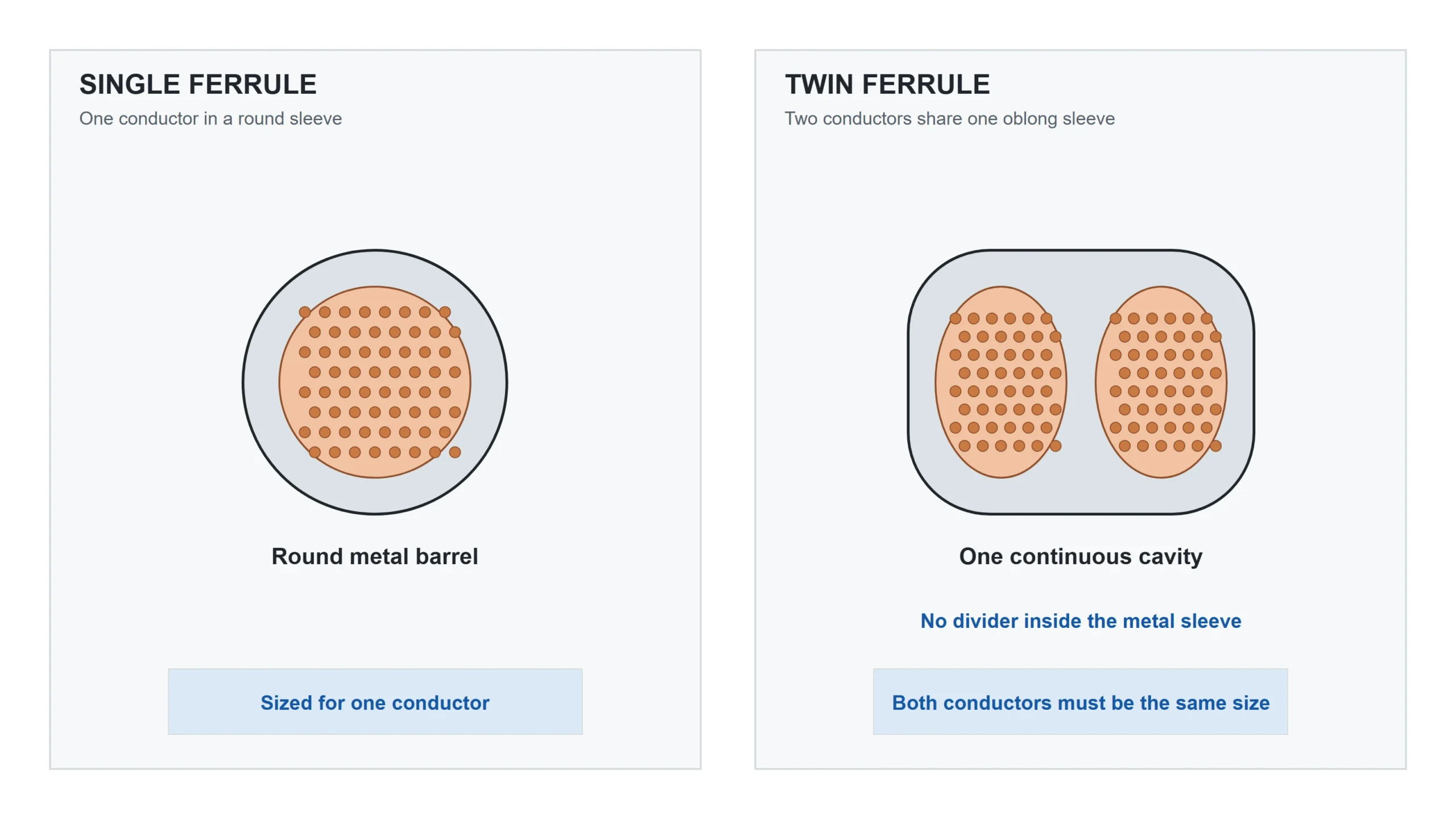
Strip both conductors to the correct length, insert one into each entry, and crimp. The crimping tool compresses the oval metal sleeve (not the plastic collar) around both conductors in one stroke. The result is one crimped termination that fits into one clamping point.
One detail that the crimp alone does not settle: inserting a twin ferrule into a terminal does not change the terminal’s permitted conductor configuration. Three separate questions sit behind any twin-ferrule connection, and each has a different authority:
- What the ferrule is. DIN 46228-4 covers insulated tubular end sleeves, so ferrule construction and dimensional requirements trace back to the standard and the supplier’s catalogue.
- Whether the terminal accepts it. Only the terminal manufacturer’s connection data answers this, per model and per conductor size.
- Whether the installation permits it. Application rules for the panel or machine, including how protective conductors may be landed, come from the standard governing that installation.
A ferrule that satisfies the first question tells you nothing about the second or third.
When to use twin wire ferrules
The typical reason for reaching for a twin wire ferrule is a loop-through connection: an incoming supply conductor and one outgoing conductor landing together at the same terminal, so the supply continues to the next device. Exactly two conductors, which is what a twin ferrule holds. If a third conductor is needed at that point, a twin ferrule is not the answer.
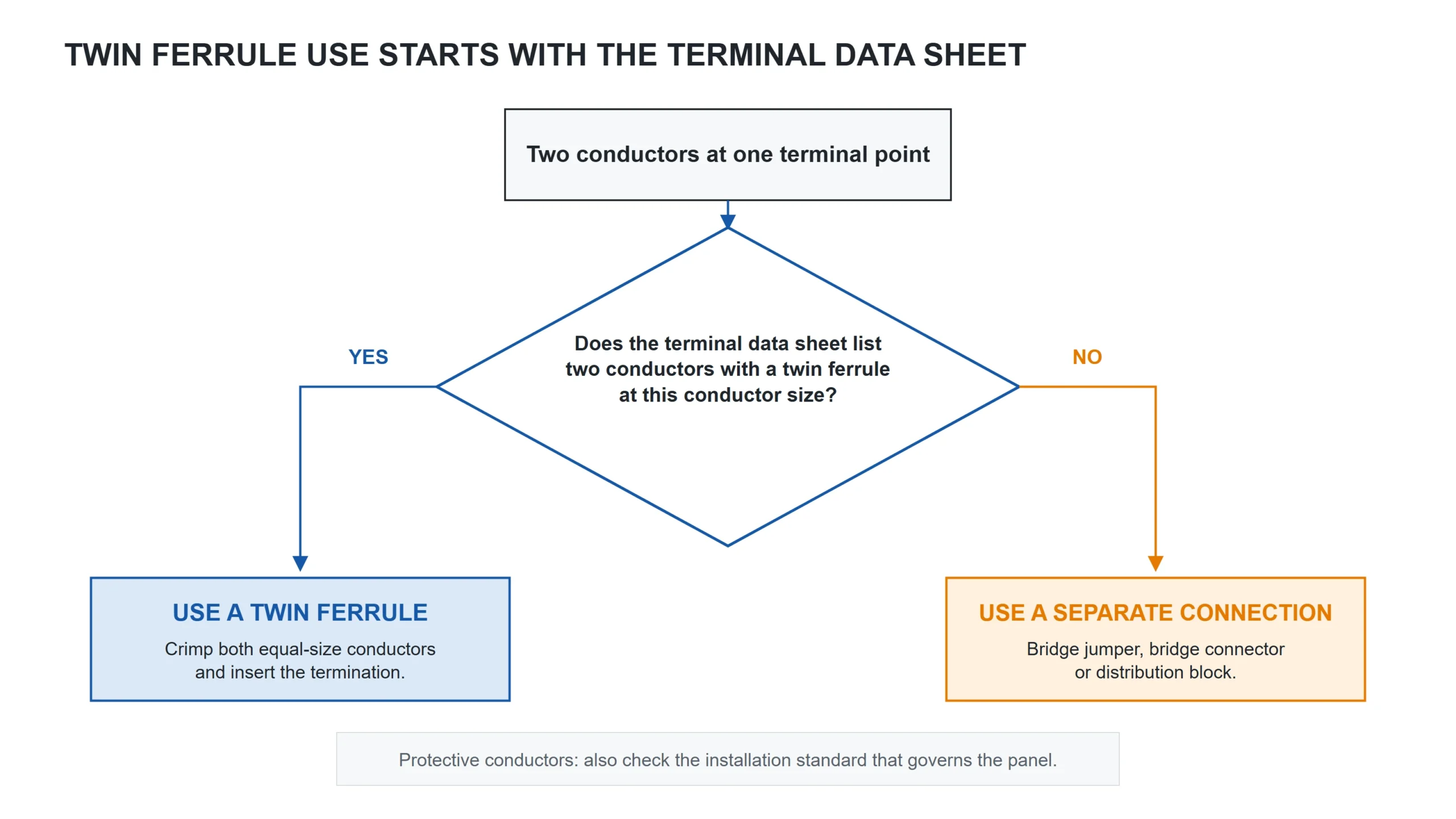
Two loose stranded conductors should not be pushed into one clamping point unless the terminal’s documentation expressly permits that bare-wire configuration. A twin ferrule turns the pair into one defined crimped termination, but it does not by itself authorise the connection. Here is the decision sequence:
- Open the terminal manufacturer’s data sheet and find the connection data for your specific model. Look for a line that lists “2 conductors with TWIN ferrule” or equivalent language, along with the accepted conductor sizes. Each listing is model-specific and size-specific, not a brand-wide rule.
- If the terminal lists twin-ferrule connections at your conductor size, use a twin wire ferrule and crimp both conductors into one sleeve.
- If the terminal lists one conductor only, a twin ferrule does not override that restriction. Use a bridging jumper, a bridge connector on the DIN rail, or a distribution block to split the connection properly.
Phoenix Contact’s PT 6-TWIN-PE shows what that entry looks like in practice. Its product data lists “2 conductors with the same cross section … with TWIN ferrule” as a separate connection category with its own size range of 0.5–2.5 mm², alongside a minimum sleeve length recommendation of 13 mm. Note that the twin-ferrule range for this category is narrower than the terminal’s headline size. Other manufacturers (WAGO, Weidmüller) publish comparable per-model connection tables, and the permitted sizes and ferrule types differ between terminal models.
A note on protective conductors: Protective-earth connections carry application-level requirements that sit outside both the ferrule catalogue and the terminal data sheet. Some installation and machinery standards restrict how many protective conductors may share one connection point, and whether a PE connection may be interrupted by removing a single conductor. The PT 6-TWIN-PE cited above is itself a protective-conductor terminal that Phoenix Contact documents for twin ferrules, so a twin ferrule on PE is not categorically prohibited. Before landing two protective conductors at one point, check the standard that governs your installation, not only the terminal’s connection table.
When not to use twin wire ferrules
Three situations where a twin wire ferrule is the wrong answer:
- The terminal accepts one conductor only. A twin ferrule produces a clean crimp, but inserting it into a terminal that is documented for single-conductor connections violates the terminal’s rated configuration. The correct alternative is a bridge jumper across two adjacent terminals or a distribution block.
- The two conductors are different sizes. Twin wire ferrules are specified for two conductors of equal cross-section, which is how Phoenix Contact, Weidmüller, and other manufacturers document them in their connection data. If your application requires combining a 1.5 mm² and a 2.5 mm² conductor at one point, use separate terminals with a bridge, or consult the ferrule and terminal manufacturers for an explicitly approved mixed-size configuration.
- The twin ferrule falls outside the terminal’s stated twin-ferrule entry. A terminal’s twin-ferrule connection category carries its own conductor size range and often a sleeve length figure, and those numbers are usually narrower than the terminal’s headline capacity. Match the ferrule to the cross-section and sleeve length the terminal actually lists for twin ferrules, and not to the terminal’s largest single-conductor rating.
Twin wire ferrule sizes
A ferrule accepts only the conductor count and equal-size configuration it is designed for. A standard single ferrule takes one conductor. A twin wire ferrule takes two of the same cross-section. The terminal must also be documented for that configuration.
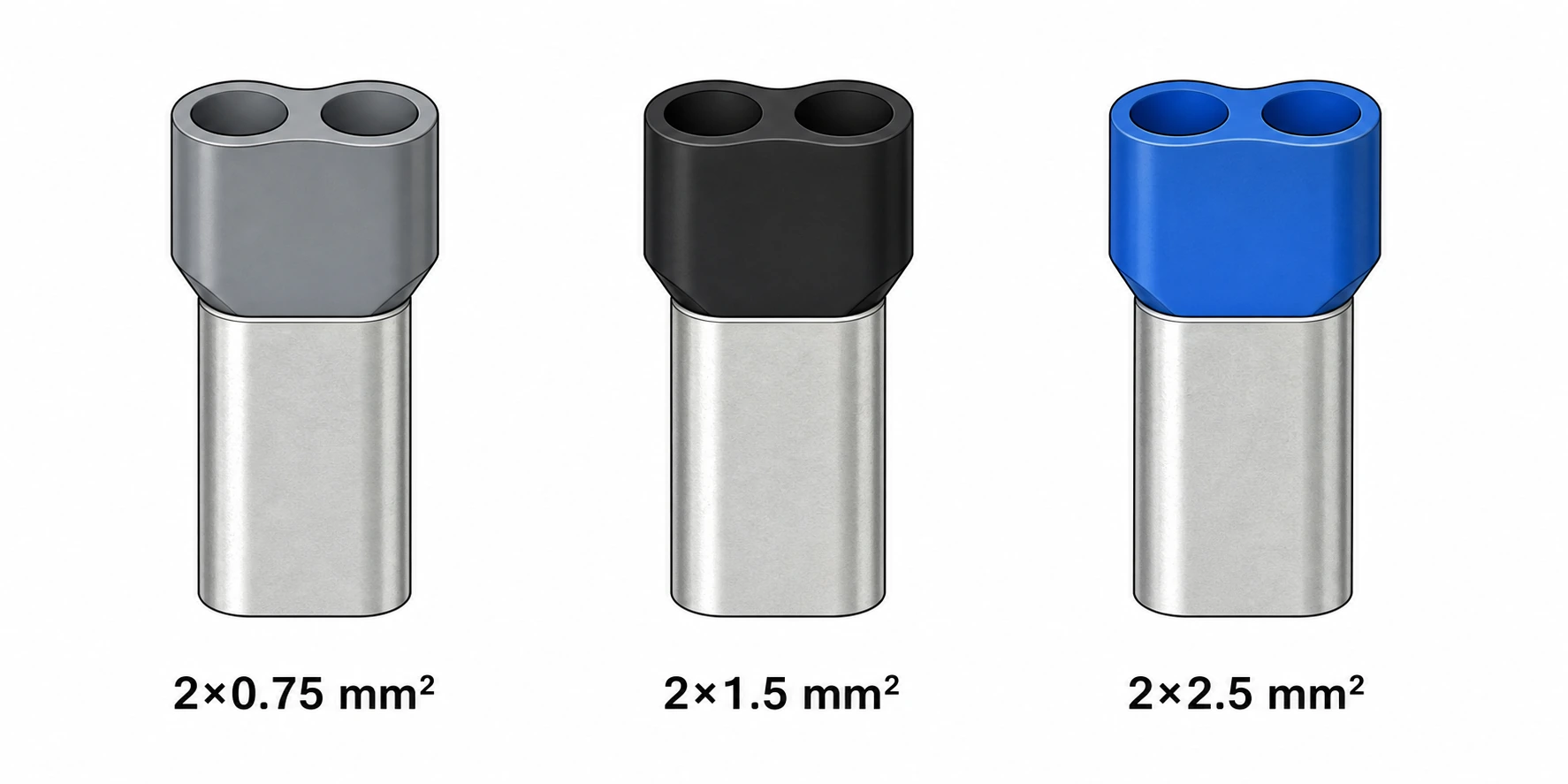
Catalogue ranges vary by manufacturer. Weidmüller’s automation and machines catalogue lists twin ferrules from 2×0.34 mm² through 2×16 mm², so treat any stated range as that supplier’s portfolio rather than a market boundary. The table below shows five sizes that appear across most catalogues:
| Conductor pair | Representative sleeve lengths | Catalogue colour examples |
|---|---|---|
| 2×0.75 mm² | 8 mm or 10 mm | Grey, White |
| 2×1.5 mm² | 8 mm or 10 mm | Black, Red |
| 2×2.5 mm² | 8 mm, 10 mm or 13 mm | Blue, Grey |
| 2×4 mm² | 12 mm | Orange, Grey |
| 2×6 mm² | 14 mm | Green, Black |
The Termnex twin range covers those same five pairs: HTE7510 at 2×0.75 mm², HTE1510 at 2×1.5 mm², HTE2513 at 2×2.5 mm², HTE4012 at 2×4 mm² and HTE6014 at 2×6 mm². The single and twin models for one conductor size sit side by side on the 1.5 mm² bootlace ferrule page and the other cross-section pages.
Colours are not interchangeable between catalogues. Manufacturers publish separate DIN 46228-4 colour codes and house colour codes for the same cross-section, so confirm the colour against the specific supplier’s chart; there is no single industry-wide assignment.
Use mm² as the controlling dimension when selecting a twin ferrule. AWG values printed on packaging are catalogue labels that vary between manufacturers. Weidmüller, for example, labels 2×0.5 mm² as 2×AWG 20, while other catalogues may show 2×AWG 22 for the same size. The mm² cross-section is the reliable sizing reference.
On current ratings: Some ferrule catalogues print a current value next to each conductor size. That figure is a ferrule-level catalogue entry, and it does not define the allowable current for the finished conductor–ferrule–terminal–circuit combination. The terminal manufacturer’s connection data and the circuit’s protective device govern what current the connection may carry. A twin ferrule does not create extra capacity at the terminal, so the two conductors’ catalogue figures cannot be added together.
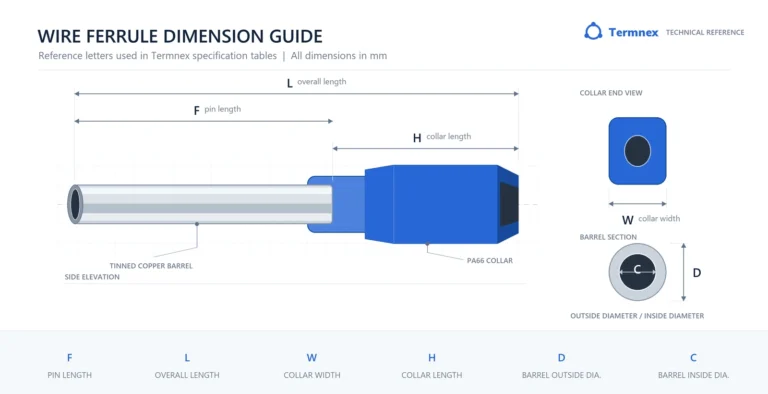
For the full dimension table with pin lengths, barrel diameters, collar widths, and pack quantities, see the twin wire ferrules and double bootlace ferrules product page. When one conductor pair is listed with several sleeve lengths, use the ferrule pin length guide before choosing among them. For single and non-insulated sizes, see the wire ferrule sizes guide.
Crimping a twin wire ferrule
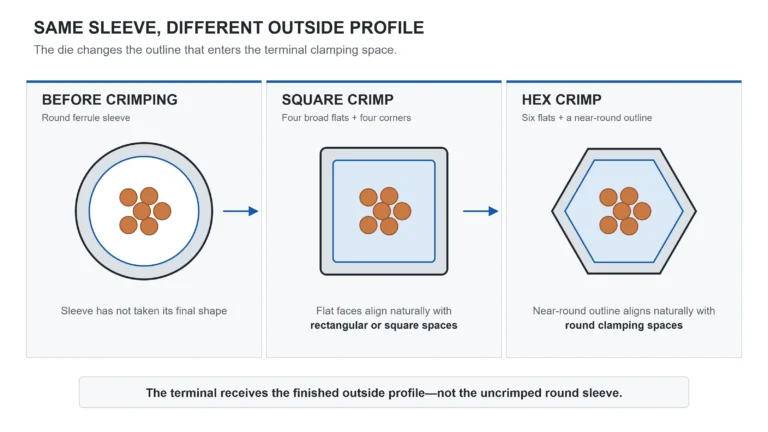
Twin wire ferrules use the same crimp profiles as single ferrules (square or trapezoidal), but the wider oval metal sleeve means the crimping tool must explicitly cover the twin size. Tool requirements are product-specific:
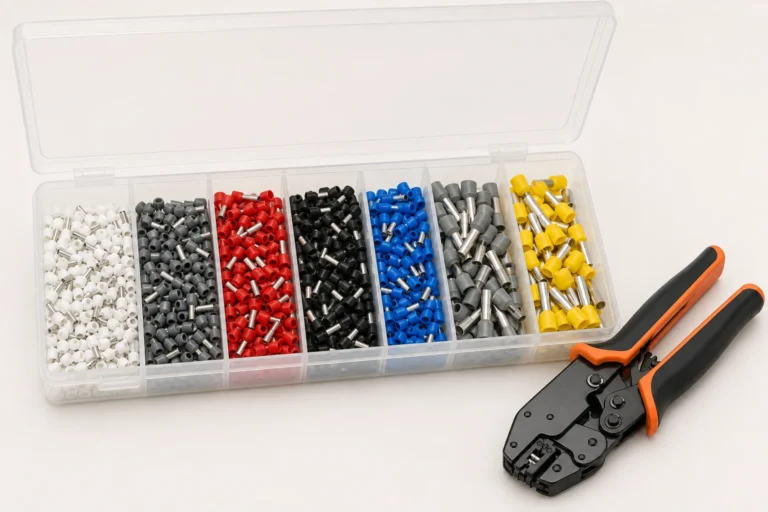
- Self-adjusting crimping tools may cover twin sizes within their stated range. Check the tool manufacturer’s specification: a tool rated to 6 mm² for single ferrules does not automatically cover 2×6 mm² twins.
- Larger twin ferrules may require a separate crimping die. Knipex, for example, lists die 97 49 18 for twin ferrules in 2×6, 2×10 and 2×16 mm². A die is not a standalone tool: it fits the manufacturer’s compatible crimp-system pliers.
- Always verify the tool manufacturer’s stated twin-ferrule capacity before crimping. The single-ferrule range on the tool’s label is not sufficient.
After crimping, a gentle retention check will catch an obviously failed crimp: neither conductor should slide out when tugged lightly, and the crimped sleeve should look uniform, without cracks or a lopsided profile. Passing that look-and-tug does not establish crimp quality. Acceptance criteria come from the ferrule and tool manufacturer’s documented inspection instructions, including any calibrated pull-out test they specify.
For the full step-by-step crimping technique, including crimp profile selection and common mistakes, see the ferrule crimping guide.
FAQ
Can I put three wires in a twin wire ferrule?
No. A twin wire ferrule is designed for exactly two conductors of equal cross-section. For three conductors at one terminal point, use a distribution terminal. Triple wire ferrules do exist for some sizes, but in every case the terminal manufacturer’s data sheet must list the three-conductor configuration; the ferrule alone does not authorise it.
Are twin wire ferrules the same as double bootlace ferrules?
Same product, different names. Twin wire ferrule, double wire ferrule, double bootlace ferrule, and twin bootlace ferrule all describe a single oblong-barrel crimp sleeve for two conductors. The preferred name varies by supplier and catalogue, and search demand for the “bootlace” variants is noticeably stronger in UK data than in US data.
Do twin wire ferrules work with push-in terminals?
It depends on the terminal. The terminal’s data sheet must list two conductors with a twin ferrule, and the twin-ferrule category has its own conductor size range and sleeve length, usually narrower than the terminal’s headline capacity. Check that connection data for the specific model; ferrule size alone does not establish compatibility.
What sizes are commercially available for twin wire ferrules?
Ranges differ by supplier. Weidmüller’s automation and machines catalogue lists twin ferrules from 2×0.34 mm² through 2×16 mm², and other catalogues start at 2×0.5 mm². Both limits reflect that manufacturer’s portfolio rather than a standards-defined maximum, and AWG labels printed alongside are catalogue designations that vary between suppliers. Check the specific supplier’s catalogue for the exact range and available sleeve lengths. The Termnex twin range runs from 2×0.5 mm² to 2×16 mm².
How many wires can you put in a ferrule?
A standard single ferrule takes one conductor. A twin ferrule takes exactly two conductors of the same cross-section. The number is fixed by the ferrule design, and the terminal must also be documented for that conductor count. There is no adjustable multi-wire ferrule.
Ordering twin ferrules for a specific terminal
Twin ferrules are bought against a terminal’s twin-conductor entry, not its headline capacity, so an order starts with that figure. The Termnex twin range runs 2×0.5 to 2×16 mm² in DIN 46228-4 colours, and mixed boxes can be built to a stated ratio. Send the conductor pair, the colour system and the quantity, and we can quote the pair, the colour and the box split together. Contact us.