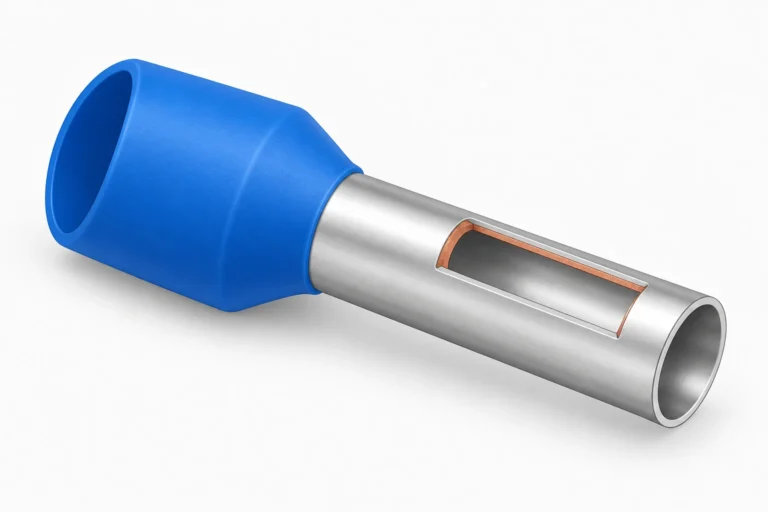

Insulated vs non-insulated ferrules comes down to one plastic collar. Product listings also call the insulated type an insulated bootlace ferrule, and the non-insulated type an uninsulated bootlace ferrule. Both use the same tinned copper barrel for a given conductor size. The collar adds colour identification, an insertion funnel, and diameter at the terminal face. The practical differences follow from that collar.
What separates insulated and non-insulated ferrules
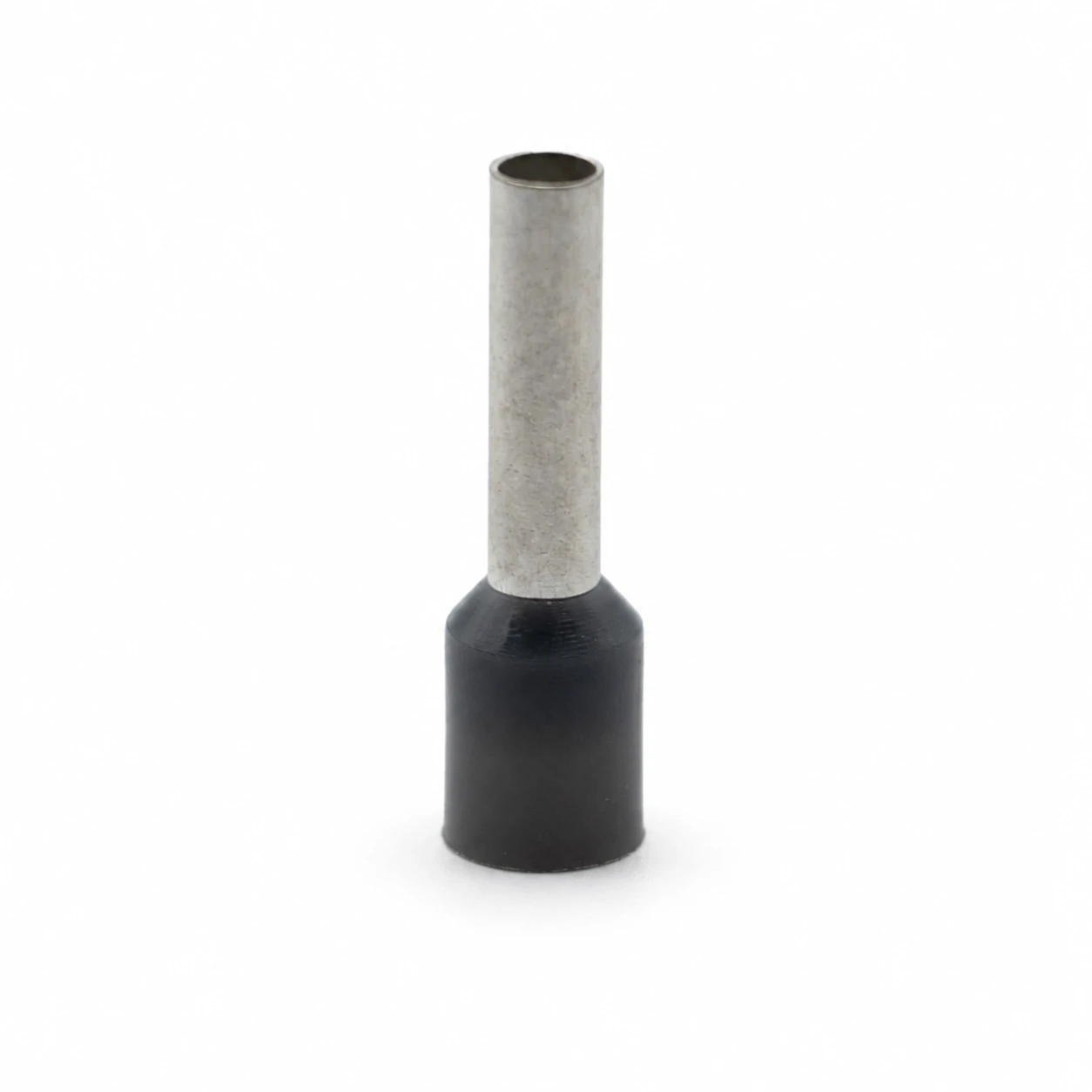
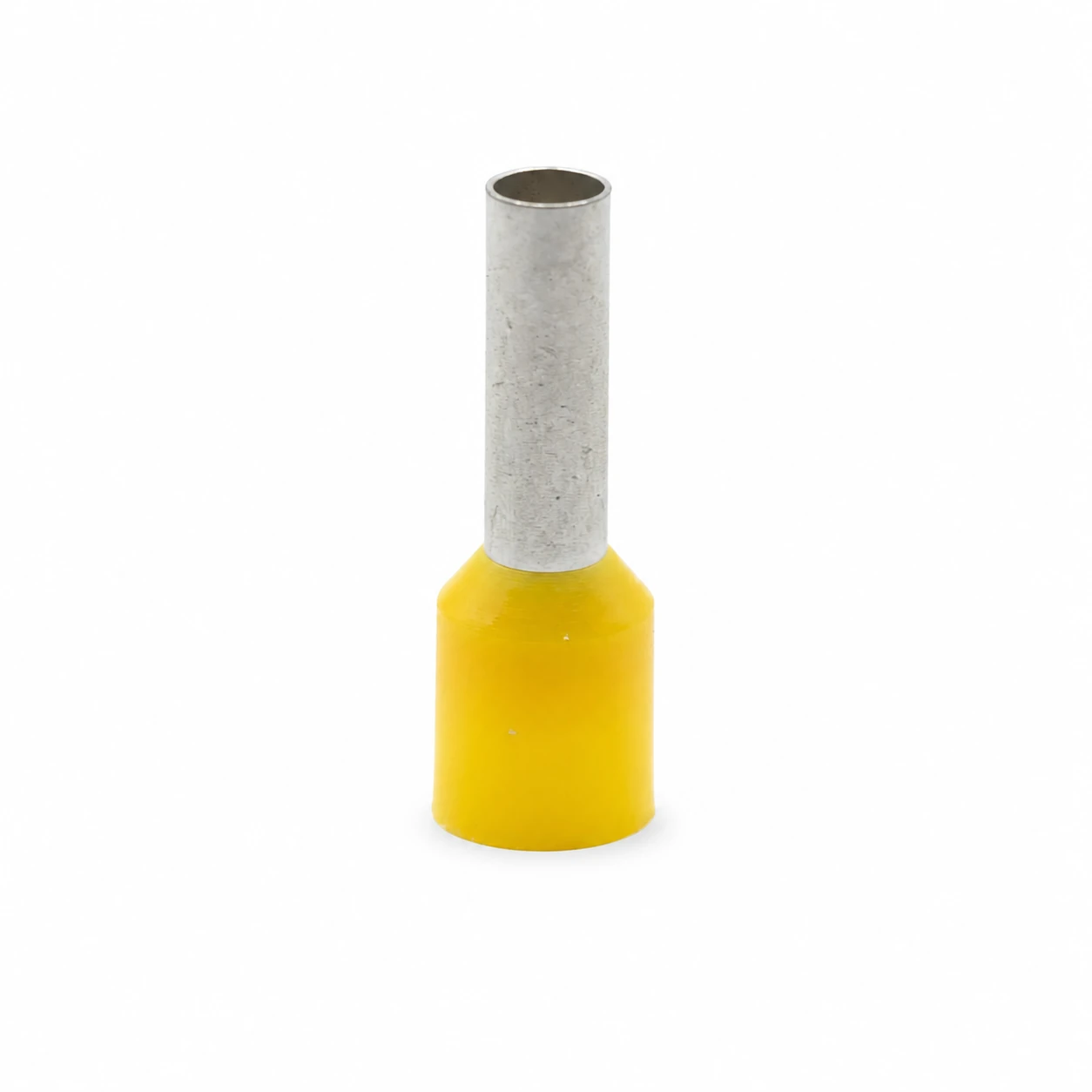
A wire ferrule (also called a bootlace ferrule, cable ferrule, or cord end terminal) is a tinned copper tube crimped onto stranded wire. Two parts of the same standard cover the two versions: DIN 46228-1 covers non-insulated cord end terminals, and DIN 46228-4 covers insulated ones. The insulated version adds a moulded plastic collar at the wire entry. That collar is the entire difference.
| Insulated (DIN 46228-4) | Non-insulated (DIN 46228-1) | |
|---|---|---|
| Crimped barrel | Tinned copper | Tinned copper |
| Collar at wire entry | Moulded plastic, commonly PA66 nylon | None |
| Colour identification | Yes, per DIN 47002 | None; every size looks the same |
| Insertion funnel | Flared, guides stray strands | Chamfered tube mouth only |
| Crimp visible after termination | Barrel only | Full length |
| Diameter at terminal face | Barrel plus collar | Barrel only |
Not the same as insulated ring or spade terminals
Search results for this comparison mix two different products. A ferrule is crimped onto a wire end so the wire can enter a screw or spring clamp. A ring or spade terminal is crimped onto a wire so it can bolt onto a stud or screw post.
The insulation decision is not the same on both. Ring and spade terminals carry insulation over the crimp barrel itself, so insulated and non-insulated versions need different crimping dies. Ferrules carry the collar outside the crimp zone, so the crimp is on bare metal either way. If the part in your hand bolts down, the rest of this article does not apply to it.
Where the insulated collar actually takes up space
Most comparisons say insulated bootlace ferrules need more clearance and stop there. Google’s AI Overview goes further and calls them unsuitable for ultra-compact spaces. Paired catalogue data does not support that framing, and the reason is worth following.
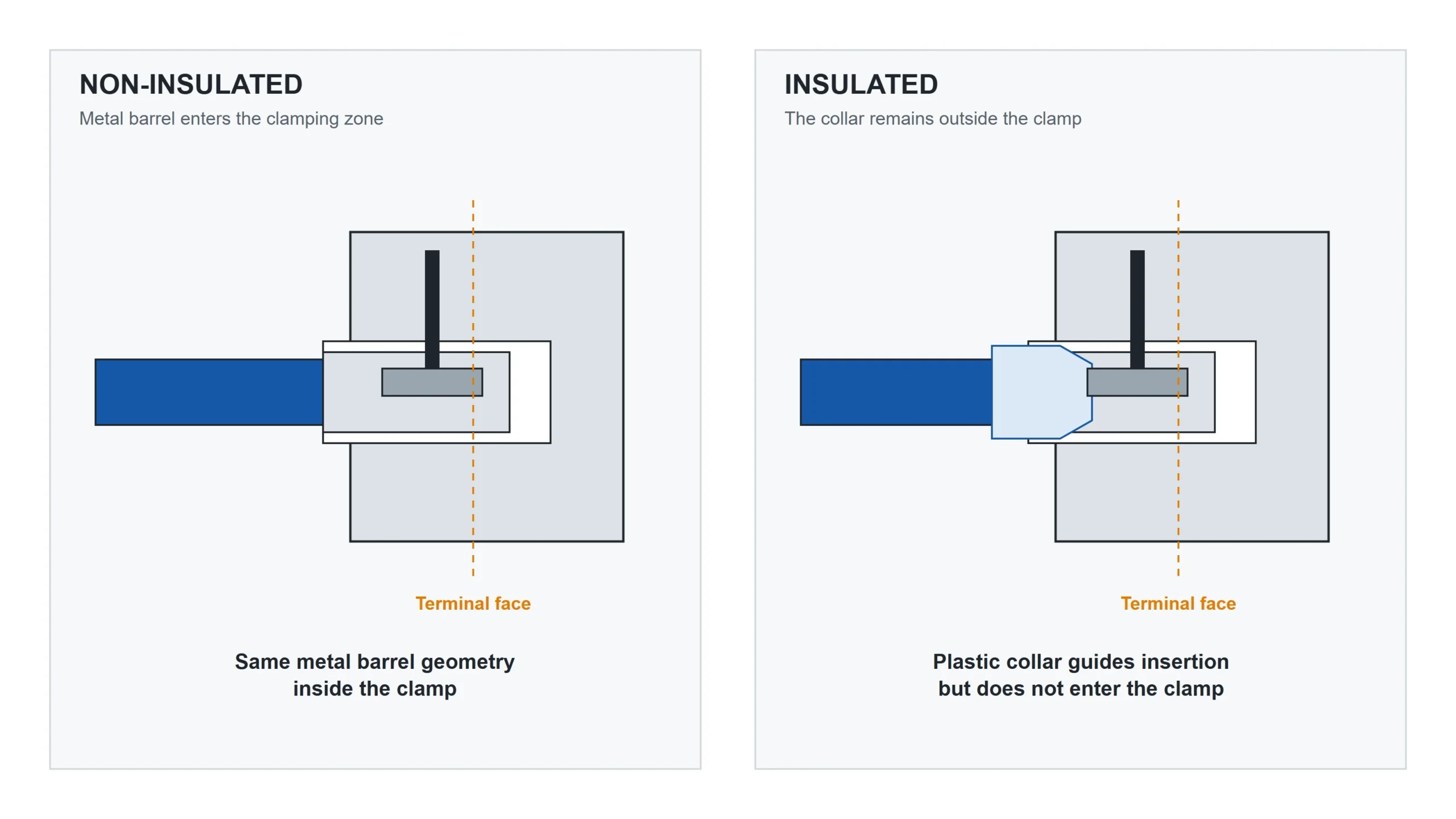
The part that enters the terminal is the crimped metal barrel. The plastic collar stops at the terminal face. So the question is not whether the collar fits the clamp, since it never goes in, but how much room it takes up around the entry.
The barrel is the same on both types. Comparing one supplier’s insulated and non-insulated series at matching cross-sections:
| Cross-section | Insulated barrel OD / bore | Non-insulated barrel OD / bore |
|---|---|---|
| 0.5 mm² | 1.3 / 1.0 mm | 1.3 / 1.0 mm |
| 0.75 mm² | 1.5 / 1.2 mm | 1.5 / 1.2 mm |
| 1.0 mm² | 1.8 / 1.4 mm | 1.8 / 1.4 mm |
| 1.5 mm² | 2.0 / 1.7 mm | 2.0 / 1.7 mm |
| 2.5 mm² | 2.6 / 2.3 mm | 2.6 / 2.3 mm |
| 4 mm² | 3.2 / 2.8 mm | 3.2 / 2.8 mm |
| 6 mm² | 3.9 / 3.5 mm | 3.9 / 3.5 mm |
Seven sizes, identical at every one. Both types are built around the same conductor, so the crimped barrel comes out the same. An insulated ferrule and a non-insulated ferrule of the same cross-section present the same geometry to the clamp.
What the collar costs is diameter at the terminal face:
| Cross-section | Barrel OD (both types) | Insulated collar OD | Collar adds |
|---|---|---|---|
| 0.5 mm² | 1.3 mm | 2.6 mm | +1.3 mm |
| 0.75 mm² | 1.5 mm | 2.8 mm | +1.3 mm |
| 1.0 mm² | 1.8 mm | 3.0 mm | +1.2 mm |
| 1.5 mm² | 2.0 mm | 3.5 mm | +1.5 mm |
| 2.5 mm² | 2.6 mm | 4.0 mm | +1.4 mm |
| 4 mm² | 3.2 mm | 4.8 mm | +1.6 mm |
| 6 mm² | 3.9 mm | 6.0 mm | +2.1 mm |
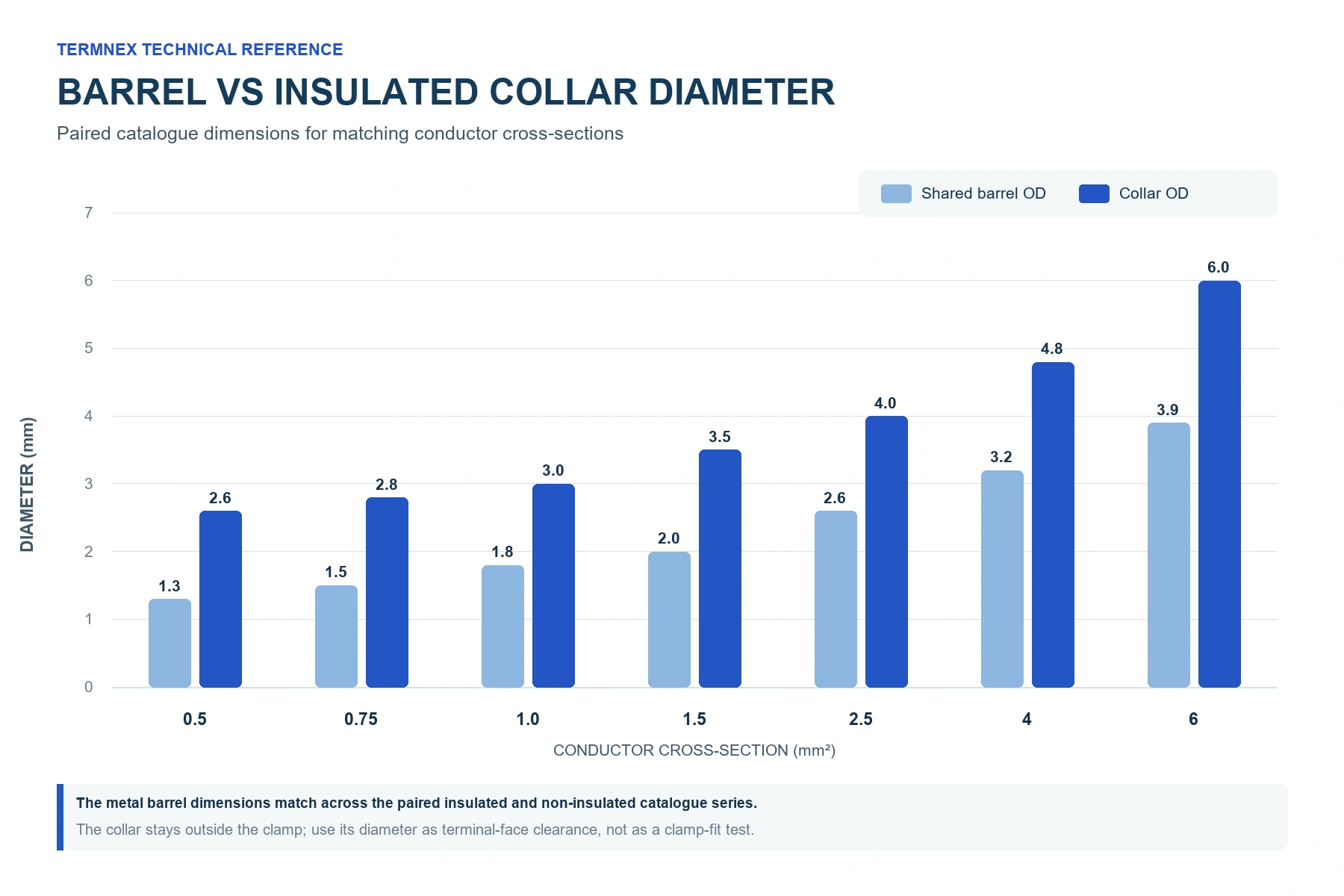
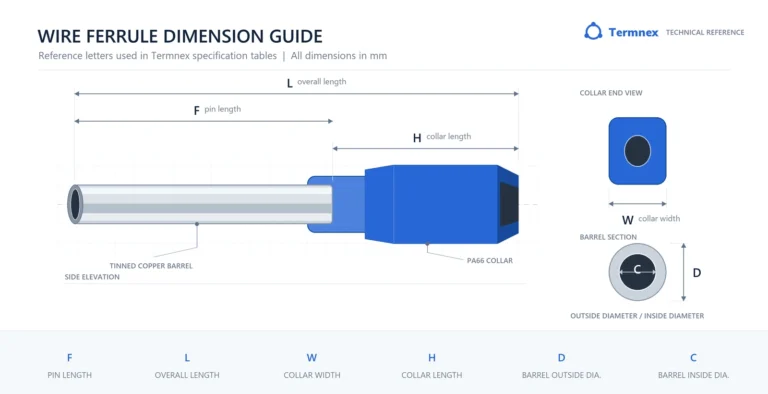
Both figures come from one supplier’s catalogue, so the two series are directly comparable. The collar figure is the sleeve’s outside diameter, the dimension DIN 46228-4 lists as d₂, and the catalogue values sit inside the tolerance band that standard publishes for it. That is a useful consistency check, not a substitute for the specific catalogue you are buying from. Note that the table covers diameter only; how far the collar projects back from the terminal face is a separate dimension worth checking when duct fill is tight.
Read the second table as a clearance budget, not a fit test. The collar diameter governs how closely adjacent ferrules sit at the terminal face, how much room a row of terminations needs, and how full the wire duct gets. Those are real constraints in a dense panel. They are solved by checking terminal pitch and duct fill, not by switching ferrule type.
One qualifier the tables cannot carry: final fit still depends on barrel dimensions, pin length, and the conductor range the terminal manufacturer permits for that model. The ferrule catalogue answers what the ferrule is. Only the terminal’s connection data answers what the terminal accepts.
Colour coding exists only on insulated ferrules
Colour is the most visible advantage of insulated ferrules, and the most commonly overstated. The colours come from DIN 47002, not from DIN 46228-4, which governs the dimensions. The two standard numbers are often confused, including by pages currently ranking for this comparison.
The published sequence runs twelve steps:
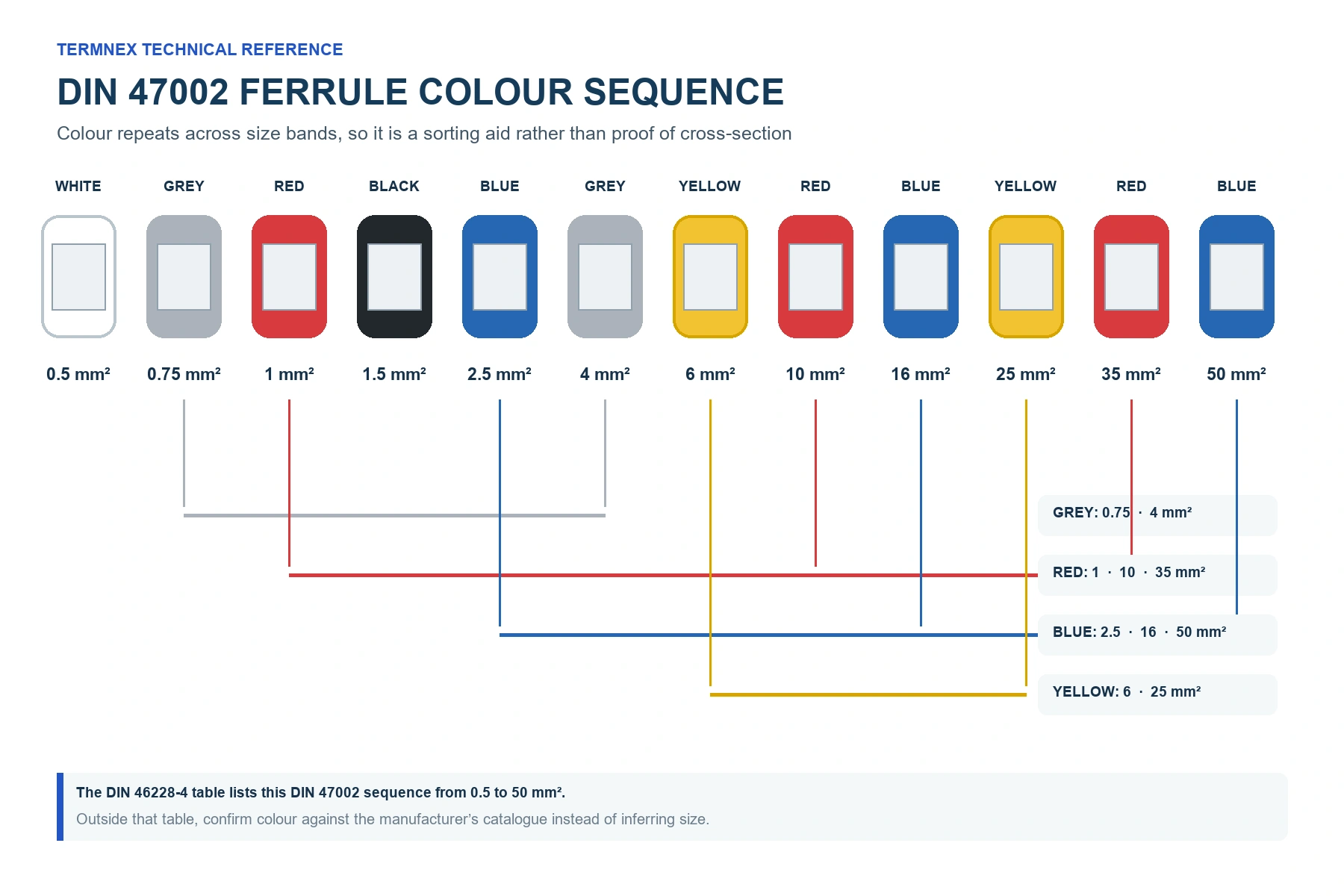
Two things about that list matter more than the list itself.
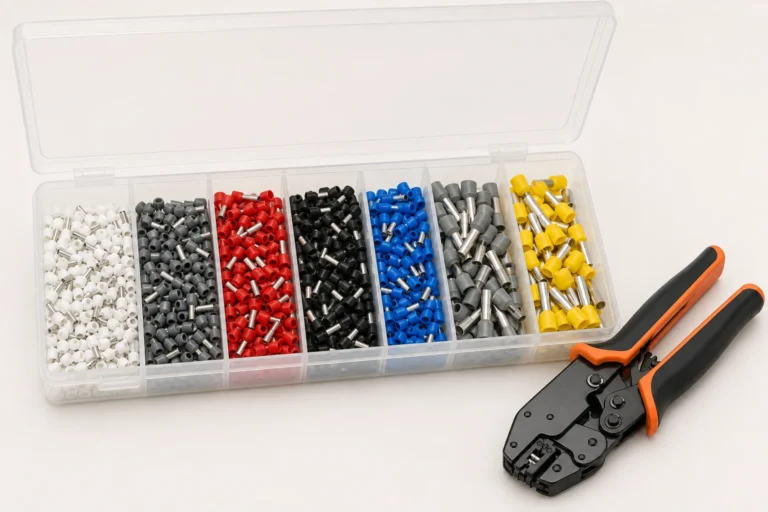
The colours repeat. Grey appears at 0.75 and 4 mm², so a 4 mm² insulated ferrule in DIN grey and a 0.75 mm² one share a colour. Red appears at 1, 10 and 35 mm². Blue appears at 2.5, 16 and 50 mm². Yellow appears at 6 and 25 mm². A red ferrule is 1 mm² or 10 mm² or 35 mm², and those are wildly different parts. They are also wildly different sizes, which is what makes the system work in practice. Colour sorts reliably within a size band and fails across bands. Treat it as a fast error-catching aid on the bench, not as proof of cross-section.
The table this data comes from ends at 50 mm². Above that, treat any colour as a manufacturer convention and confirm it against the catalogue, because no standard reaches that far.
Then the part that decides the comparison: non-insulated ferrules have no colour dimension at all. Every bare tube in the drawer looks like every other bare tube. After crimping, verifying that the right size was used becomes a dimensional or documentary check instead of a glance. In a panel that someone else will inspect or extend in five years, that is the strongest concrete argument for insulated ferrules, considerably stronger than the vague safety claims usually offered.
A second European colour convention exists alongside DIN, and it assigns different colours to the same cross-sections. A red 1.5 mm² ferrule is correct under one system and wrong under the other. If a specification names a colour without naming the standard behind it, confirm which system is meant before ordering.
Outside the DIN system, do not assume colour encodes cross-section at all. Ferrules sold into North America commonly follow no published colour scheme, and the colour is whatever the manufacturer chose. Read the cross-section off the packaging or the catalogue, and treat the sleeve colour as decoration.
What UL 508A actually requires
For panels built to UL 508A, ferrules are covered explicitly. Clause 29.3.4 lists the permitted ways to connect a wire to a component terminal, and item (g) is a wiring ferrule per clause 29.3.6.
Clause 29.3.6 sets five conditions. A wiring ferrule shall be:
- used with stranded copper wire only;
- terminated in a connector rated for copper wire, and rated for the number and size of wires crimped to the ferrule;
- crimped with an appropriate tool as recommended by the ferrule manufacturer, before terminating in a component terminal;
- sized in diameter appropriately for the number of wires and wire sizes, as recommended by the ferrule manufacturer;
- crimped such that the length of the uninsulated portion of the wires does not reduce electrical spacings once installed.
None of the five mentions insulation. UL 508A 29.3.6 does not require insulated or non-insulated ferrules; both types satisfy the clause when used correctly. Pages that present insulated ferrules as a compliance requirement are adding something the standard does not say.
The condition that does interact with the choice is the last one. Exposed conductor between the wire insulation and the ferrule barrel eats into electrical spacings, and that is governed by stripping and crimping discipline rather than by ferrule type. An insulated collar shrouds the transition, which helps in appearance and in handling, but it does not create a universal strip-length formula. Follow the ferrule manufacturer’s stripping instruction for the specific insulated or non-insulated design and leave no bare conductor showing.
On the IEC side, terminal blocks are covered by IEC 60947-7-1, and the practical consequence is the same one that closes the previous section: the terminal manufacturer’s connection data is the deciding document for what may be inserted into a given model.
Temperature: the ferrule is rarely the limiting part
A common claim is that non-insulated ferrules work above 105 °C where insulated ones do not. The figure is real enough. One supplier rates its insulated series to 105 °C, and the plastic collar is what sets it. The reasoning built on top of it usually is not.
Removing the collar removes one material limit from the assembly. It does not touch the others. The wire insulation has a rating. The terminal block body has a rating. The enclosure has a rating. The permitted operating temperature of the connection is set by the lowest of them, and a bare ferrule raises the ceiling only when the collar was the lowest-rated part in that stack.
That is a thing to check on the specific build, not to assume. A conductor with 90 °C insulation entering a bare ferrule is still a 90 °C connection. Choosing a bare tube to solve a heat problem works only after confirming what is actually limiting.
When the catalogue leaves no choice
Sometimes the decision is made before you reach it.
At the top of the range. In the supplier catalogue reviewed for this article, the non-insulated series runs to 185 mm² while the insulated series stops at 150 mm². Above 150 mm², the insulated version simply is not made in that range, so the choice disappears. Other manufacturers draw the line elsewhere, so treat this as a reason to check the range you are buying from, and not as an industry rule.
Certificate coverage. In North America the relevant listing standard is UL 486F, and its UL product category is Bare and Covered Ferrules, the standard covers both types. Being non-insulated does not disqualify a ferrule from being listed. What decides it is whether that manufacturer submitted that series.
Two things follow, and both cost money when missed. Approval is granted per model number rather than per size band, so a range can be listed at 1.5 mm² in four pin lengths and not in a fifth. And a certificate covering a model is not the same as the goods carrying the mark; UL’s own certificates state that only products bearing the UL Mark should be considered UL Certified. For a UL panel build, check the exact model numbers against the file, and check that the parts in the box are marked. A UL file number can be verified against UL Product iQ.
Packing quantity. Bare tubes take less volume, so they often come in larger standard packs, twice as many per bag in the catalogue reviewed here at the smaller sizes. When comparing prices between the two types, confirm the pack size before comparing the per-piece figure.
Ferrules or bare wire: the question before this one
Plenty of people arriving at this comparison have not settled the prior question. Ferrules are not universally required, and some spring-clamp terminals are explicitly rated for direct entry of stranded conductors.
What a ferrule changes is the geometry the clamp acts on. Tightening a screw clamp onto bare stranded wire loads the outer strands first. Strands splay outward, and annealed copper creeps under sustained pressure, so clamping force relaxes over time even without movement. Vibration accelerates that. A crimped ferrule gives the clamp a compacted, defined termination to compress against instead of a bundle of loose strands, and it keeps stray strands from escaping toward the neighbouring terminal.
That is the mechanism. Whether your terminal needs it is answered by the terminal manufacturer’s connection data, which lists the conductor configurations each model accepts: bare stranded, ferruled, or two conductors in one twin ferrule. The ferrule catalogue does not authorise a connection; the terminal documentation does.
How to choose insulated vs non-insulated ferrules
The decision is narrower than it looks. Compare the current insulated wire ferrules and non-insulated wire ferrules after the terminal and conductor size are known. Both types crimp the same, enter the terminal the same, and satisfy UL 508A 29.3.6 the same. The decision runs on three practical questions:
| Question | Points to insulated | Points to non-insulated |
|---|---|---|
| Who inspects or maintains this panel later? | Someone else, and colour-assisted checking has value | You, or the build is documented in detail |
| Is space at the terminal face tight? | Normal terminal pitch and duct fill | Row pitch or duct fill cannot take the collar diameter |
| What cross-section? | Within the insulated range | Above the insulated range in your catalogue |
Two more, if they apply: fine stranded conductors benefit from the flared collar’s insertion guidance, and a crimp that must be visually inspectable along its full length has to be non-insulated. Pin length is a separate axis from either: the same cross-section is made in several lengths, and the terminal manufacturer’s requirements decide which one applies.
What should not drive the choice is a belief that insulated ferrules will not fit a tight terminal. In the paired series above, both types present the same nominal barrel to the clamp, and the terminal manufacturer’s connection data decides compatibility either way. Check the correct cross-section and pin length first; that decision matters more than the collar.
FAQ
What is a non-insulated ferrule?
A non-insulated ferrule is a bare tinned copper tube crimped onto the end of a stranded conductor so it can enter a screw or spring clamp as one compacted termination. DIN 46228-1 covers this type. It has no plastic collar, and therefore no colour coding. Every cross-section looks the same once it is out of the packet.
Does UL 508A require insulated ferrules?
No. UL 508A clause 29.3.6 sets five conditions for using a wiring ferrule in an industrial control panel, and none of them specifies insulated or non-insulated. Both types are acceptable when used with stranded copper wire, crimped with the manufacturer’s recommended tool, sized correctly, and installed without reducing electrical spacings.
Do insulated and non-insulated ferrules use the same crimping tool?
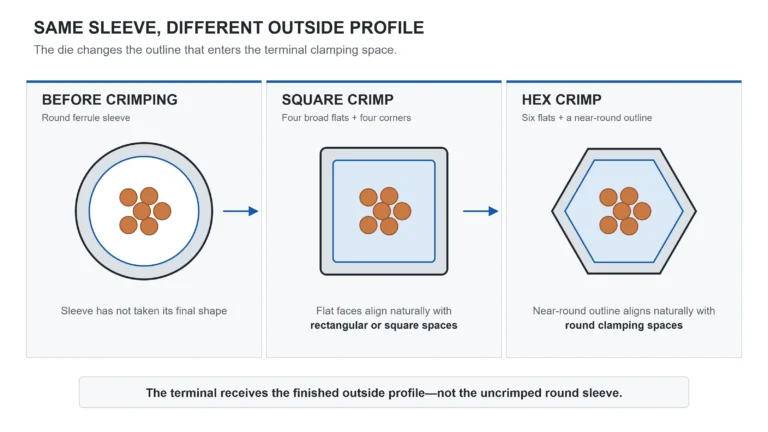
Usually yes. The crimp acts on the metal barrel, which is the same on both types at a given cross-section, so one ferrule crimper commonly covers both. Ring and spade terminals work the opposite way, since their insulated and non-insulated versions genuinely need different dies, and that is where the confusion comes from. Confirm the cross-section range and crimp profile against the tool and ferrule data sheets before assuming interchangeability.
Can you tell a ferrule’s size from its colour?
Only within a size band. The DIN 47002 sequence reuses colours: red covers 1, 10 and 35 mm², and blue covers 2.5, 16 and 50 mm². Those pairs differ enough in physical size to tell apart by eye, so colour works well as a bench check and poorly as proof of cross-section. Non-insulated ferrules have no colour at all.
Are non-insulated ferrules UL listed?
Some are. UL 486F is the listing standard for ferrules and its product category covers bare and covered types alike, so non-insulated ferrules can be listed. Whether a particular series is depends on what that manufacturer submitted, and listings are granted per model number rather than per size range. Check the exact models against the file before specifying them into a UL panel.
What are the most common wire ferrule mistakes?
Three recur. Using a ferrule sized for a different cross-section, which leaves either a loose crimp or strands that will not fit. Leaving bare conductor exposed between the wire insulation and the barrel, which is what UL 508A 29.3.6 addresses directly. And re-using a ferrule that has already been crimped, where the deformation is permanent and the second termination will not hold reliably.
Getting the collar decision right
The collar choice only becomes concrete against a specific terminal and a specific market. Send Termnex the terminal model, the cross-section and pin length you are working to, and where the panel ships. That is enough to come back with the models that fit, the colour system they follow, and the documents that market asks for. Contact us.